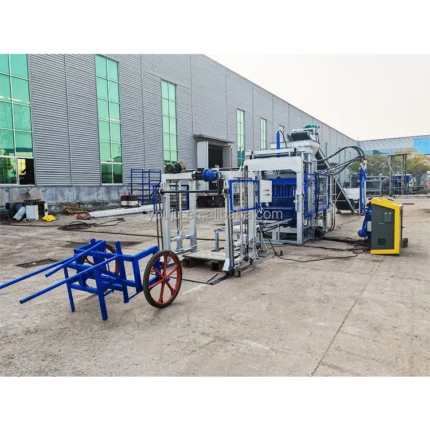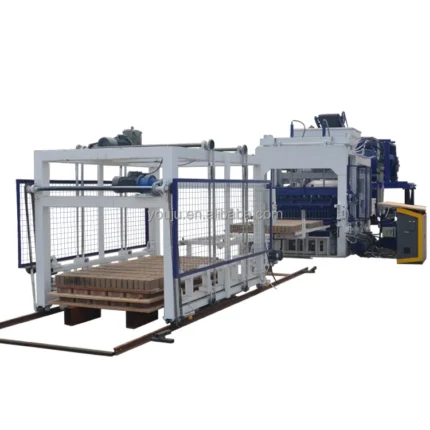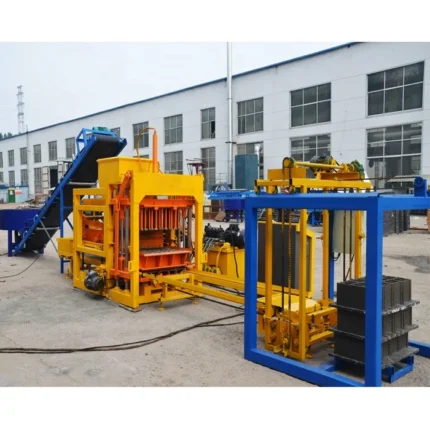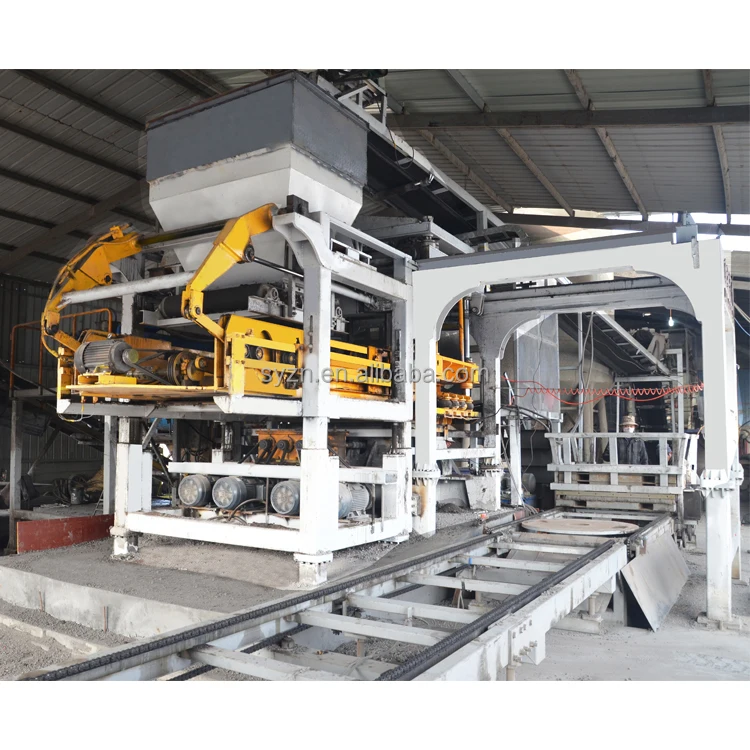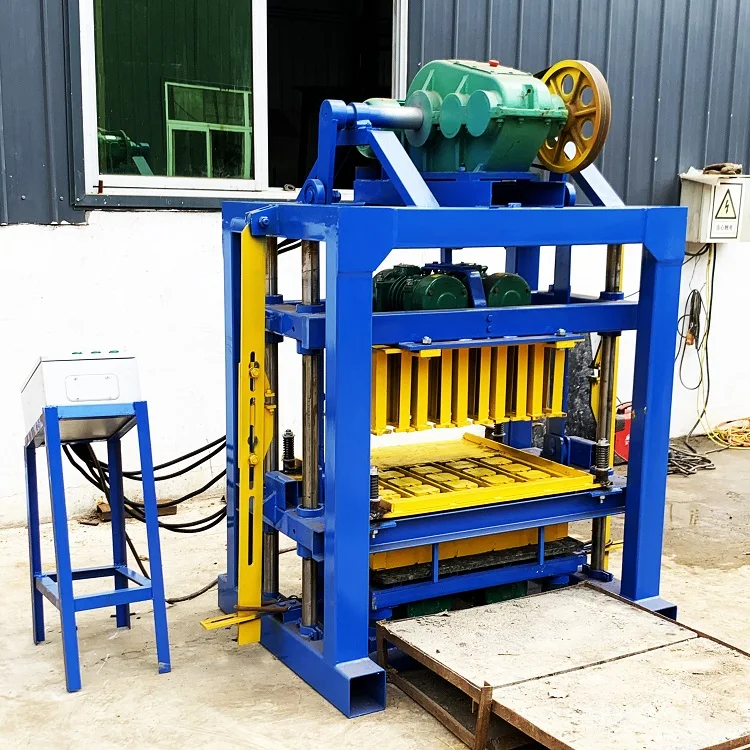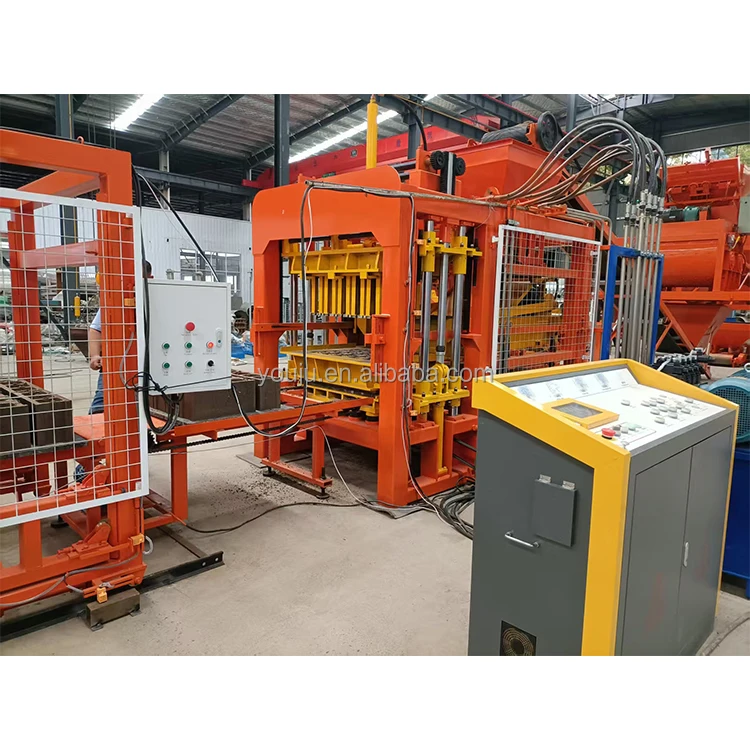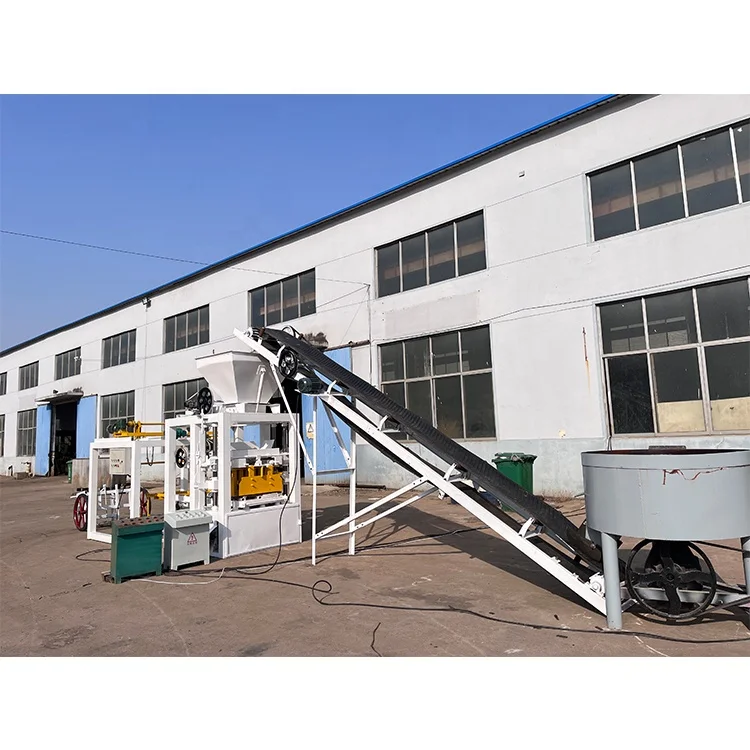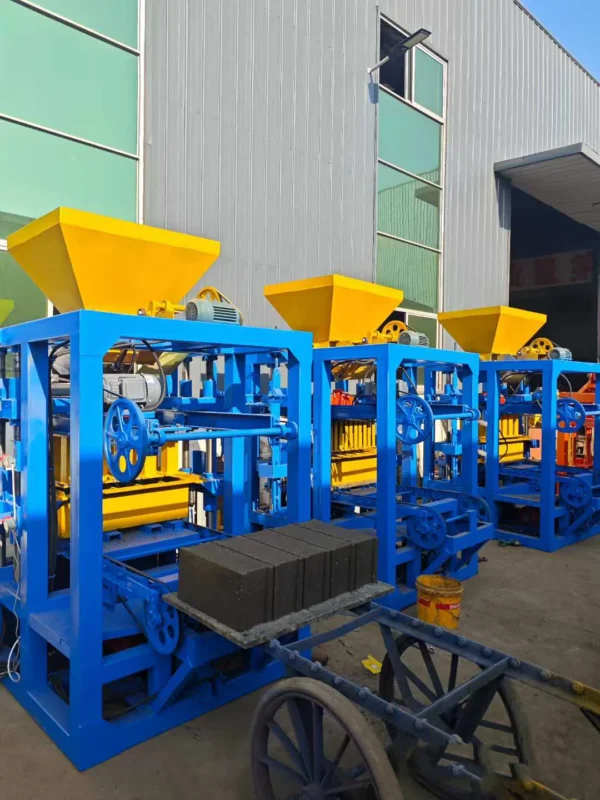


Description
Integrated System Matching — The QTJ4-24 block machine is configured against your actual mix design, local aggregate, and target block format rather than shipped as a catalogue default, ensuring PLC parameters align with real-world production conditions.
Technical Specifications
| Parameter | Value |
|---|---|
| Model | QTJ4-24 |
| Product Type | Automatic Hydraulic Cement Block Making Machine |
| Overall Dimensions (L×W×H) | 3600×1700×2560 mm |
| Pallet Size | 850×450 mm |
| Molding Cycle | 24-26 s (basis not stated in source — confirm block format / material / thickness) |
| Overall Power | 11.95 kW |
| Vibration Force | 45 kN (2×3 kW lower vibrators + 2×1.5 kW upper vibrators) |
| Total Mass | 2 T |
| Molding Method | Mechanical |
| Control System | PLC (configurable language and display options) |
| Material Feeding | Full-automatic spiral material distribution |
| Reducer | 350-type (for mold lifting) |
| Compatible Materials | Cement, sand, stone |
| Block Formats | Hollow bricks, interlocking bricks, paving bricks, solid bricks |
| Voltage & Frequency | Configurable per buyer’s local grid (basis to be confirmed) |
| Output Capacity | Depends on block format, material, and thickness (basis to be confirmed) |
| Automation Level | Semi-automatic (PLC controlled, mechanical molding, manual pallet handling) |
| Standards | CE declaration where applicable |
Application Suitability
| Application | Material or Output |
|---|---|
| Hollow block production for building construction | Cement, sand, crushed stone mix |
| Solid block manufacturing | Dense aggregate and cement blend |
| Interlocking brick production | Fine sand and cement with precise grading |
| Paving brick production | High-strength mix with coarse aggregate |
| Small to medium block plant operation | Daily runs across multiple block formats |
| On-site production for construction contractors | Local aggregate sourced near the project |
What the PLC Display Language Question Reveals About Commissioning Delays
A machine that arrives with the wrong interface language is a machine that sits idle while operators guess at menu functions.
Many buyers focus on cycle time and vibration force during the purchasing stage, yet the automatic QTJ4-24 block machine PLC controlled system arrives on site with a display language the operators cannot read. Voltage and frequency are confirmed verbally but never locked in writing. The result is a commissioning delay that stretches from days into weeks while new HMI screens are sourced or reprogrammed. I have watched plants lose an entire first month of production because these configuration details were treated as afterthoughts rather than pre-shipment checkpoints [NEED_CITE: voltage and frequency standards by export market].
How the Control System Manages Molding Consistency
The PLC on this automatic QTJ4-24 block machine PLC controlled unit governs the 24-26 second molding cycle, coordinating the spiral material feeder, vibration sequence, and mold lifting reducer in a repeatable loop. Each parameter — feed duration, vibration intensity, dwell time — is stored as a recipe so operators can recall settings for each block format without manual recalibration. This removes the variability that comes from different shift operators adjusting timing by feel, and it provides a baseline for quality control across production batches.
Vibration Architecture and Block Density Control
The dual-level vibration system pairs two 3 kW lower vibrators with two 1.5 kW upper vibrators to deliver a combined 45 kN force across the mold cavity. Lower vibrators compact the aggregate from the pallet upward, while upper vibrators settle the face mix and eliminate voids near the block surface. This split arrangement means the core density and surface finish are addressed independently, which matters when producing hollow blocks that must meet structural load requirements alongside a clean appearance for exposed masonry walls [NEED_CITE: block compressive strength testing standards for masonry units].
Reading the Spec Sheet Against Your Actual Production Targets
The 3600×1700×2560 mm footprint tells you the floor space the press occupies, but the 850×450 mm pallet size is the dimension that governs your curing area layout and forklift compatibility. If your existing curing racks were built for a different pallet format, you will need to modify or replace them before the QTJ4-24 can run. The 11.95 kW overall power requirement determines the dedicated circuit specification your electrician must prepare. The 350-type reducer on the mold lifting mechanism is sized for repeated mold changes throughout a shift — undersized reducers in this class typically show gear wear within the first year of continuous operation, so this specification directly affects your maintenance intervals. The semi-automatic configuration means pallet feeding and block stacking are handled manually, which defines your labor allocation per shift.
When the Automation Level Does Not Match the Labor Pool
Buyers who select a semi-automatic machine without mapping their available workforce often find that manual pallet handling and stacking consume more labor hours than anticipated. The QTJ4-24 leaves pallet feeding and output stacking to operators, which is viable for lower-volume plants but becomes a bottleneck when daily output targets increase. Mismatched automation also means the PLC-controlled cycle waits for operators to complete manual steps, effectively stretching the real cycle time well beyond the rated 24-26 seconds. Plants that skip this labor analysis before ordering frequently return to add automatic pallet feeders and stackers within the first year, paying retrofit costs that could have been avoided with an upfront automation assessment [NEED_CITE: automation level impact on block plant labor requirements].
Why Configuration Verification Matters Here
The QTJ4-24 is specified against your actual mix design and local aggregate, not pulled from a default catalogue line. Voltage, frequency, and PLC display language are confirmed in writing before production starts, eliminating the most common commissioning blockers. The machine, mold, pallet, and handling equipment are treated as a matched system so that pallet size aligns with your curing racks and forklifts. Mould designs are produced for the block formats your market actually sells, with custom drawings available when standard formats do not match. The automation level is selectable, giving you a clear path from this semi-automatic base to higher automation as production volume grows.
Documentation & Verification
- Machine specification sheet with confirmed voltage, frequency, and PLC language
- Mould drawing and format list matched to your target block products
- Hydraulic and electrical schematic with PLC I/O address list
- Factory test record on your specified block format before dispatch
- Pallet specification confirming dimensions and material grade
- Operation and maintenance manual in the confirmed display language
Installation, Commissioning & Support
- Foundation plan based on the 3600×1700 mm footprint and 2 T operating mass
- Dedicated power circuit sized for the 11.95 kW total load at confirmed voltage
- Machine delivered in assembled or partially dismantled state per container loading plan
- PLC parameter setup and recipe programming for each target block format on site
- Operator training covering mold change procedure using the 350-type reducer mechanism
- Wear parts and mould supply schedule aligned with your first replacement interval
- Routine maintenance intervals documented for vibration motors and hydraulic components
What We Need to Move Forward
To configure the QTJ4-24 correctly, share the block formats you intend to produce, the local aggregate and cement types available, and your target daily output per format. Confirm the voltage and frequency at your plant, the preferred PLC display language, and the pallet dimensions that match your existing curing infrastructure. These details allow the capacity calculation and automation level recommendation to be grounded in your actual operating conditions rather than generic assumptions.
Frequently Asked Questions
Q: How does the 24-26 second molding cycle change with different block formats?
A: The cycle time varies depending on block height, wall thickness, and material composition. Taller hollow blocks with thin walls require longer vibration to achieve full compaction, while solid paving bricks may complete faster due to their simpler geometry. Request a written cycle time calculation for each specific format you plan to produce, as the stated range assumes conditions that may differ from your mix design.
Q: What PLC language options are available for the operator interface?
A: The display language is configurable before shipment based on your operator team’s requirements. Common options include English, Spanish, Arabic, French, and Russian. Switching the language after delivery may require HMI reprogramming, so confirming this during the order stage avoids commissioning delays and ensures operators can navigate all menus from day one.
Q: Can this semi-automatic configuration be upgraded to include automatic pallet feeding and stacking?
A: The QTJ4-24 platform supports adding automatic pallet feeders and stacking systems as production volume grows. The PLC architecture allows integration of additional I/O modules for these stations. Planning the upgrade path during initial configuration ensures the electrical panel and control logic have reserved capacity, avoiding a full panel replacement when automation is added later.
Q: How should voltage and frequency be specified before shipment?
A: Provide the exact voltage and frequency at your plant’s incoming supply, along with any phase configuration requirements. Industrial grids vary significantly across regions, and a mismatch between the machine’s electrical configuration and your local supply will prevent commissioning entirely. Written confirmation before production ensures the motor windings, transformer, and PLC power supply are built to match.
Q: What automation level is appropriate for my labor situation and output target?
A: Semi-automatic operation suits plants with available manual labor and moderate daily output, as pallet handling and stacking require dedicated operators. If labor is scarce or expensive in your area, or if your output target demands continuous running, a higher automation level reduces operator dependency. The decision should factor in local wage conditions, shift structure, and your growth plan over the next production cycle.