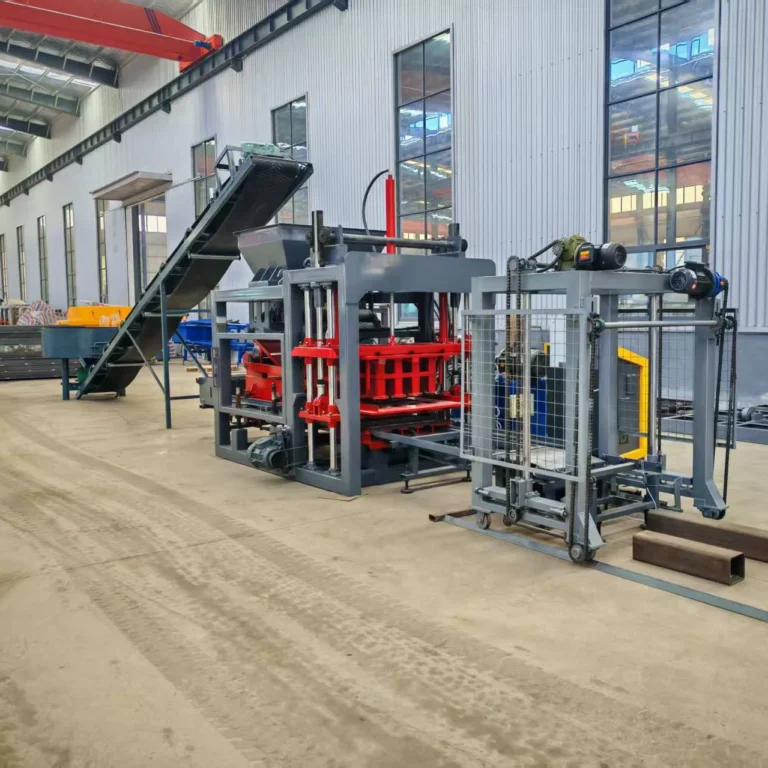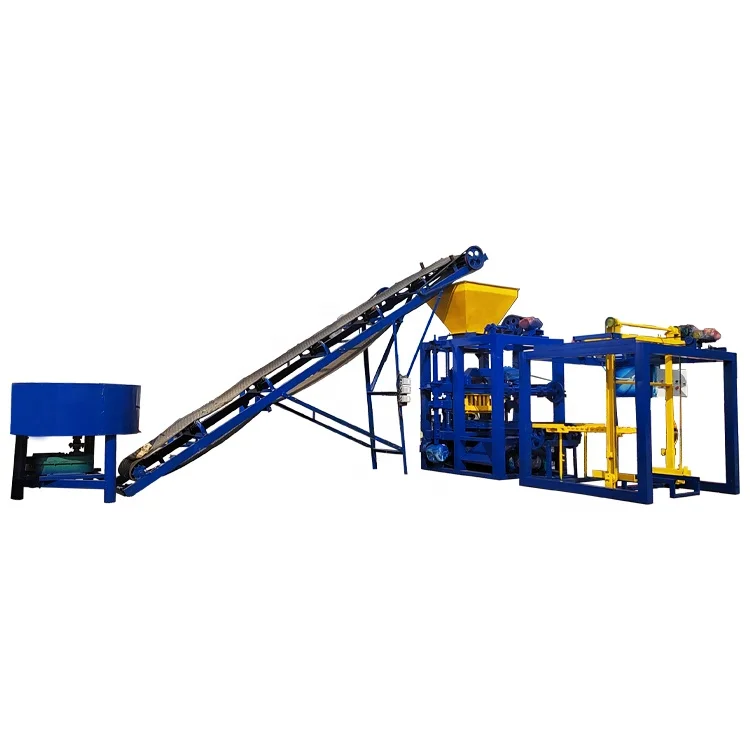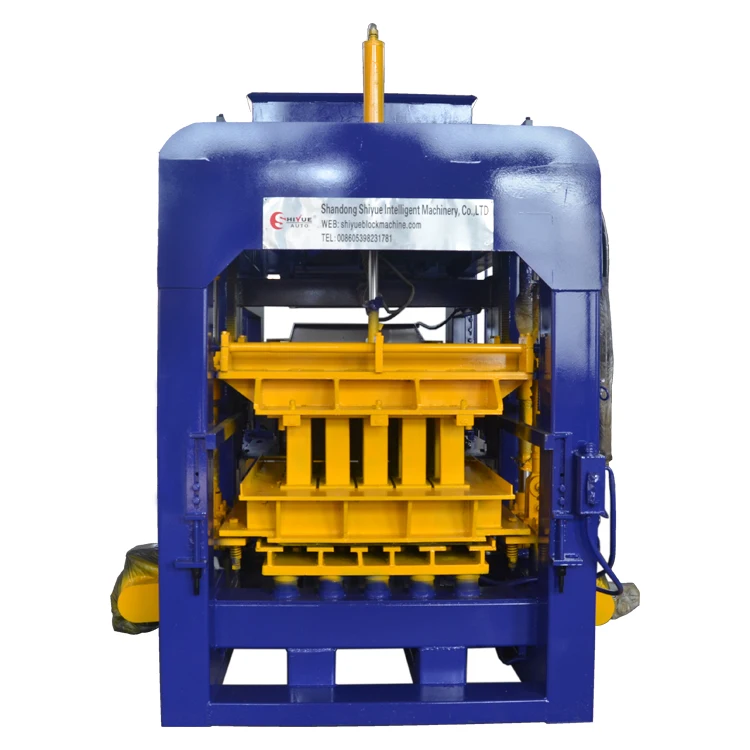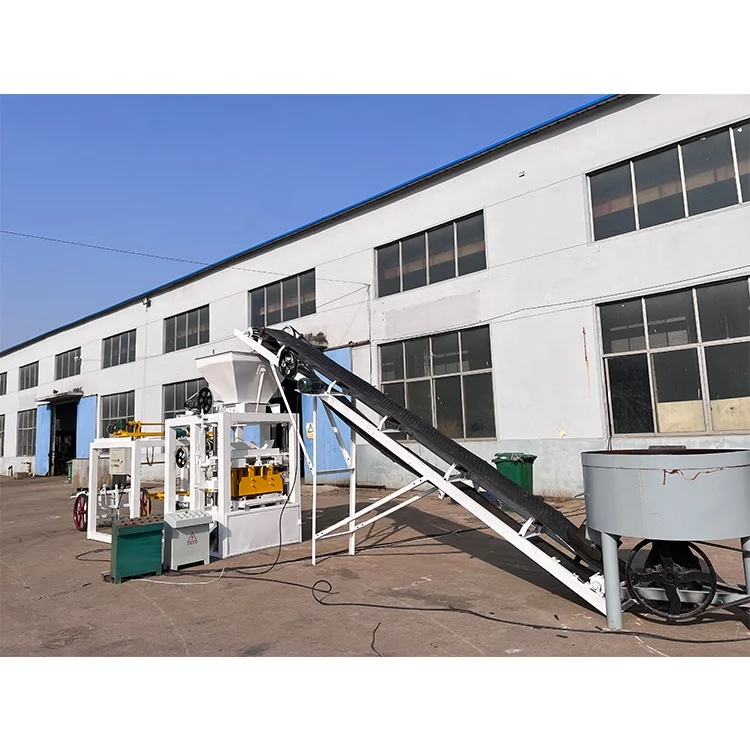
Description
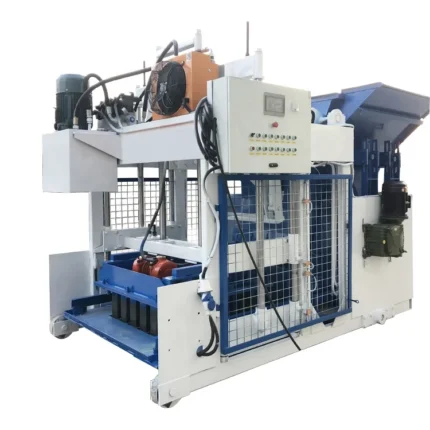
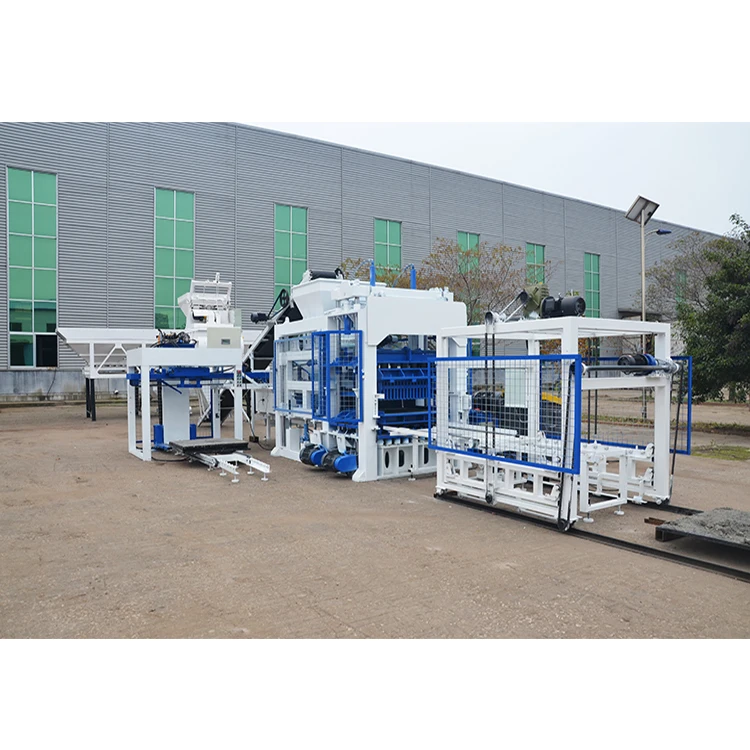
Configurable automation logic — The QT4-24 ships as a semi-automatic press with a clear upgrade path toward PLC-controlled pallet feeding and stacking, letting you add automation stations only when your output volume justifies them.
Technical Specifications
| Parameter | Value |
|---|---|
| Model | QT4-24 |
| Product Type | Semi-Automatic Concrete Block Making Machine |
| Overall Dimensions (L×W×H) | 2060×1730×2580 mm |
| Net Weight | 1800 kg |
| Cycle Time | 26 s |
| Vibration Frequency | 4200 r/min |
| Vibration Force | 35.5 kN |
| Rated Power | 14.25 kW |
| Mixer Model | JQ350 |
| Pallet Size | 850×450×20 mm |
| Mould Guide | Four guide pillars with automatic mould movement |
| Output — Hollow Block | 480 pcs/hr based on 390×190×190 mm, 4 pcs/mould |
| Output — Hollow Block | 600 pcs/hr based on 400×150×200 mm, 5 pcs/mould |
| Output — Solid Brick | 2100 pcs/hr based on 240×115×53 mm, 18 pcs/mould |
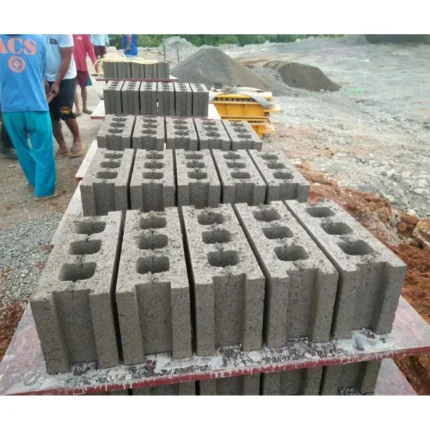
| Applied Products | 8-inch and 6-inch hollow blocks, solid bricks |
| Raw Materials | Crushed stone, sand, cement, fly ash, dust |
| Control System | Available with PLC or relay-based manual control |
| Voltage & Frequency | Configurable to buyer’s local supply |
Application Suitability
| Application | Material or Output |
|---|---|
| Small-scale hollow block plant | 8-inch and 6-inch concrete hollow blocks from crushed stone, sand and cement |
| Solid brick production for local masonry | Standard 240×115×53 mm solid bricks from fly ash, sand and cement |
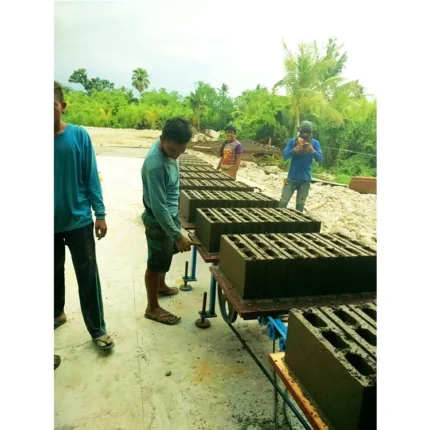
| On-site block making for housing contractors | Hollow blocks produced directly at the construction site using locally sourced aggregate |
| Entrepreneur first plant with expansion room | Semi-automatic operation with upgrade path to PLC-controlled pallet feeding and stacking |
What "8-Hour Output" Figures Hide From the Buyer
Every capacity number on this page is tied to a specific block size and mould cavity count.
When a quotation lists a single daily output figure, that number almost always assumes the smallest or lightest format the machine can press. In Linyi, I have watched QT4-24 units run side by side — one producing 400×150×200 mm hollow blocks at a steady 600 pieces per hour, the other struggling to hold 480 per hour on 390×190×190 mm blocks because the local sand carried high clay content and the vibration window was too short for full compaction. [NEED_CITE: effect of aggregate clay content on block compaction cycle time]. The automatic concrete block making machine you choose must be rated against the exact format you sell, not the format that produces the highest headline number. That is why every output figure in the table above names the block dimension and cavity count it was measured against.
PLC Control as an Upgrade Path, Not a Starting Obligation
The QT4-24 can be ordered with relay-based manual control and upgraded to a PLC-controlled system later without replacing the press. For a first-time plant operator, starting semi-automatic keeps the initial investment contained while the crew learns the pressing rhythm and mix behaviour. When daily volume grows, adding a PLC-controlled block making machine logic module enables automatic pallet indexing and consistent cycle timing that removes variation from the operator’s hands.
Matching Vibration Force to Your Actual Mix Design
The 35.5 kN vibration force generated by dual under-mould motors at 4200 r/min is calibrated for standard crushed-stone and cement mixes. If your local aggregate includes fly ash or high-fines sand, the excitation frequency may need adjustment to achieve uniform density across the block cross-section. [NEED_CITE: vibration frequency tuning for fly-ash-rich concrete mixes]. Sending a material sample before the machine is built allows the vibration parameters to be set against what you will actually feed into the mixer, not a laboratory default.
Reading the Specification Sheet Against Real Production
The 26-second cycle time assumes a standard hollow block format with a typical concrete slump. Changing to a solid brick mould with 18 cavities alters the compaction demand; the cycle time stays similar, but the per-hour output jumps because the mould produces more units per press. The 14.25 kW rated power covers the press motor, vibration motors and the JQ350 pan mixer together, which matters when sizing the transformer and dedicated circuit at the plant. Pallet dimensions of 850×450×20 mm should be checked against the curing racks and forklift tine spacing you already have on site — ordering non-standard pallets after the machine arrives is a delay no buyer plans for.
The Cost of Skipping Voltage and Language Confirmation
A machine that arrives with a 380 V / 50 Hz motor in a country running 220 V / 60 Hz will not start, and rewinding a motor on site costs both time and block strength consistency. The same applies to the PLC display language — if the HMI shows error codes in a language the operator cannot read, the first fault becomes a multi-day event instead of a quick reset. [NEED_CITE: voltage and frequency standards by export market]. These details are confirmed during the quotation stage so the automatic concrete block making machine that ships matches the plant’s electrical infrastructure.
Why Specify Through Shiyue
Block machinery is the sole production focus, which means the press, mould, pallet and handling equipment are designed as one matched system rather than sourced separately. Each QT4-24 order begins with a line layout that states the block format assumed for every capacity figure, so there is no guesswork after the machine arrives. Mould design covers the formats your market actually buys, including custom drawings when a standard cavity count does not fit. The automation level is selectable, so the semi-automatic press can grow into a PLC-controlled block making machine line without swapping the core press. Factory testing runs the machine on the buyer’s mix design — or a close proxy — before the crate is sealed.
Documentation & Verification
- Line layout drawing with capacity calculation tied to each block format and mould cavity count
- Machine specification sheet confirming vibration force, cycle time and pallet size
- Mould drawing and format list including any custom cavity design
- Voltage, frequency and PLC display language confirmation sheet signed before production
- Factory test record showing cycle time and block density on the agreed mix
- Operation and maintenance manual with wear parts list and pallet specification
Installation, Commissioning & Support
- Foundation pad sized for 2060×1730 mm footprint with anchor bolt template supplied
- Dedicated circuit rated for 14.25 kW total draw plus starting surge margin
- Machine shipped as a single skid; on-site assembly limited to mixer and pallet feed connection
- First-run commissioning includes vibration timing adjustment to local aggregate sample
- Operator training covers mould change procedure using the four-pillar guide system
- Wear parts list identifies vibration motor mounts and guide bushings for reorder planning
What We Need to Quote Accurately
Send the block format you plan to sell — dimensions, wall thickness and whether hollow or solid — along with your target daily output. Include a local aggregate sample or at least a description of available sand, stone and cement types. State your site voltage, frequency and the language your operators read on a control screen. With those three inputs, a matched configuration and honest capacity calculation can be built around the QT4-24 automatic concrete block making machine.
Frequently Asked Questions
Q: How is output capacity verified and what block format does each number assume?
A: Every capacity figure is measured against a named block dimension and mould cavity count. The 480 pcs/hr figure assumes a 390×190×190 mm hollow block with four cavities, while the 2100 pcs/hr figure assumes a 240×115×53 mm solid brick with eighteen cavities. No single headline number is used without its format basis.
Q: What automation level options are available and how does the upgrade path work?
A: The QT4-24 ships as a semi-automatic press with relay-based control. A PLC module can be added later to automate pallet indexing and cycle timing without replacing the press frame or vibration system. Full stacking and cubing automation can follow as output volume grows.
Q: How is the control system confirmed for the target market?
A: Voltage, frequency and PLC display language are confirmed in writing before production starts. The electrical schematic matches the buyer’s supply, and the HMI shows prompts in the operator’s language so fault codes are immediately readable on site.
Q: How is vibration force matched to the buyer’s local aggregate?
A: A material sample or detailed aggregate description is requested before the machine is built. The 35.5 kN vibration force and 4200 r/min frequency are then adjusted so that compaction time and density match the actual mix rather than a catalogue default.
Q: What is the mould change procedure and how long does it take?
A: The four-pillar guide system allows the mould to be unclamped and lifted out as a single unit. With trained operators, a format change takes a portion of one shift rather than a full day, keeping the machine available for production across multiple block types.