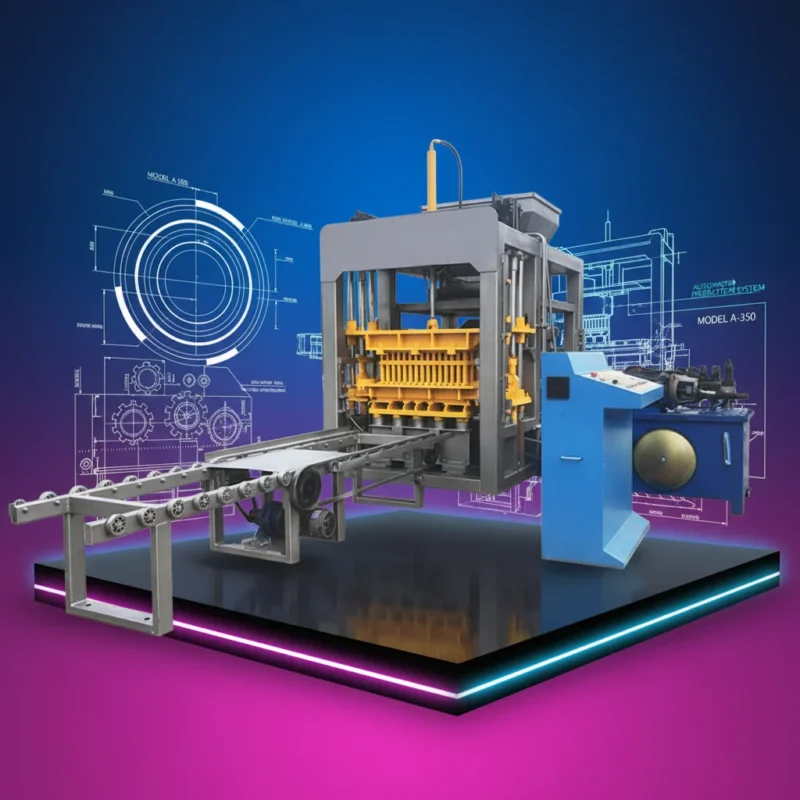

Description
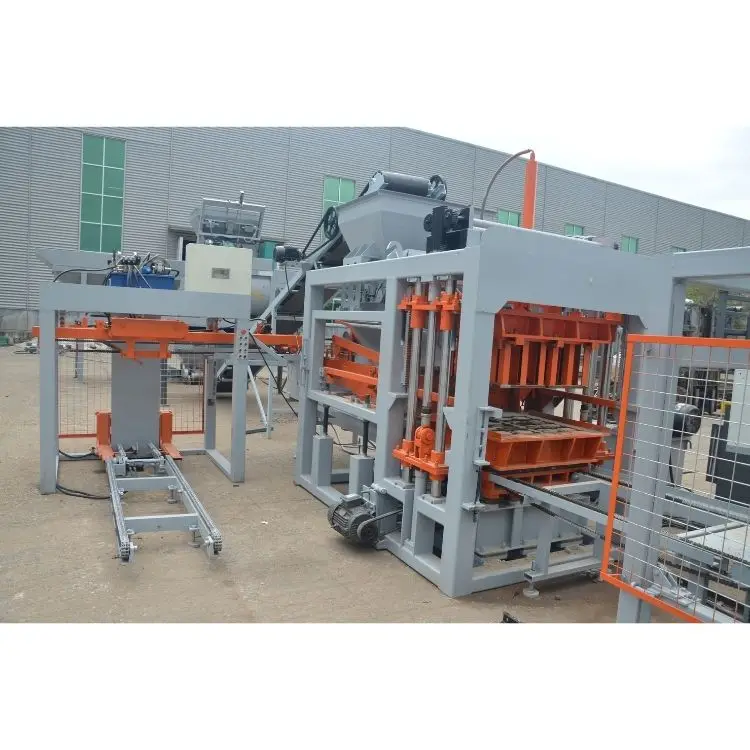
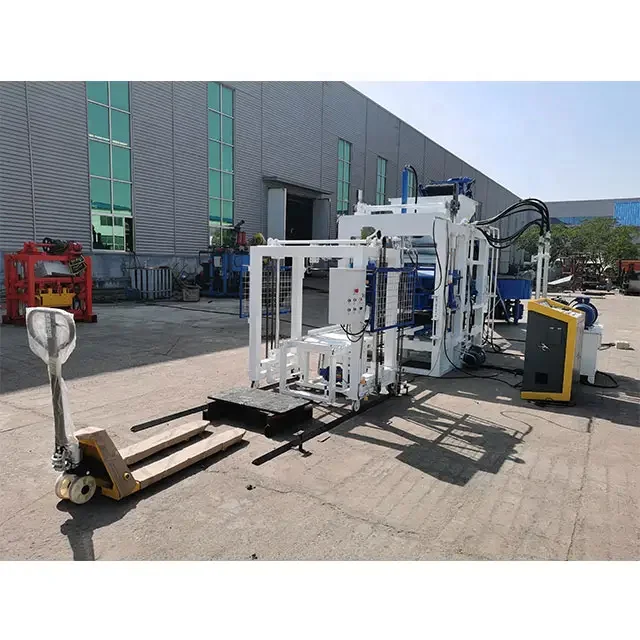
Integrated System Match — The QT5-15 is configured as a complete automated loop from PLC-controlled pallet feeding through hydraulic demoulding, with vibration parameters tuned to the buyer’s actual aggregate rather than a factory default.
Technical Specifications
| Parameter | Value |
|---|---|
| Model | QT5-15 |
| Product Type | Automatic Concrete Block Making Machine |
| Overall Dimensions (L×W×H) | 7400 × 1950 × 2800 mm |
| Total Mass | 5000 kg |
| Overall Power | 32 kW |
| Vibration Frequency Range | 0–60 Hz |
| Vibration Force | 80 kN |
| Vibration Form | Platform Vibration |
| Moulding Mode | Automatic loading, vibration moulding |
| Demolding Method | Hydraulic |
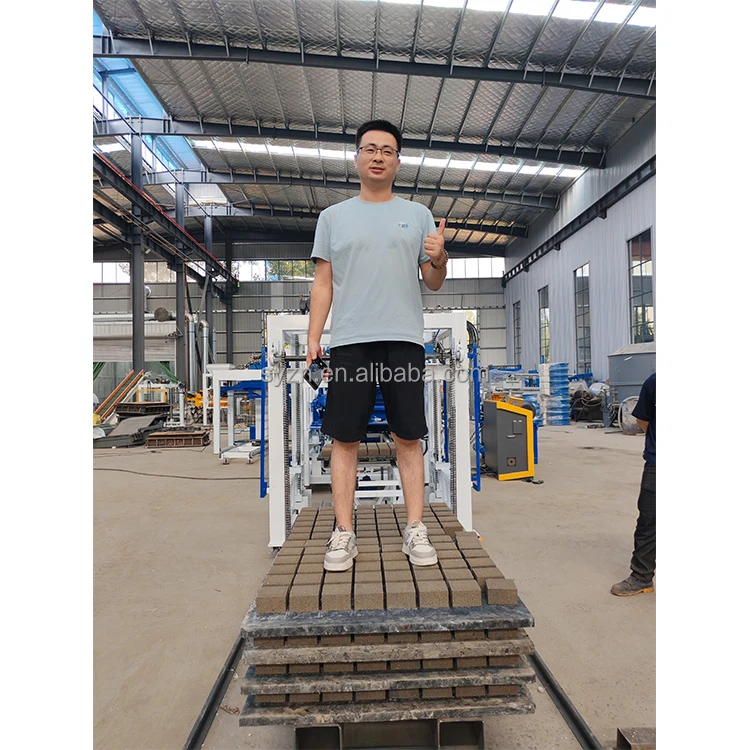
| Pallet Size | 1100 × 550 mm |
| Molding Cycle | 15–20 s |
| Control System | PLC (Programmable Logic Controller) |
| Block Compressive Strength | >15 MPa |
| Hydraulic System | Independent integrated hydraulic station |
| Flyash Content Tolerance | Up to 70% |
| Required Factory Area | 1000 m² |
| Output — Hollow Block 400×200×200 mm | 900–1200 pcs/h, 7200–9600 pcs/8h |
| Output — Hollow Block 400×150×200 mm | 1080–1440 pcs/h, 8640–11520 pcs/8h |
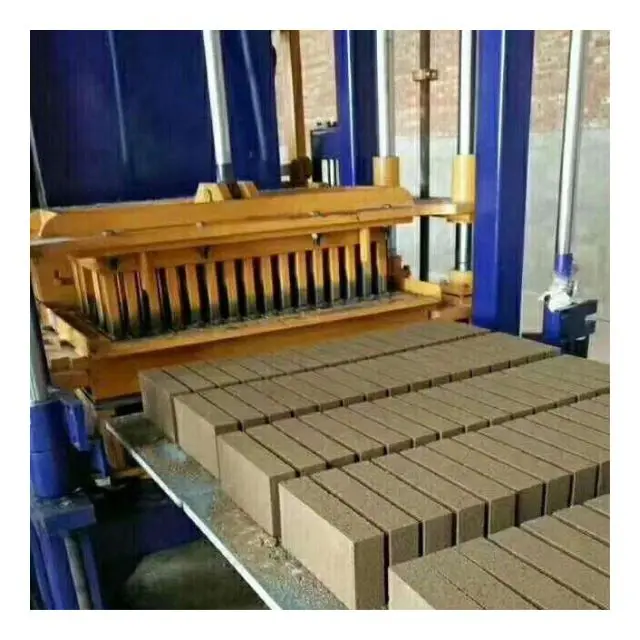
| Output — Solid Brick 240×115×53 mm | 5760–7680 pcs/h, 46080–61440 pcs/8h |
| Output — Rectangular Paver 200×100×60 mm | 3600–4500 pcs/h, 28800–36000 pcs/8h |
| Output — Zigzag Brick 225×112.5×60 mm | 2304–2880 pcs/h, 18432–23040 pcs/8h |
| Electrical & Hydraulic Components | Original imported or China famous brand (basis to be confirmed) |
| Voltage & Frequency | Configurable per target market (basis to be confirmed) |
| PLC Display Language | Configurable (basis to be confirmed) |
| Mould Change Time | To be confirmed per mould format |
| Stacking Method | Products come out together, stacked (basis to be confirmed) |
| Mould Format Compatibility | Hollow block, solid brick, paving brick (rectangular, zigzag) |
Application Suitability
| Application | Material or Output |
|---|---|
| Hollow block production for wall construction | Flyash, slag, crushed stone, sand, cement blends up to 70% flyash |
| Solid brick manufacturing for load-bearing structures | Standard concrete mix with local aggregate, achieving >15 MPa |
| Rectangular paving brick for roads and walkways | Dense aggregate mix with high vibration compaction |
| Zigzag interlocking brick for permeable surfaces | Porous mix design with controlled water-cement ratio |
| Multi-format production in a single block plant | Quick mould change across hollow, solid, and paver formats |
What "Automatic" Really Means When the Mix Goes Wrong
An automatic concrete block making machine PLC controlled is only as reliable as the material data behind its programming.
I have watched plants invest in full automation and still lose entire shifts because the PLC was loaded with parameters for dry sand while the local quarry was delivering aggregate at high moisture content. The布料 system jams, the cycle stalls, and operators end up shovelling material by hand — defeating the automation they paid for. The QT5-15 addresses this by allowing process data input and storage within the PLC, so each local mix recipe gets its own vibration profile and feeding sequence rather than running on a generic default [NEED_CITE: PLC parameter tuning for variable aggregate moisture].
The PLC as the Brain of the Block Line
The QT5-15 runs on a programmable logic controller with a touch screen interface, giving operators direct access to cycle timing, vibration frequency, and material feed sequences. This automatic concrete block making machine PLC controlled system stores multiple production recipes, meaning a shift from hollow blocks to paving bricks does not require manual recalibration of every parameter. Fault diagnosis runs through the same screen, flagging hydraulic pressure drops or sensor misalignments before they produce off-spec output.
Remote Diagnostics Remove the Waiting Game
When a fault code appears, the PLC enables remote troubleshooting so support engineers can review process logs without being on-site. This matters most during the first weeks of commissioning when operators are still learning the interface. The system separates the hydraulic station from the host vibration zone, reducing dust contamination that typically causes premature valve failure in integrated designs [NEED_CITE: hydraulic station isolation in vibration-heavy environments]. An independent hydraulic loop means demoulding force stays consistent whether the press is running its first cycle or its five-hundredth.
Reading the Numbers That Actually Matter
The 80 kN vibration force combined with the 0–60 Hz frequency range determines how densely the mix compacts inside the mould cavity. Higher frequency at lower amplitude suits thin-walled hollow blocks where surface finish matters, while lower frequency with full force produces the density needed for load-bearing solid bricks exceeding 15 MPa. The 1100 × 550 mm pallet size defines how many blocks form per cycle, and that dimension must match the curing racks and forklifts already in the buyer’s yard. The 15–20 second molding cycle sets the rhythm for the entire line — every upstream feeder and downstream stacker must synchronize to this interval or the press sits idle waiting.
When Automation Becomes a Liability Instead of an Asset
Plants that skip the material-to-parameter matching step end up with blocks that pass visual inspection but fail compressive strength tests weeks later. The vibration profile ran for a different mix, and nobody noticed until the batch was already in the curing area. I have seen buyers blame the machine when the real problem was a PLC running factory-default timing on aggregate with double the expected moisture [NEED_CITE: block strength failures traced to uncalibrated automation parameters]. The automation did exactly what it was told — the instructions were simply wrong for the material on the floor.
Why Sourcing This Machine Here Makes a Difference
Block machinery is our single focus, so the QT5-15 arrives with its mould, pallet, and handling equipment specified as one matched system rather than assembled from separate suppliers. We configure the PLC parameters against the buyer’s actual mix design and local aggregate, not a catalogue default that assumes materials unavailable at the job site. Mould design covers the formats the buyer’s market actually sells, with custom drawings accepted when standard formats do not match local building codes. The automation level is selectable — a buyer can start with semi-automatic pallet handling and add automatic stacking later as production volume grows. Installation includes on-site commissioning with operator training so the team understands recipe storage and fault diagnosis before the first production run.
Documentation & Verification
- Line layout and capacity calculation stating which block format each output figure assumes
- Machine specification sheet with confirmed voltage, frequency, and PLC display language
- Hydraulic and electrical schematic matching the as-built configuration
- Factory test record running the buyer’s specified block format before dispatch
- Wear parts and mould list with part numbers for local reordering
Installation, Commissioning & Support
- Foundation must accommodate 7400 × 1950 mm footprint with level tolerance for platform vibration alignment
- Dedicated 32 kW power circuit required with voltage and frequency confirmed before production
- Machine ships partially dismantled; reassembly includes hydraulic station reconnection and PLC boot-up
- First-run commissioning covers PLC recipe programming for the buyer’s local aggregate and target block format
- Operator training addresses touch screen navigation, mould change procedure, and fault code response
- Wear parts inventory includes hydraulic seals and vibration components matched to the 80 kN system
What We Need to Size This Machine to Your Plant
Tell us which block format your market buys most — hollow, solid, or paver — and the daily volume you need to hit. Share your local aggregate type and whether flyash or slag is available, since this determines the PLC recipe we load before shipment. Confirm your site voltage and frequency, the PLC language your operators read, and whether you need pallet handling and stacking included in the line or already have that infrastructure in place.
Frequently Asked Questions
Q: How is the quoted output capacity verified and what block format does it assume?
A: Every output figure on the QT5-15 is tied to a specific block format. The 900–1200 pieces per hour rating applies to 400×200×200 mm hollow blocks; switching to solid bricks or pavers changes the per-cycle count. We provide a capacity calculation sheet that states the assumed format so buyers can compare against their actual production target rather than a generic best-case number.
Q: What voltage and frequency configurations are available for the target market?
A: The QT5-15 electrical system is configured before production to match the buyer’s local grid. We confirm voltage, frequency, and phase during the quotation stage so the motor ratings and PLC power supply arrive ready for connection. Shipping a machine with mismatched electrical specs causes commissioning delays that we prefer to eliminate upfront.
Q: How does the PLC control system handle fault diagnosis and remote support?
A: The touch screen displays fault codes with diagnostic descriptions when sensors detect pressure anomalies, feed blockages, or cycle timing deviations. Remote access allows our engineers to review logged data and guide on-site teams through corrective steps. This reduces downtime during the learning phase and eliminates unnecessary service visits for configuration adjustments.
Q: What is the mould change procedure and how long does it take per format?
A: The QT5-15 supports multi-format production through mould replacement on the platform vibration table. Change time depends on the mould size and whether the buyer has practiced the sequence. We recommend scheduling format runs in batches to minimize changeover frequency and training operators on the procedure during commissioning so production adjustments stay within a single shift window.