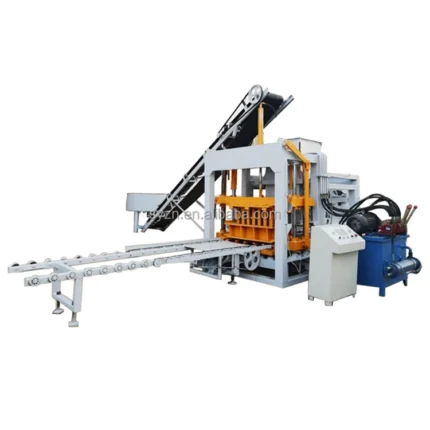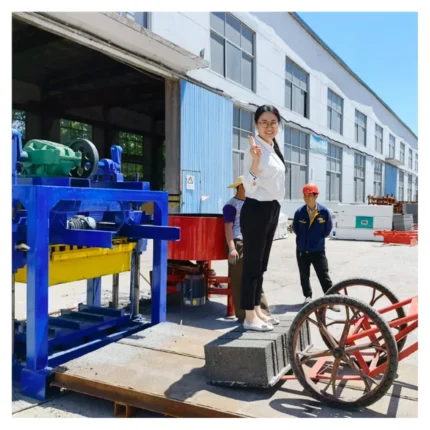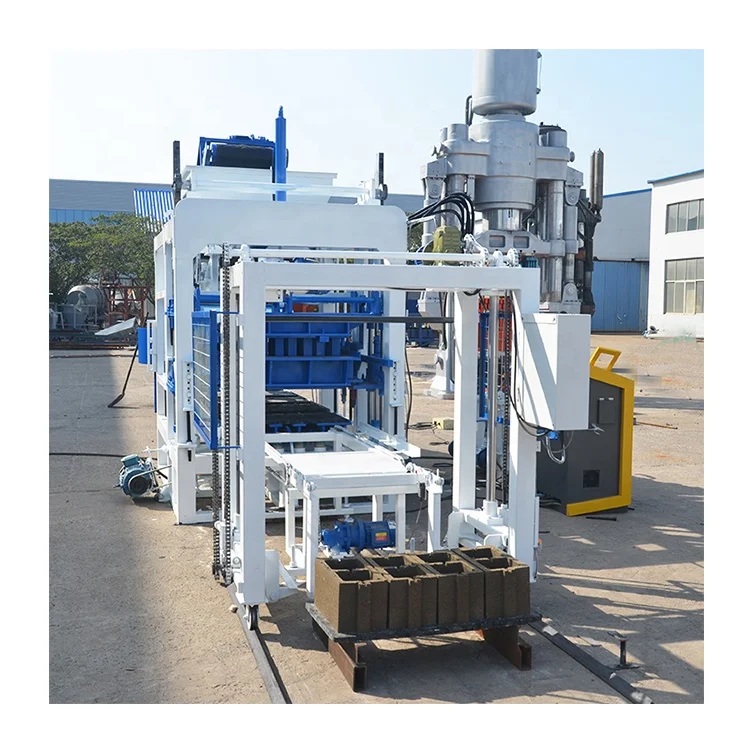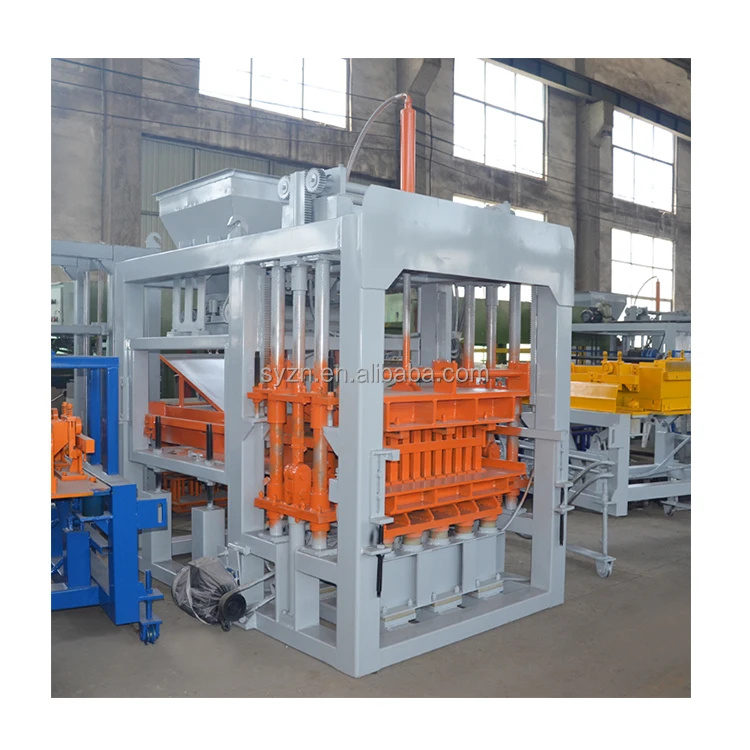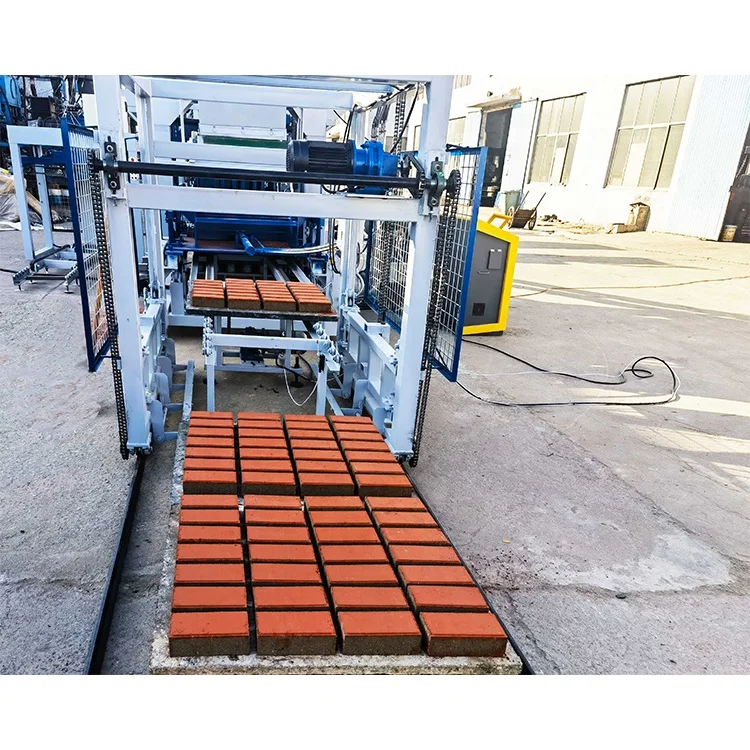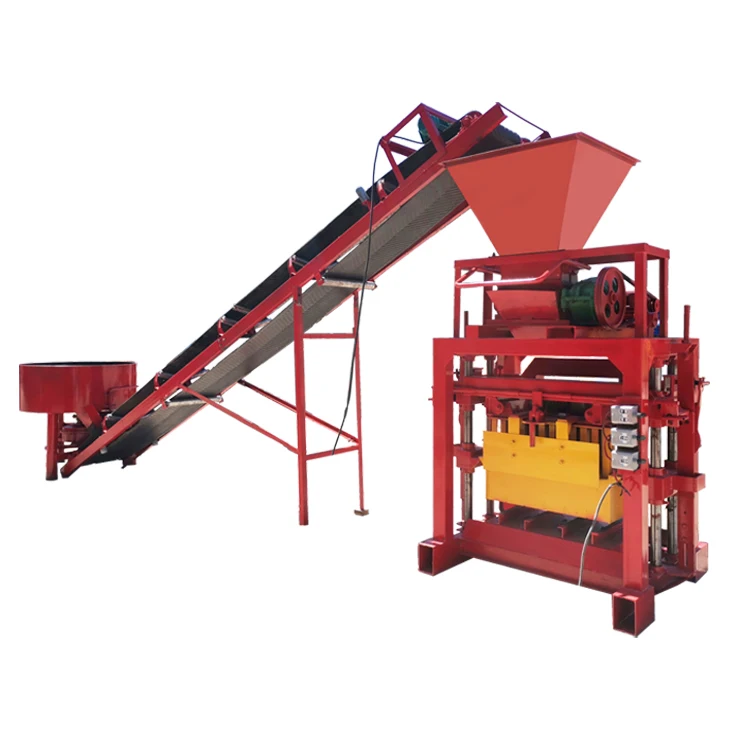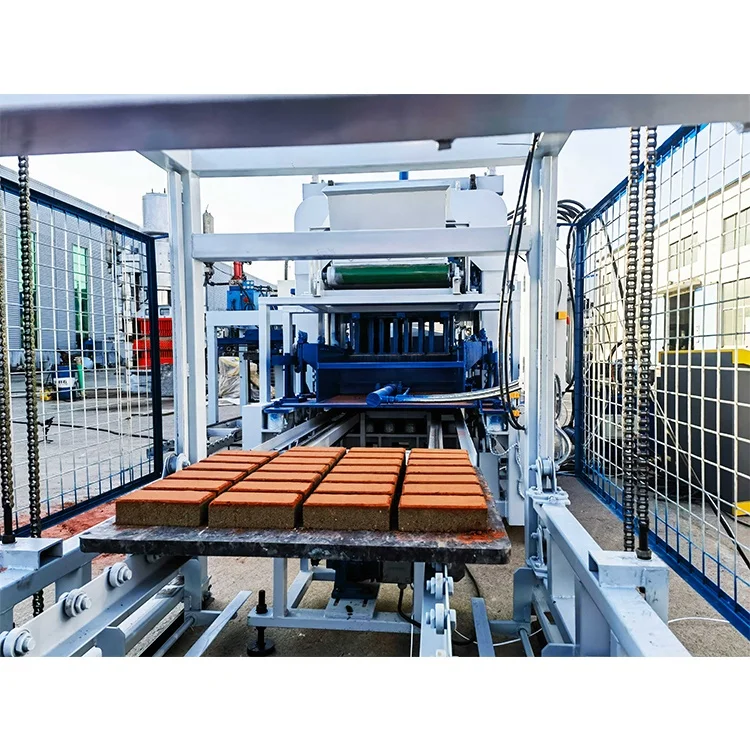
Description
Single-focus automation engineering — every QT8-15 control loop is tuned against the buyer’s actual mix design before dispatch, not set to a catalogue default.
Technical Specifications
| Parameter | Value |
|---|---|
| Model | QT8-15 |
| Product Type | Hydraulic Concrete Block Making Machine |
| Overall Dimensions (L×W×H) | 8300×1860×3000 mm |
| Rated Pressure | 21 MPa |
| Main Vibration Form | Platform Vibration |
| Vibration Frequency | 2800–4500 r/min |
| Vibration Force | 45 kN |
| Pallet Size | 950×900 mm |
| Molding Cycle | 15–20 s |
| Overall Power | 55.5 kW |
| Total Mass | 8 T |
| Demolding Method | Hydraulic |
| Factory Area | 300 m² |
| Raw Materials | Crushed stone, sand, cement, fly ash, gravel, slag, dust |
| Applied Products | Hollow/solid blocks, pavers, interlocking blocks, curbstone, colored pavers |
| Output Capacity | basis not stated in source — confirm block format and material |
| Control System | PLC (brand and logic to be confirmed) |
| Voltage & Frequency | to be confirmed per site |
| Automation Level | configurable from semi-automatic to fully automatic |
| Warranty | 1 year (whole machine, excluding spare parts) |
| Loading | 1×40HQ container (basic equipment) |
Application Suitability
| Application | Material or Output |
|---|---|
| Hollow block production for residential wall systems | Crushed stone, sand, cement, fly ash blends |
| Solid block manufacturing for load-bearing structures | Gravel, cement, and slag aggregates |
| Paving block runs for municipal and commercial hardscapes | Colored concrete mixes with fine aggregate |
| Interlocking block production for retaining walls | Coarse aggregate and cement at controlled moisture |
| Curbstone forming for road and sidewalk edges | High-density concrete with graded crushed stone |
What "Cycles per Hour" Hides From the Automatic QT8-15 Concrete Block Making Machine Buyer
A cycle time is only meaningful when tied to the exact block format and mix you will actually run.
Catalogues love quoting the fastest possible cycle. In practice, a hollow block, a paver, and an interlocking brick each demand different vibration durations, hydraulic dwell times, and feed sequences. I have watched plant owners arrive at commissioning expecting one output figure and discover that their primary product format runs noticeably slower than the headline number. The automatic QT8-15 concrete block making machine addresses this by letting the PLC store format-specific recipes, so the 15–20 s molding cycle adjusts to what you are actually producing. [NEED_CITE: block format impact on cycle time and daily throughput]
Recipe-Based PLC Logic Removes Operator Guesswork
The PLC controlled block machine stores individual parameter sets for every block format the plant produces. Vibration frequency, hydraulic pressure ramp, feed duration, and dwell time are all recalled with a single selection on the HMI. This means the transition from hollow blocks in the morning to pavers after lunch does not depend on an operator remembering which dial to adjust. Consistency shifts from human memory to stored logic.
Scaling Automation Without Replacing the Press
A plant can begin with manual pallet handling and add automatic pallet feeding, stacking, and cubing as volume grows. The automatic QT8-15 concrete block making machine is wired to accept these modules without a full control cabinet swap. For owners moving away from labour-intensive semi-automatic lines, this upgrade path spreads capital expenditure across phases while keeping the core press in service. [NEED_CITE: automation upgrade paths in block production lines]
Reading the Numbers That Matter
The 21 MPa rated pressure and 45 kN vibration force work together to compact the mix into a dense, consistent block. Platform vibration at 2800–4500 r/min transmits energy through the pallet into the mould cavity, and the adjustable range lets the operator match frequency to aggregate gradation — finer sand needs higher frequency, coarser crushed stone needs lower frequency with greater amplitude. The 950×900 mm pallet size dictates how many blocks form per cycle and must align with the curing rack dimensions and forklift capacity already on site. A mismatch here forces double-handling that no amount of press automation can fix.
When Voltage and Language Get Overlooked
Arriving at a job site to find the local supply is 440V/60Hz while the machine was built for 380V/50Hz delays commissioning by weeks. I have seen transformers sourced locally as a workaround, adding heat, losses, and a failure point that the original electrical schematic never accounted for. The same applies to HMI language — an operator staring at fault codes in a language they cannot read will call the technician for every minor alarm. The PLC controlled block machine must ship with voltage, frequency, and display language confirmed in writing before the crate is closed. [NEED_CITE: voltage and frequency standards by export market]
Why the Source Matters for Automation-Rich Presses
Block machinery is our single focus, so the QT8-15 press, mould, pallet, and handling equipment are specified as one matched system. Configuration is set against your actual mix design and local aggregate rather than a generic baseline. Mould design covers the formats your market buys, including custom drawings when standard shapes do not apply. Automation level is selectable at order and expandable on site. Installation includes commissioning and operator training so the crew knows the PLC menus before the first production shift.
Documentation & Verification
- Line layout showing QT8-15 station spacing and pallet flow path
- Capacity calculation stating the specific block format assumed
- PLC brand confirmation and HMI language sign-off sheet
- Hydraulic and electrical schematics for the 55.5 kW system
- Factory test record on your target mould before dispatch
- Wear parts and mould list matched to your product range
Installation, Commissioning & Support
- 300 m² factory area with level concrete slab for the 8 T machine mass
- Dedicated 55.5 kW circuit at confirmed voltage and frequency
- 1×40HQ container load with reassembly at destination
- PLC parameter upload and format-specific recipe tuning on site
- Operator training covering HMI navigation, mould change, and fault clearing
- Wear parts supply list with first-order recommendation
Before You Request a Quote
Share the block formats you sell today and the ones you plan to add, along with the aggregate types available locally. Confirm your site voltage, frequency, and preferred HMI language. If you already run pallets and curing racks, provide their dimensions so the pallet feeding and stacking modules align with your existing handling system.
Frequently Asked Questions
Q: How is output capacity calculated for the QT8-15, and which block format does it assume?
A: Output depends on block format, mould cavity count, and the cycle time that format demands. A hollow block cycle differs from a paver cycle. We calculate daily capacity against your specific product mix and state the assumed format clearly, so the number you plan against is the number you actually get on the floor.
Q: What PLC brand and control language options are available for this block machine?
A: The PLC brand and HMI language are confirmed during the order stage to match your site requirements. We supply the control logic documentation and display language sign-off before shipment, ensuring operators can navigate menus and read fault messages from day one.
Q: Can we start semi-automatic and add pallet feeding and stacking later?
A: Yes. The QT8-15 control architecture supports adding automatic pallet feeding, stacking, and cubing modules in later phases. The main press and PLC cabinet are pre-wired to accept these additions without replacing the control system, spreading investment across production growth stages.
Q: How do you match vibration and hydraulic pressure to our local aggregate?
A: We request samples of your local aggregate and run test cycles to set vibration frequency within the 2800–4500 r/min range and tune the 21 MPa hydraulic pressure profile. The resulting parameters are saved as format-specific recipes in the PLC before the machine leaves the factory.
Q: What remote diagnostics does the control system support?
A: The PLC can report fault codes and operating states for troubleshooting. The depth of remote access depends on the selected PLC brand and site network conditions. We discuss diagnostic options during configuration to match your maintenance team’s workflow.