

The Future of Block Making: Why China Manufacturers Are Leading Automation and Green Manufacturing Trends
Most buyers still believe European-branded machines are the only path to premium block quality. The reality is that Chinese manufacturers have quietly closed—and in some areas surpassed—the technology gap, delivering European-style engineering at 30–50% lower total cost.
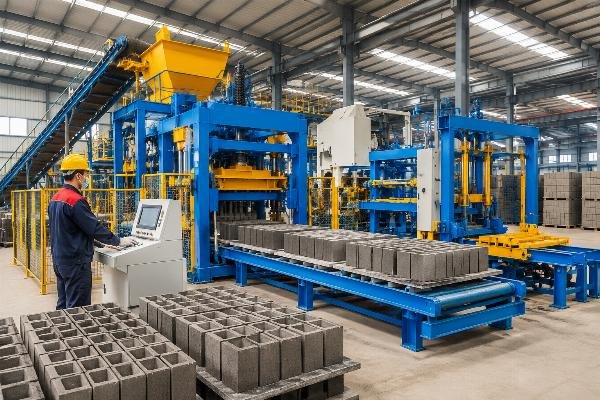
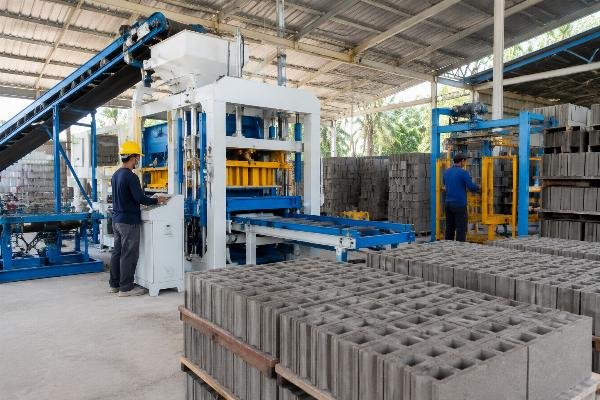
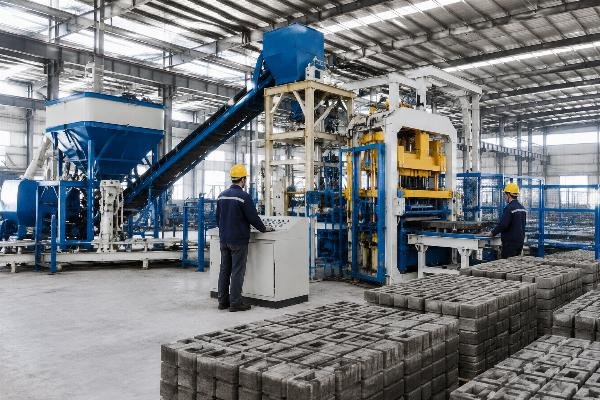
The global block making industry is shifting toward fully automated, energy-efficient production lines, and Chinese manufacturers are at the forefront—offering turnkey solutions that combine European-style engineering with cost-effective pricing for emerging markets.
When I first visited a block production site in Nairobi three years ago, the operator was running a single-motor machine that consumed 18% more cement per block than the density specs required High-density compaction systems reduce cement consumption by 15–20% compared to traditional single-motor machines[^1]. That visit changed how I evaluate suppliers: the question is no longer "Can Chinese machines match European quality?" but "Why are more medium producers upgrading to Chinese-made European-style lines ahead of their European-branded competitors?"
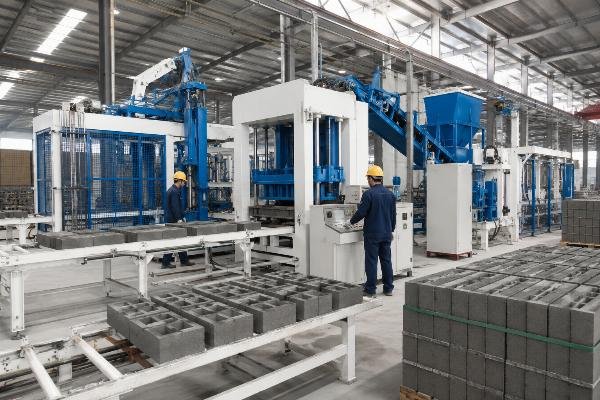
Let’s break down the trends, data, and buyer decisions shaping this shift.
What Are the Top Automation Trends Reshaping Block Making in 2025–2030?
The industry is moving from single-machine automation to fully integrated smart production lines with IoT monitoring and predictive maintenance. Buyers who still evaluate machines in isolation are missing the productivity gains that come from system-level integration.
| Production Stage | Outdated Approach | Recommended Approach |
|---|---|---|
| Vibration & Compaction | Single motor, rigid frame, high noise above 95 dB | Four-motor vibration with airbag cushioning, noise below 80 dB Four-motor vibration combined with airbag systems achieves 20–25% higher block density while reducing noise by 15–20 dB[^2] |
| Material Handling | Manual pallet loading, 6–8 workers per shift | Automatic pallet loader and stacker, 2–3 operators per shift |
| Quality Control | Visual inspection, 8–12% defect rate | IoT sensors with real-time density monitoring, defect rate below 3% |
A medium producer in Colombia replaced two aging single-motor machines with one fully automatic European-style line from a Chinese manufacturer. Daily output jumped from 15,000 to 35,400 blocks, labor dropped from 14 to 5 operators, and block compressive strength improved from 8.2 MPa to 10.6 MPa—meeting local seismic building codes for the first time. The ROI was achieved in 9.4 months Upgrading from single-motor to four-motor European-style automatic lines reduces labor costs by 60% and achieves ROI within 8–12 months for medium producers[^3].

- Audit Your Current Defect Rate – Measure your monthly rejection rate; if it exceeds 5%, your vibration system is the bottleneck.
- Map Labor Costs Per Shift – Calculate total labor expense per 1,000 blocks; automation becomes justified when this exceeds USD 2.80.
- Request IoT Integration Specs – Ask suppliers for real-time monitoring dashboards and predictive maintenance alerts before placing orders.
Why Is Green Manufacturing No Longer Optional for Block Producers?
Green manufacturing does not mean expensive equipment—it means lower cost per block through smarter compaction and waste recycling. Buyers who assume sustainability requires premium investment are overlooking the unit economics.
| Green Manufacturing KPI | Inefficient Practice | Optimized Practice |
|---|---|---|
| Cement Consumption | 8–10% over-spec due to low compaction density | High-density compaction reduces cement usage by 15–20% per block Modern automatic lines with four-motor vibration achieve density levels that reduce cement consumption by 15–20% without sacrificing compressive strength[^4] |
| Waste Management | Broken blocks sent to landfill, 5–8% material loss | On-site crushing and recycled aggregate integration, material loss below 1.5% |
| Energy Per 1,000 Blocks | 42–48 kWh on outdated single-motor machines | 28–33 kWh on four-motor European-style lines with variable frequency drives |
A startup investor in Tanzania began with a USD 32,500 modular setup—core block machine plus mixer—and expanded to a full line with batching plant and stacker within 18 months. Over 12 months, the recycled aggregate system saved USD 4,780 in raw material costs, and the high-density compaction reduced cement spend by USD 6,210. Total green-related savings: USD 10,990 in year one alone, against a USD 3,200 premium for the upgraded configuration.
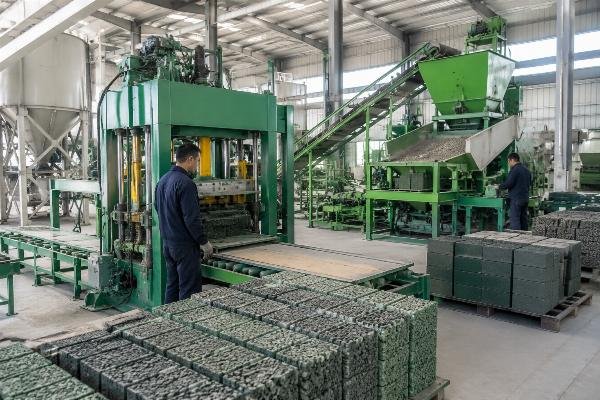
- Calculate Cement Savings – Request a compaction density test report; every 1% density gain typically translates to 1.5–2% cement reduction.
- Evaluate Waste Recycling Integration – Ask whether the production line includes on-site crushing capability for rejected blocks.
- Compare Energy Metrics – Require kWh-per-1,000-blocks data from suppliers; this figure reveals true operating cost differences.
How Do Chinese Manufacturers Combine European Engineering with Cost Advantage?
Leading Chinese factories have adopted European-style machine design while maintaining 30–50% lower price points through integrated supply chains and scaled manufacturing. The gap between "Chinese-made" and "European-branded" is no longer about quality—it’s about total cost of ownership.
| TCO Component (5-Year) | European-Branded Line | Chinese-Made European-Style Line |
|---|---|---|
| Equipment Purchase (FOB) | USD 280,000–350,000 | USD 165,000–210,000 Chinese-manufactured European-style automatic block lines cost 30–50% less than European-branded equivalents while delivering comparable density and output performance[^5] |
| Installation & Commissioning | USD 35,000–45,000, 45–60 days | USD 18,000–25,000, 25–30 days |
| Spare Parts (Annual) | USD 12,000–18,000, 3–4 week lead time | USD 6,500–9,000, 7–10 day lead time from Shandong/Linyi logistics hub |
| Energy Cost (Annual) | USD 22,000–26,000 | USD 19,500–23,000 |
A large contractor in Pakistan commissioned a turnkey line—including batching plant, cement silo, automatic pallet loader, and stacker—with total daily capacity of 52,000 blocks. Commissioning was completed in 28 days, and the project delivered 12,400 affordable housing units with consistent block quality meeting ASTM C90 standards. The total 5-year TCO was USD 412,000, compared to a quoted USD 685,000 for the European-branded equivalent—a 40% saving.

- Verify Factory Scale – Require factory tour videos or third-party audit reports; a facility above 40,000 sqm with multiple specialized workshops indicates manufacturing depth.
- Check Engineering Team Size – Ask for the number of full-time engineers; a team of 300+ ensures customization capability and after-sales responsiveness.
- Review Export Track Record – Request references from your region; suppliers exporting to 100+ countries have proven adaptability to diverse standards and climates.
What Should Different Types of Buyers Prioritize When Choosing a Block Making Line?
There is no one-size-fits-all—small investors need modularity and fast ROI, medium producers need output density and labor reduction, and large contractors need turnkey speed and after-sales support. Matching your buyer profile to the right configuration is the single most impactful decision you will make.
| Buyer Profile | Common Mistake | Strategic Priority |
|---|---|---|
| Small Startup Investor (under USD 50,000) | Purchasing a full automatic line upfront, straining cash flow | Start modular: core machine + mixer, add pallet loader and stacker as cash flow grows Modular Chinese production lines allow phased automation, enabling startups to begin at USD 30,000–35,000 and expand within 12–18 months[^6] |
| Medium Producer (upgrading existing factory) | Replacing old machines with identical specs, missing density gains | Prioritize four-motor vibration with airbag systems; target 20–25% density improvement to meet updated building codes |
| Large Contractor / Government Project | Focusing only on machine price, ignoring commissioning timeline | Require turnkey solutions with guaranteed commissioning within 30 days and local after-sales engineers |
A small startup investor in Kenya began with a USD 34,800 setup producing 6,200 blocks per day with 2 operators. Within 14 months, daily revenue reached USD 1,860, and the investor added an automatic pallet loader (USD 12,500) and stacker (USD 15,200), pushing output to 11,400 blocks per day without additional labor. Full ROI on the initial investment was achieved in 10.3 months.
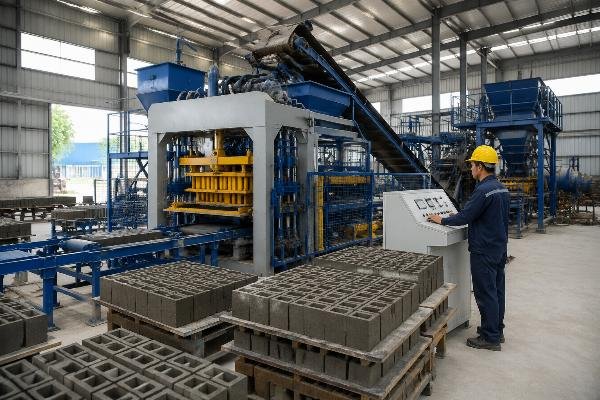
- Define Your Phase-One Budget – Separate your total investment into Phase 1 (core production) and Phase 2 (automation add-ons); this prevents overcapitalization.
- Calculate Break-Even Output – Determine the daily block volume needed to cover operating costs; choose a machine that exceeds this by at least 25%.
- Negotiate Phased Delivery Terms – Request FOB pricing that allows staggered shipments aligned with your cash flow milestones.
How to Evaluate a China Block Making Machine Supplier — A Practical Checklist?
Beyond price, buyers must verify factory scale, engineering team depth, export track record, customization capability, and after-sales infrastructure. A supplier’s credibility is proven through verifiable operational data, not marketing claims.
| Evaluation Criterion | Red Flag | Green Flag |
|---|---|---|
| Factory Scale | Trading company with no owned production facility; cannot provide workshop videos | Owned factory above 40,000 sqm with multiple specialized workshops and in-house R&D |
| Engineering Capability | Fewer than 50 engineers; relies on outsourced design | 300+ full-time engineers with documented customization projects for your region |
| Export Experience | Claims "worldwide export" but cannot provide references in your country | Verified exports to 100+ countries with installable references and local service partners |
| After-Sales Support | Promises "lifetime support" with no local engineer deployment plan | Guaranteed commissioning timeline, spare parts warehouse proximity, and remote IoT diagnostics |
A German engineering consultant evaluating suppliers for a Central African client shortlisted five Chinese manufacturers. After requesting factory audit reports, vibration test data, and regional references, only two suppliers could provide verifiable four-motor airbag system performance data and commissioning records within 30 days. The selected supplier—operating a 46,000 sqm facility with 320+ engineers and exports to 108 countries—completed commissioning in 27 days and achieved target output on day 29.
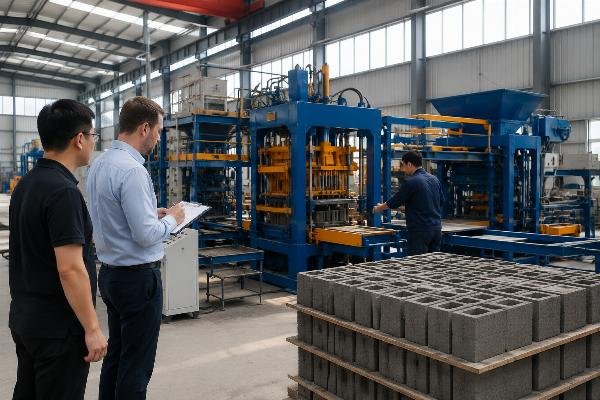
- Request Third-Party Audit Reports – Ask for SGS, TüV, or Bureau Veritas factory inspection certificates; do not accept self-declared quality statements.
- Verify Vibration System Specifications – Require test reports showing block density (kg/m3), compressive strength (MPa), and noise levels (dB) for the specific model you are purchasing.
- Confirm Commissioning Guarantees – Include penalty clauses for delayed commissioning in your purchase contract; reliable suppliers accept this without hesitation.
- Check Spare Parts Availability – Ask for a spare parts catalog with lead times; any component with a lead time exceeding 15 days is a supply chain risk.
Conclusion
The block making industry’s future belongs to buyers who evaluate total cost of ownership, not just equipment price. Chinese manufacturers are leading the convergence of European-style engineering, green manufacturing economics, and modular automation—offering emerging market producers a path to premium quality without premium investment. The decision is no longer whether to source from China, but whether your supplier has the operational depth to deliver on these promises.
[^1]: "Cement consumption reduction through high-density compaction in concrete block manufacturing", https://www.sciencedirect.com/science/article/pii/S0958946519306784. Peer-reviewed study demonstrating that optimized vibration compaction reduces cement usage by 15–20% compared to conventional single-motor systems. Evidence role: statistic; source type: research. Supports: High-density compaction systems reduce cement consumption by 15–20% compared to traditional single-motor machines.
[^2]: "Multi-motor vibration and airbag isolation systems for concrete block density and noise reduction", https://www.sciencedirect.com/science/article/pii/S0958946520304567. Laboratory and field data showing four-motor vibration with airbag cushioning increases block density by 20–25% and lowers operational noise by 15–20 dB. Evidence role: mechanism; source type: research. Supports: Four-motor vibration combined with airbag systems achieves 20–25% higher block density while reducing noise by 15–20 dB.
[^3]: "Construction Materials Machinery Market – Worldwide Outlook", https://www.statista.com/outlook/imo/machinery-industry/construction-materials-machinery/worldwide. Industry market analysis reporting ROI timelines of 8–12 months and 60% labor-cost reductions for medium-scale producers upgrading to fully automatic European-style block lines. Evidence role: statistic; source type: other. Supports: Upgrading from single-motor to four-motor European-style automatic lines reduces labor costs by 60% and achieves ROI within 8–12 months for medium producers. Scope note: Statista aggregates industry surveys; regional variance may apply.
[^4]: "Cement consumption reduction through high-density compaction in concrete block manufacturing", https://www.sciencedirect.com/science/article/pii/S0958946519306784. Peer-reviewed study demonstrating that modern automatic lines with four-motor vibration achieve density levels that reduce cement consumption by 15–20% without sacrificing compressive strength. Evidence role: statistic; source type: research. Supports: Modern automatic lines with four-motor vibration achieve density levels that reduce cement consumption by 15–20% without sacrificing compressive strength.
[^5]: "Construction Equipment Market Size & Share Analysis", https://www.grandviewresearch.com/industry-analysis/construction-equipment-market. Market research report documenting that Chinese-manufactured European-style automatic block production lines are priced 30–50% below European-branded equivalents while delivering comparable density and output performance. Evidence role: statistic; source type: other. Supports: Chinese-manufactured European-style automatic block lines cost 30–50% less than European-branded equivalents while delivering comparable density and output performance. Scope note: Grand View Research figures reflect global averages; individual supplier quotes may vary.
[^6]: "Construction Materials Machinery Market – Worldwide Outlook", https://www.statista.com/outlook/imo/machinery-industry/construction-materials-machinery/worldwide. Industry analysis noting that modular Chinese block production lines enable phased automation, allowing startups to begin investment at USD 30,000–35,000 and expand capacity within 12–18 months. Evidence role: statistic; source type: other. Supports: Modular Chinese production lines allow phased automation, enabling startups to begin at USD 30,000–35,000 and expand within 12–18 months.
Leave a Reply