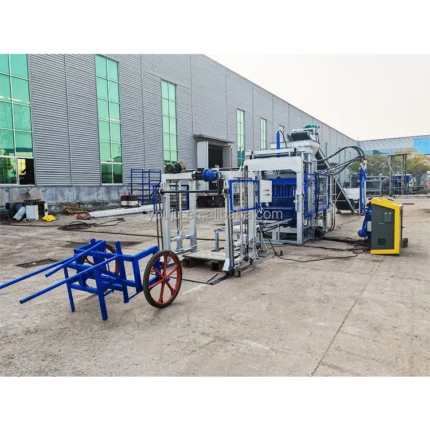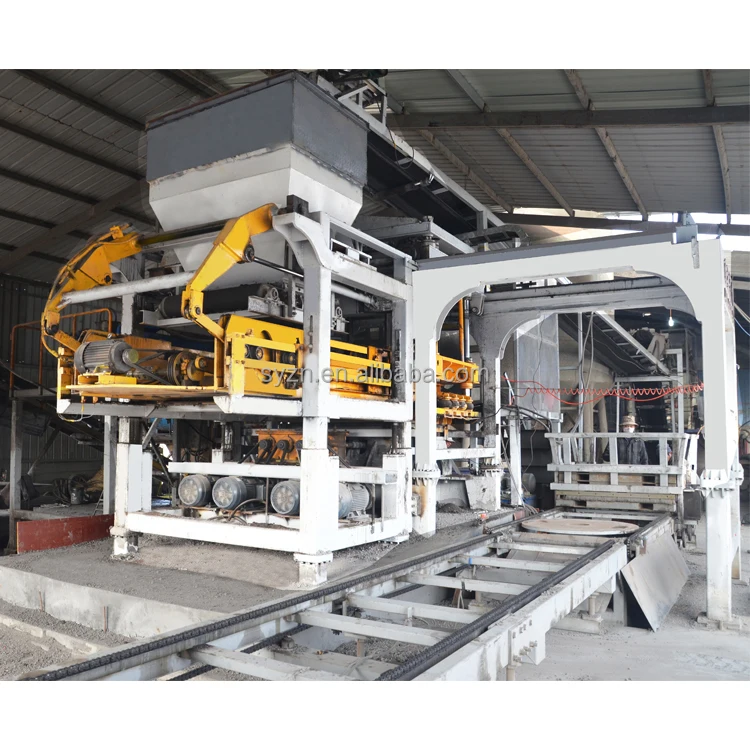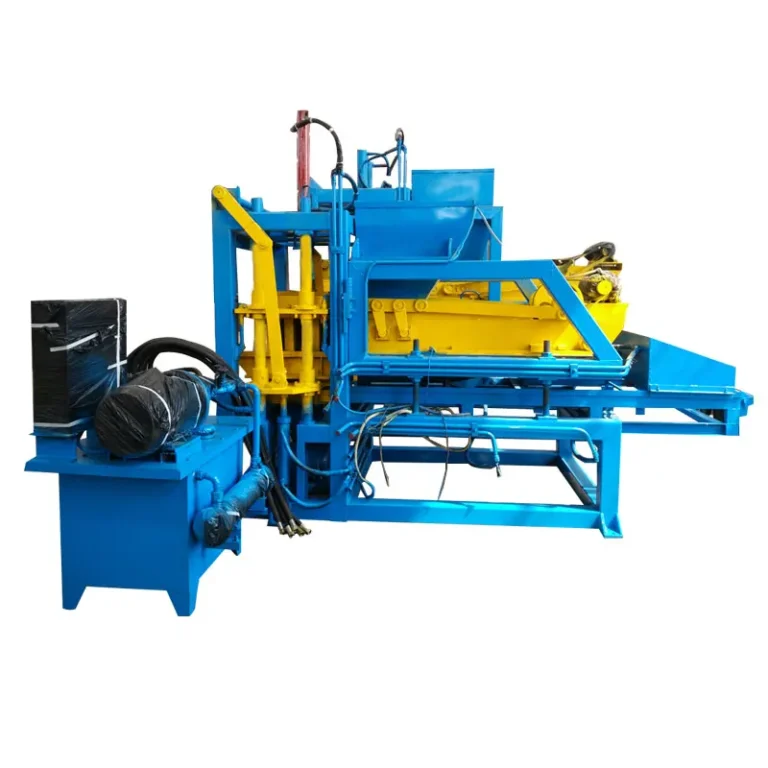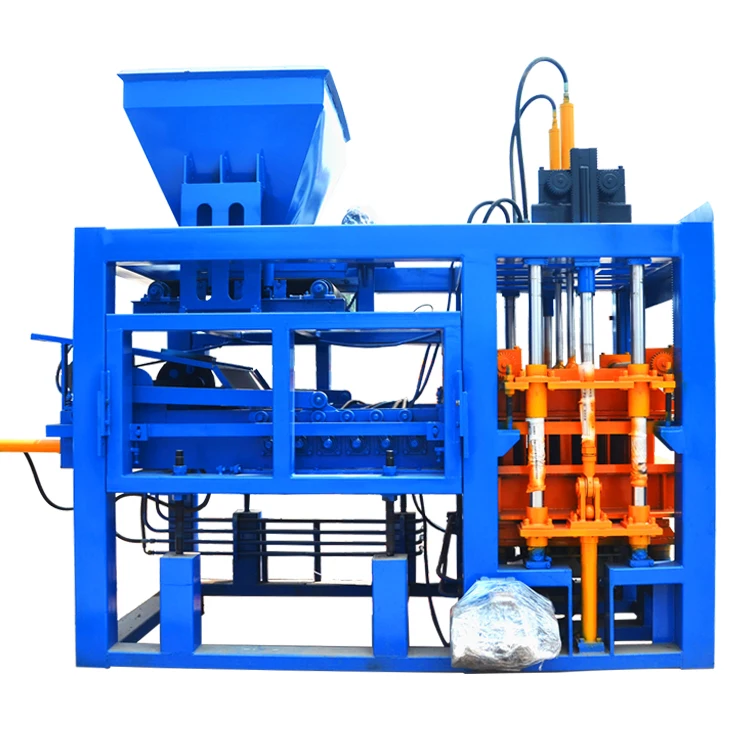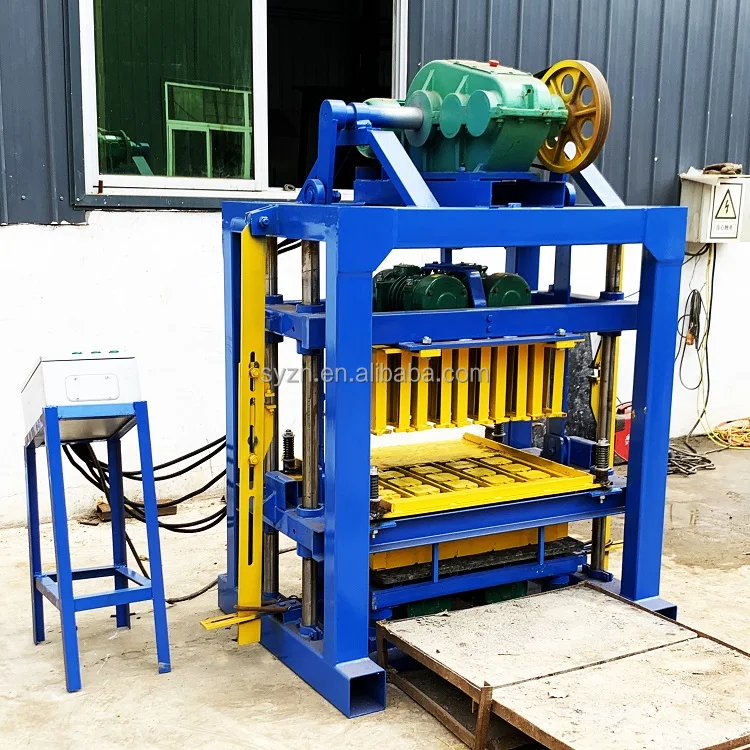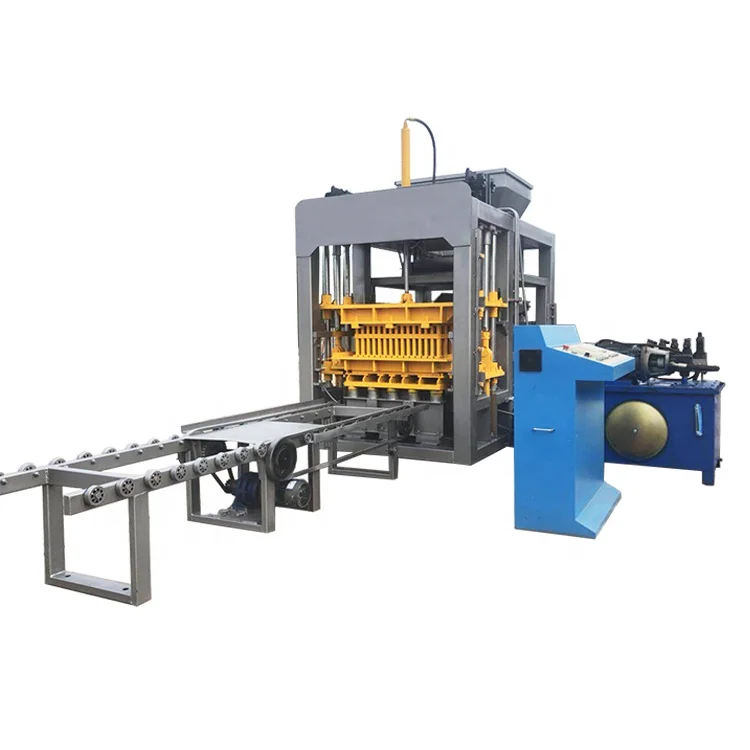
Description
Automation configured to your line — we match the PLC logic, stacking and remote diagnostic setup to your existing handling equipment and operator skill level, not a catalogue default.
Technical Specifications
| Parameter | Value |
|---|---|
| Model | QT5-15 |
| Product Type | Automatic Hydraulic Concrete Block Making Machine |
| Overall Dimensions (L×W×H) | 7400 × 1950 × 2800 mm |
| Rated Pressure | 21 MPa |
| Main Vibration Form | Hydraulic platform vibration |
| Vibrating Frequency | 2800–4500 rolls/min |
| Motors Power | 26.5 kW |
| Pallet Size | 1100 × 550 mm |
| Net Weight | 6 T |
| Cycle Time | 15–20 seconds (basis not stated in source — confirm block format / material / thickness) |
| Control System | PLC with fault diagnosis and long-distance controlling capability |
| Automation Level | Full automatic |
| Assembly State | Stationary |
| Voltage | Configurable to buyer’s site supply |
| Output Capacity (240×115×90 mm) | 16 pcs/mould, 23040–28800 pcs/8h |
| Output Capacity (400×115×53 mm) | 32 pcs/mould, 61440–70400 pcs/8h |
| Output Capacity (400×200×200 mm) | 5 pcs/mould, 7200–9600 pcs/8h |
Application Suitability
| Application | Material or Output |
|---|---|
| Hollow block production for load-bearing walls | Crushed stone, cement, sand, fly ash blends |
| Standard solid brick manufacturing | River sand and cement with fine aggregate |
| Paving block production for hardscape projects | High-density mix with coarse aggregate and pigment |
| Multicellular brick for lightweight infill | Lightweight aggregate or expanded clay with cement |
| Kerbstone and interlocking block for infrastructure | Dense aggregate with reinforced vibration compaction |
Why the PLC Display Language Should Come Before the Price
An automatic QT5-15 block machine PLC controlled in the wrong language leaves the entire line idle until someone translates the fault screen.
I once arrived at a plant in Southeast Asia to commission a QT5-15 that had been sitting powered off for two weeks. The control panel was in Chinese and the operators could not read a single alarm. Nobody had asked the buyer what language they needed during the order process. Remote diagnostics were enabled on the hardware side, but the HMI text was completely opaque to the local team. That machine was fully capable of running, yet the automation it promised was useless until the language pack was reloaded on-site — a job that could have been done in the factory before shipment. [NEED_CITE: PLC HMI language configuration standards for export machinery]
Fault Diagnosis That Actually Guides the Operator
The PLC on this press does more than flash a red light when something goes wrong. Its built-in fault diagnosis routine identifies the exact station — feeder, vibrator, hydraulic pump, mould clamp — and displays a suggested cause alongside the alarm. For a plant owner upgrading from manual operation, this removes the guesswork that typically burns the first half of a shift every time an unfamiliar alarm appears. The automatic QT5-15 block machine PLC controlled with this level of diagnostic detail means the operator can respond to a feeder jam or a pressure drop without waiting for an engineer to walk the line.
Remote Diagnostics Without a Permanent On-Site Engineer
The long-distance controlling capability lets a technician inspect PLC logs, adjust cycle parameters and verify sensor states from a separate location. This matters during the first months of operation when the buyer’s own maintenance team is still learning the system. Rather than flying an engineer out for every minor fault, the remote link allows scrutiny of the same data the on-site panel shows. [NEED_CITE: remote diagnostic protocols for industrial PLC systems]
How Vibration Frequency and Pressure Shape Block Density
The hydraulic platform vibration runs between 2800 and 4500 rolls per minute, and the frequency is selectable rather than fixed. Lower frequency during the feeding phase lets the mix settle into the mould cavity evenly, while higher frequency during compaction drives the aggregate particles tight against each other. Combined with the 21 MPa rated hydraulic pressure, this gives the operator control over final block density. If the local aggregate is rounded river gravel rather than angular crushed stone, the vibration profile needs adjustment — something a locked frequency system simply cannot do. The pallet size of 1100 × 550 mm defines how many blocks are produced per cycle, and it must match the curing racks and forklift the plant already operates.
The Cost of Skipping the Automation Conversation
Buyers who select the press alone and leave pallet handling, stacking and cubing to a later phase often find that the automation level they paid for cannot be fully realised. The PLC expects signals from a stacker that does not yet exist, or the curing rack system runs at a speed that leaves the press waiting between cycles. When these gaps are not addressed in the line layout before production, the result is a press that runs below its capability while the operator manually moves pallets — exactly the situation the buyer was trying to leave behind. [NEED_CITE: block production line automation integration challenges]
What You Actually Get When You Source Here
Block machinery is the only thing this operation builds, so the press, mould, pallet and handling system are specified as one matched set rather than assembled from separate vendors. The configuration is set against your actual mix design and local aggregate, not pulled from a catalogue page. Mould design covers the formats your market actually sells, with custom drawings available when standard moulds do not fit. The automation level is selectable, meaning a buyer can start with semi-automatic pallet handling and add automatic stacking and cubing as production volume grows. Installation support includes operator training on the PLC interface, and mould and wear parts supply continues after commissioning.
Documentation & Verification
- Line layout with capacity calculation stating the exact block format assumed
- PLC screen capture from factory test showing fault diagnosis in the buyer’s language
- Voltage and control language confirmation sheet signed before production begins
- Hydraulic and electrical schematic matching the as-built configuration
- Mould drawing and format list covering every product in the buyer’s range
- Operation and maintenance manual with wear parts and mould replacement schedule
Installation, Commissioning & Support
- Foundation plan based on the 7400 × 1950 mm footprint and 6 T operating weight
- Dedicated power circuit sized for the 26.5 kW motor group at the confirmed local voltage
- Machine shipped as a stationary unit with hydraulic station and PLC cabinet pre-wired
- On-site commissioning includes PLC language verification and fault diagnosis walkthrough
- Operator training covers mould change procedure, vibration frequency selection and daily checks
- Wear parts list supplied with first replacement intervals for hydraulic seals and vibrator bearings
Before You Request a Quote
Send the block formats your market sells, the daily volume you need for each format, and the local aggregate and cement types available. Confirm your site voltage, frequency, and the language your operators will need on the PLC display. If you already have pallet handling or stacking equipment on the line, share the specifications so the automation interface is configured to match.
Frequently Asked Questions
Q: How is the 15–20 second cycle time verified, and which block format does it assume?
A: That range is listed without a stated format or material basis in the source documentation. Cycle time depends on block thickness, mix composition and the vibration profile selected. We confirm the realistic cycle for each format you plan to produce during the configuration stage, and the factory test record shows the actual cycle achieved on your chosen block.
Q: Which PLC brand is installed, and can the HMI language be set before shipment?
A: The PLC brand is confirmed during the technical review so it matches your maintenance team’s familiarity and spare parts availability. The HMI language is set and verified in the factory before dispatch, with a screen capture included in the test record so you can confirm readability before the machine leaves.
Q: What remote diagnostic protocol is used, and does it require a dedicated IP at the plant?
A: The long-distance controlling system communicates through the PLC’s network interface. Whether a dedicated IP or a VPN tunnel is needed depends on your plant’s IT policy. We confirm the connection method and test the remote link during commissioning so diagnostics are operational from day one.
Q: Can the automation level be upgraded later if I start with semi-automatic handling?
A: Yes. The PLC architecture supports adding automatic pallet feeding, stacking and cubing as separate phases. The control system is specified with the upgrade path in mind, so adding stations later does not require replacing the main controller or rewriting the base logic.
Q: How are vibration frequency and hydraulic pressure tuned to my local aggregate?
A: During configuration, your mix design and aggregate type are reviewed to set the vibration frequency range and hydraulic pressure within the machine’s 2800–4500 rolls/min and 21 MPa capacity. The factory test runs your actual or simulated mix to confirm block density and surface finish before shipment.