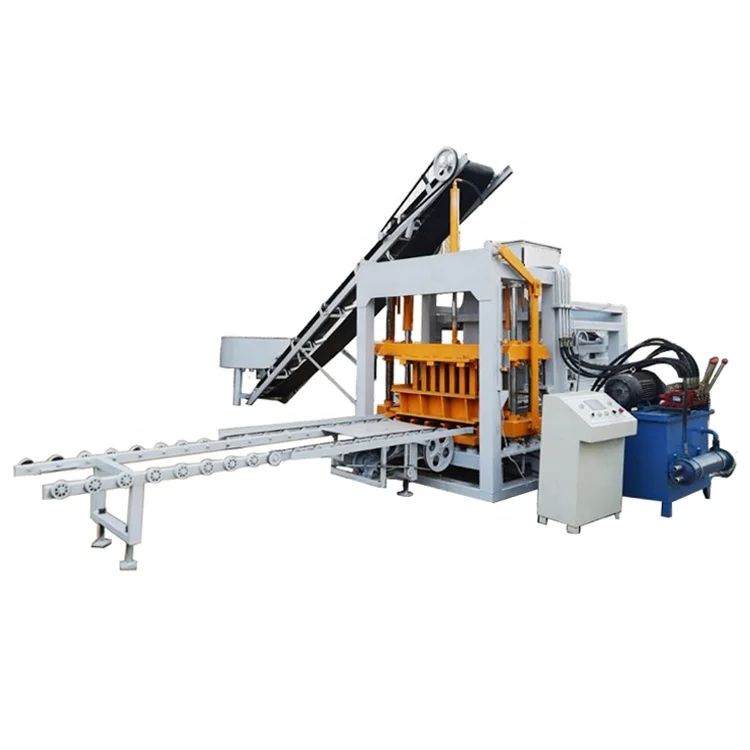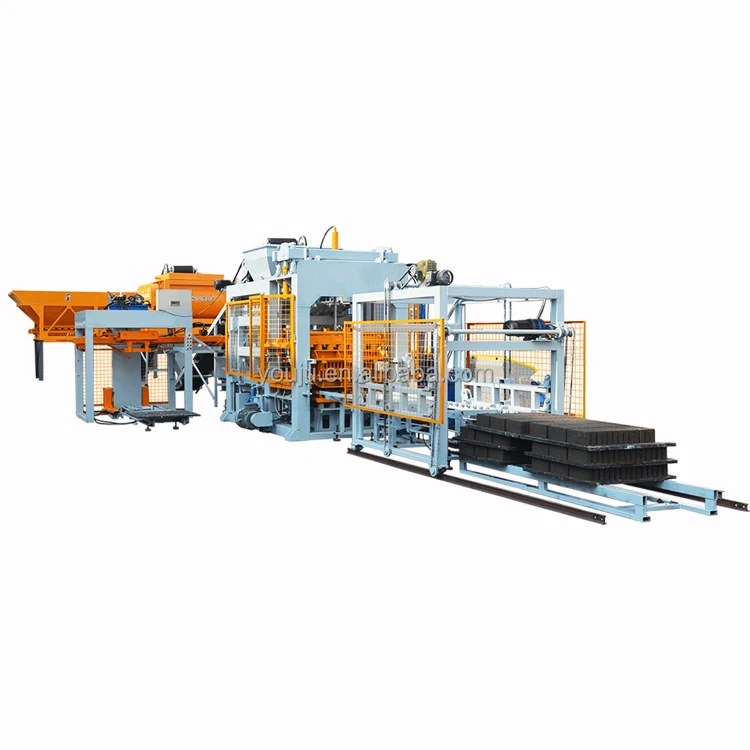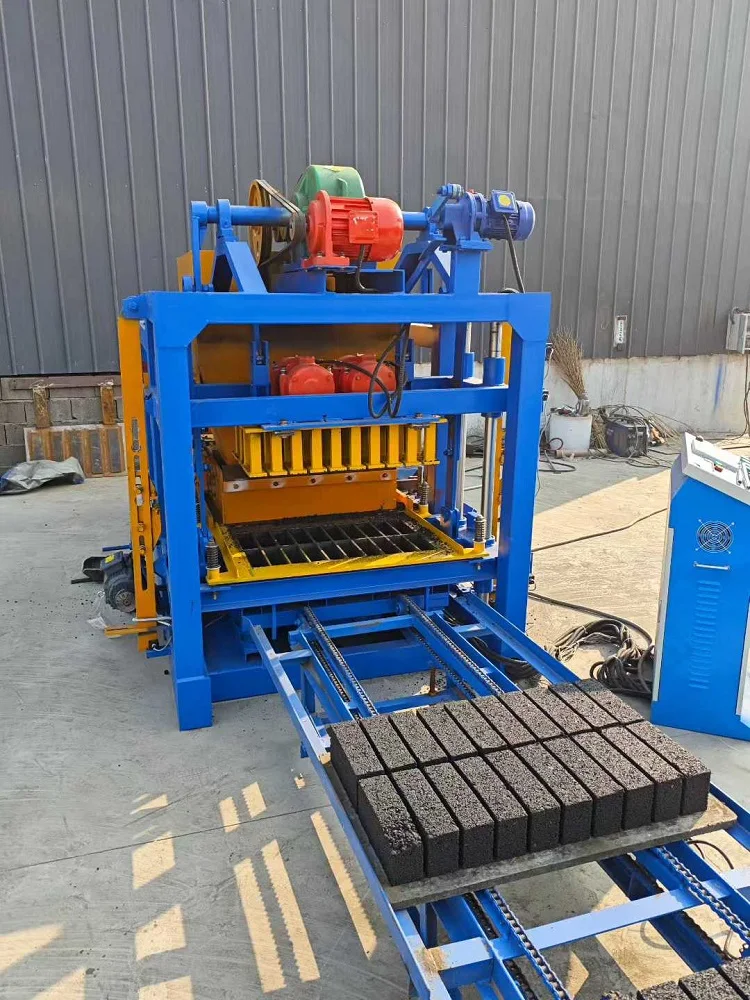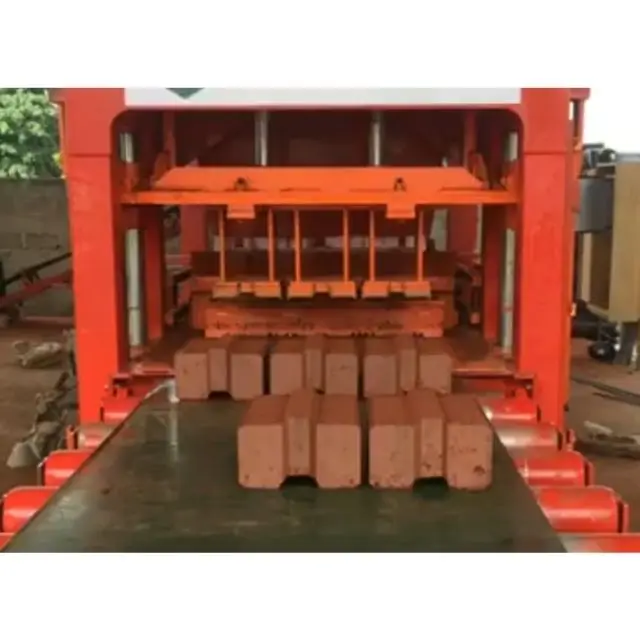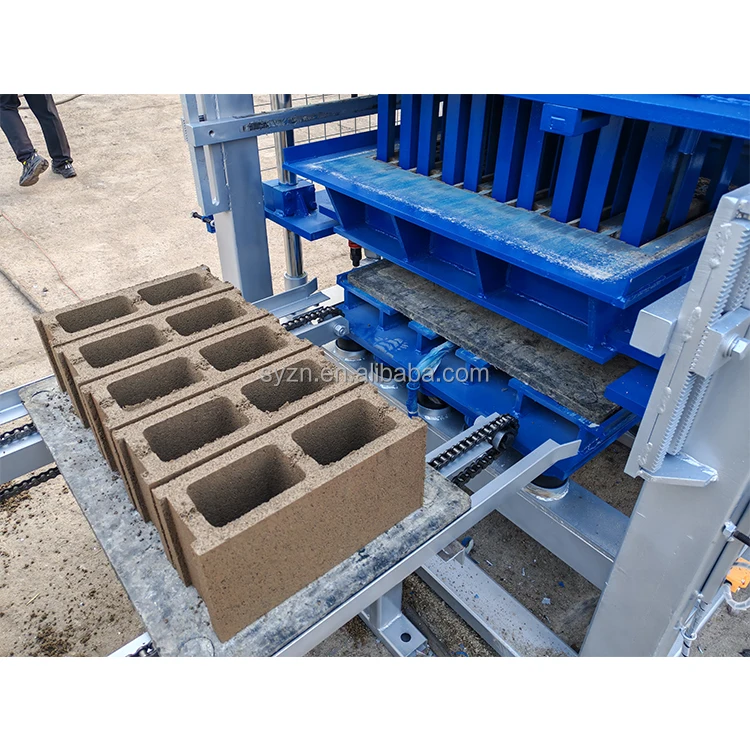
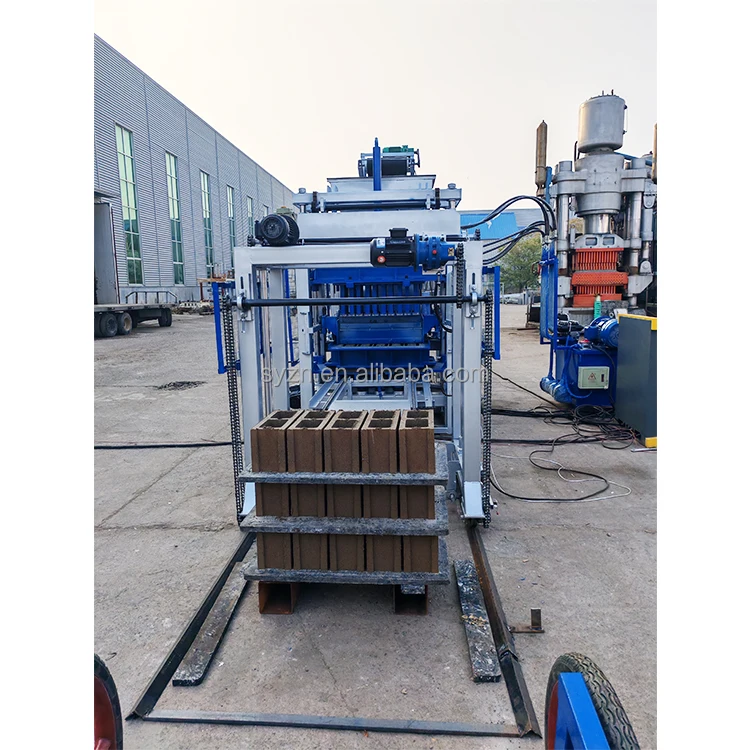


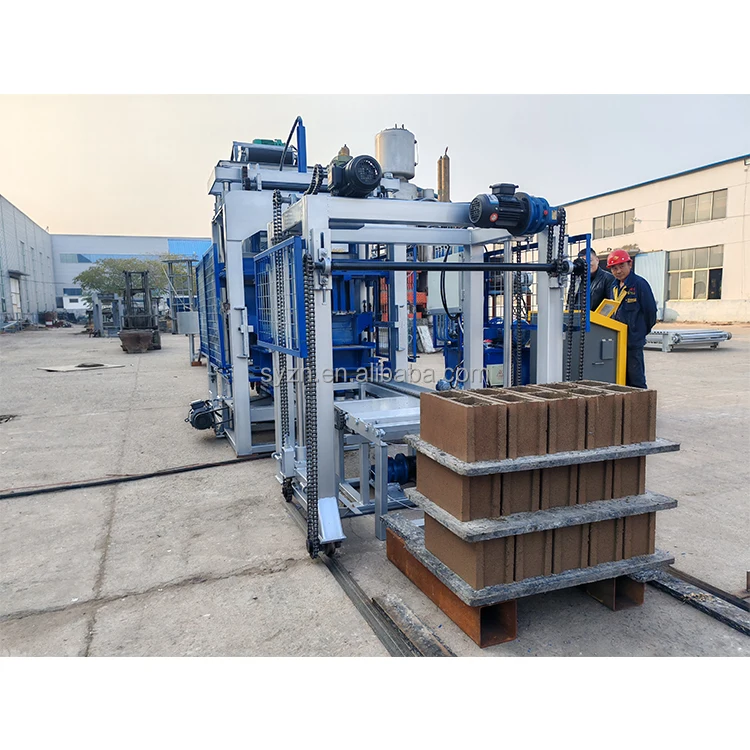
Description
Automation configured to your block format — the QT4-15A PLC program is written around the cycle time, demolding stroke and vibration duration your specific hollow, solid or paver format demands, not a generic default.
Technical Specifications
| Parameter | Value |
|---|---|
| Model | QT4-15A |
| Product Type | Fully Automatic Concrete Block Making Machine |
| Overall Dimensions (L×W×H) | 4100×1600×2600 mm |
| Rated Hydraulic Pressure | 16–21 MPa |
| Main Vibration Form | Platform Vibration |
| Vibration Frequency | 4200 r/min |
| Vibration Force | 55 kN |
| Pallet Size | 880×550 mm |
| Molding Cycle | 25–30 s (basis not stated in source — confirm block format / material / thickness) |
| Overall Power | 18.45 kW |
| Total Mass | 4 T |
| Demolding Method | Hydraulic |
| Factory Area Required | 300 m² |
| Control System | PLC (brand and model to be confirmed) |
| Voltage & Frequency | To be confirmed before order |
| Automation Level | Fully automatic |
| Warranty | 1 year (whole machine, excluding spare parts) |
| Loading | 1×40HQ container (basic equipment) |
Application Suitability
| Application | Material or Output |
|---|---|
| Hollow block production for building walls | Crushed stone, sand, cement, fly ash |
| Solid block production for load-bearing structures | Gravel, sand, cement, slag |
| Paver and interlocking block production for walkways and driveways | Crushed stone, sand, cement, colored pigment |
| Kerbstone production for road edging | Coarse aggregate, sand, cement |
| On-site block production for housing projects | Locally sourced aggregate and cement |
Why "25–30 Seconds per Cycle" Needs a Block Format Attached
A cycle time only means something when you know which block it was measured on.
I have walked into plants where the automatic block making machine PLC controlled the press beautifully, but the quoted cycle assumed a thin paver while the buyer was running 200 mm hollow blocks. The difference between those two formats can stretch a single cycle well beyond the brochure number, and daily output drops accordingly. The QT4-15A molding cycle is listed at 25–30 s, yet that figure carries no format assumption in the source data. Before you compare this machine to any other, ask the supplier to state which block size, wall thickness and mix design were on the press when that cycle was timed. [NEED_CITE: block cycle time varies by format thickness and mix design]
What the PLC Actually Takes Over
On a manual or semi-automatic line, the operator watches the press, decides when vibration has run long enough, and triggers demolding by hand. The QT4-15A removes those decisions. The PLC holds the vibration duration, hydraulic pressure ramp and demolding stroke for each mould installed, so the automatic block making machine PLC controlled repeats the same sequence whether it is the first cycle of the shift or the last. Operator dependency drops, and batch-to-batch density stays within a narrow band.
Where Consistency Shows Up in the Yard
Block strength testing is where automation earns its place. When vibration force and hydraulic pressure drift from cycle to cycle, some blocks cure dense and others crumble at the corners. The 55 kN vibration force and 16–21 MPa hydraulic pressure on the QT4-15A are held constant by the PLC once they are matched to your mix design. That matching step happens before shipment, not after arrival, so the first production run already meets the target compressive strength. [NEED_CITE: hydraulic pressure and vibration force matching to aggregate for consistent block density]
Reading the Spec Sheet Against Your Actual Product
Four numbers on the QT4-15A deserve closer attention than the rest. The 880×550 mm pallet size determines how many blocks sit on each board and whether your existing curing racks and forklifts can handle them without modification. The 4200 r/min platform vibration frequency, combined with 55 kN force, governs how well fine aggregate packs around larger stone — change your local sand gradation and you may need the frequency adjusted in the PLC. The 16–21 MPa hydraulic pressure range gives room to dial in demolding force: too low and the block cracks on release, too high and the mould wear accelerates. Finally, 18.45 kW total power means you need a dedicated circuit with enough headroom for the vibration motor start-up surge, not just the running load.
The Hidden Cost of Skipping Configuration Confirmation
A buyer who confirms voltage after the machine is built faces a rewired control cabinet on the factory floor. A buyer who never states the PLC display language watches operators guess at alarm messages in a foreign script. A buyer who accepts a default pallet size discovers the curing yard needs new racking. Every one of these mismatches costs downtime that no amount of automation can recover. [NEED_CITE: commissioning delays caused by unconfirmed electrical and control specifications]
What Sets This Procurement Path Apart
Block machinery is the only product line here, so the QT4-15A is specified as part of a matched system — press, mould, pallet and handling — rather than assembled from unrelated catalog pages. The PLC program is written against the block format you actually sell, with cycle parameters loaded before factory testing. Mould design covers the shapes your market demands, including custom drawings when standard formats do not fit. Automation level is selectable, meaning you can start with the QT4-15A and add automatic stacking or cubing later without replacing the press. Installation support includes operator training on the PLC interface so your crew is not learning from an untranslated manual.
Documentation & Verification
- Line layout showing the 300 m² factory area with pallet flow and curing rack positions
- Capacity calculation sheet stating which block format the 25–30 s cycle assumes
- Mould drawing and format list confirming every block shape included in the quotation
- Hydraulic and electrical schematic matching the confirmed voltage and frequency
- Factory test record with actual cycle time and block density measured on your mix
- PLC display language confirmation signed off before production begins
Installation, Commissioning & Support
- Foundation plan sized for the 4100×1600 mm footprint and 4 T operating mass
- Dedicated electrical circuit rated for 18.45 kW total load plus motor start-up surge
- Machine arrives in one 40HQ container; reassembly of hydraulic and vibration modules on site
- First-run commissioning includes PLC parameter tuning to your local aggregate and mix
- Operator training covers mould change procedure, alarm response and daily lubrication points
- Wear parts list with hydraulic seals and mould销轴 identified for first reorder cycle
What to Include in Your Inquiry
Send the exact block formats your market sells, including dimensions and target compressive strength. State your local aggregate type and gradation so the vibration and pressure settings can be matched before the machine is built. Confirm your site voltage, frequency and preferred PLC display language to avoid rewiring and reprogramming after delivery.
Frequently Asked Questions
Q: How is the 25–30 s molding cycle verified, and which block format does it assume?
A: The source data does not state which block format the 25–30 s cycle was measured on. Before order, we run a factory test using your specified block dimensions, mix design and target density, then record the actual cycle time. That verified figure becomes the basis for your daily output calculation, not the generic range.
Q: What PLC brand is used, and can the display language be set before shipment?
A: The PLC brand and model are confirmed during the proposal stage so you can verify spare part availability in your region. The display language is set to your operator’s language before the machine leaves the factory, and that setting is documented in the electrical schematic we supply.
Q: How are vibration force and hydraulic pressure matched to my local aggregate?
A: You send us a sample of your crushed stone, sand and any supplementary material like fly ash or slag. We run test cycles on the QT4-15A, adjusting the 55 kN vibration force and 16–21 MPa hydraulic pressure until the blocks meet your target compressive strength. The winning parameters are saved in the PLC before shipment.
Q: What is the upgrade path if I later add automatic stacking and cubing?
A: The QT4-15A automation architecture allows stacking and cubing stations to be added downstream without replacing the press or rewriting the core PLC program. The pallet conveyor interface is already present; the additional stations plug into the existing control logic with a program extension and added I/O modules.
Q: How is voltage and frequency confirmed to match my site supply before the machine is built?
A: We require written confirmation of your site voltage and frequency before production begins. That value is locked into the motor specifications, transformer sizing and PLC power supply. A voltage confirmation sheet is signed by both parties and attached to the factory test record so there is no mismatch on arrival.