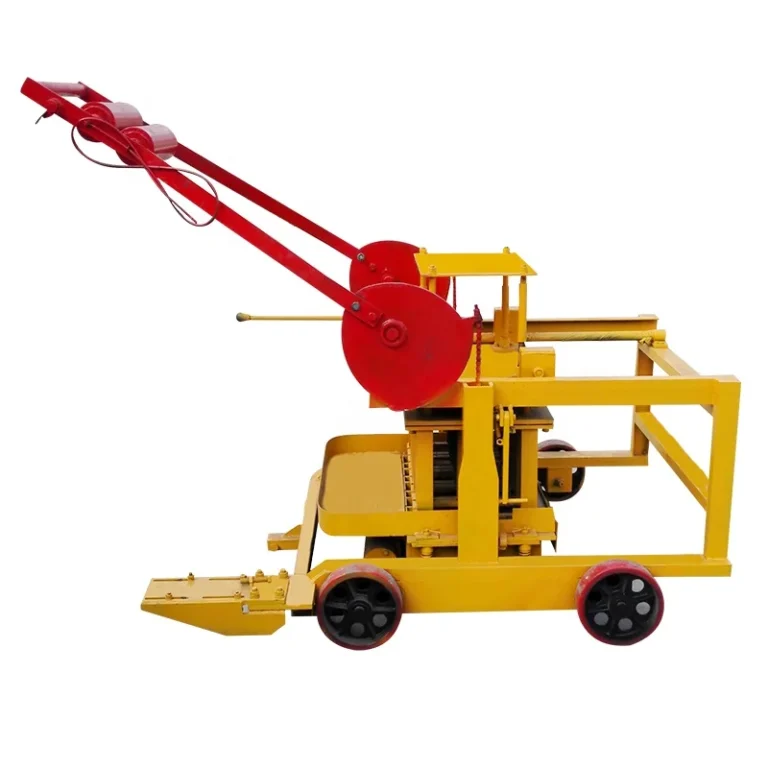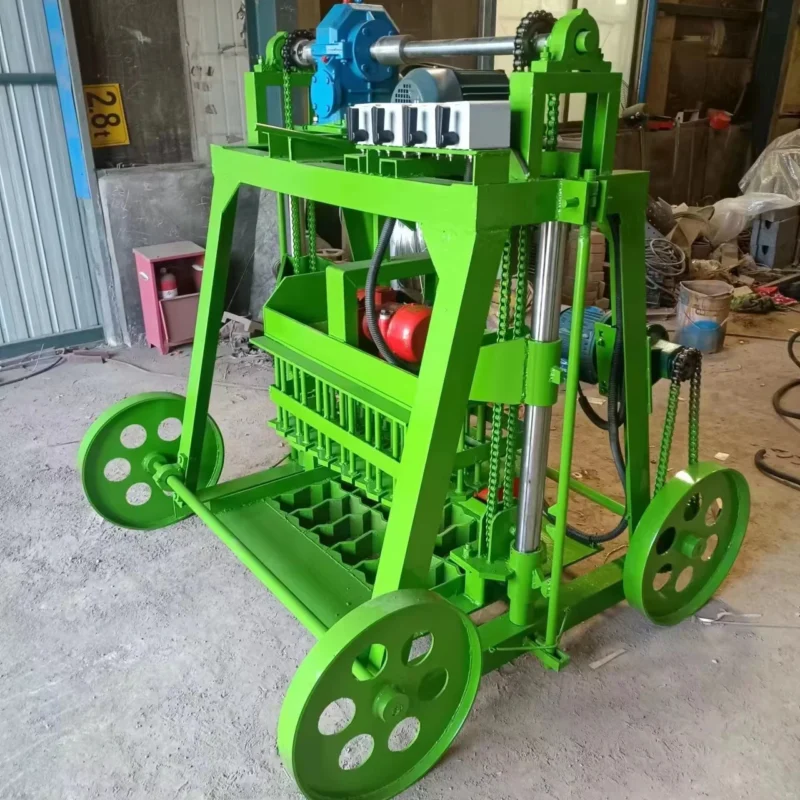

Description
Single-Focus Machinery Matching — the QMJ4-45 is specified against your actual mix design and target hollow block format, so vibration force and cycle time arrive tuned for the aggregate you can source locally, not a generic factory default.
Technical Specifications
| Parameter | Value |
|---|---|
| Model | QMJ4-45 |
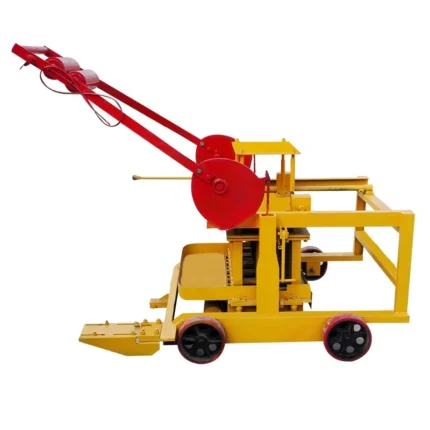
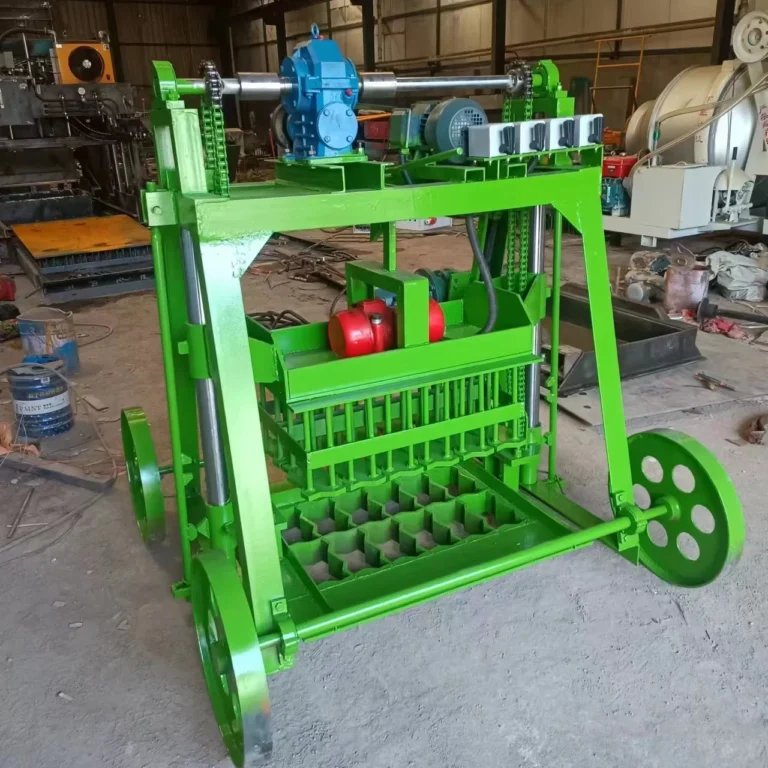
| Product Type | Mobile Egg Laying Block Making Machine |
| Molding Capacity | 4 pcs/mold (basis: 400×200×200 mm hollow block) |
| Vibration Frequency | 2400 r/min |
| Productivity (400×200×200 mm hollow block) | 3000 pcs/day (8-hour shift) |
| Productivity (400×150×200 mm hollow block) | 3500 pcs/day (8-hour shift) |
| Productivity (400×120×200 mm hollow block) | 4500 pcs/day (8-hour shift) |
| Forming Method | Twice-vibration of molding core |
| Molding Cycle | 40–45 s (basis: hollow block formats listed above) |
| Demold / Turning Method | Manual |
| Total Power | 6 kW |
| Power Source | Diesel / Petrol engine |
| Automation Level | Manual / egg-laying (no pallet required) |
| Hydraulic System | Not equipped (vibration-only forming) |
| Pallet Size | N/A — blocks laid directly on ground |
| Warranty | 1 year (whole machine) |
Application Suitability
| Application | Material or Output |
|---|---|
| On-site hollow block production for housing projects | Crushed stone, sand, cement, water |
| Remote construction sites without grid power | Diesel or petrol engine driven operation |
| Startup block yards with limited capital | 400×200×200 mm, 400×150×200 mm, 400×120×200 mm hollow blocks |
| Infrastructure contractors producing blocks at job site | Local aggregate mixed with Portland cement |
| Rural and off-grid block supply | Flat compacted ground as curing surface |
Why the Daily Output Figure Means Nothing Without a Block Format
A productivity number detached from a specific block dimension is marketing, not engineering.
I have watched buyers receive a mobile block machine rated at a single daily figure, only to discover halfway through commissioning that the number assumed a slim partition block they never intended to sell. The QMJ4-45 lists output separately for 400×200×200 mm, 400×150×200 mm, and 400×120×200 mm hollow blocks because each format changes the mold fill volume, vibration dwell, and cycle count per shift. When a supplier quotes one blanket number for an automatic mobile block machine, ask which format it assumes before you sign anything [NEED_CITE: block format assumptions in capacity quotations].
Vibration Core Design and Block Density
The QMJ4-45 uses a twice-vibration molding core rather than the single-vibration arrangement found on lighter egg-laying models. The first vibration settles the concrete mix into the mold cavity while the second compression pass forces out trapped air and consolidates the aggregate around the cement matrix. This two-stage action matters most when your local sand carries high clay content, because clay holds moisture and resists single-pass compaction. For buyers evaluating a PLC controlled egg laying block machine, understanding the vibration sequence is more useful than comparing motor power alone.
Engine-Powered Operation Beyond the Grid
Diesel or petrol engine drive removes the three-phase electricity requirement that blocks most rural projects. The 6 kW total power demand sits within the output range of a small single-cylinder diesel unit, meaning fuel planning replaces transformer installation on your site checklist. Contractors working on road-side kerb or remote housing developments start producing the week the machine arrives rather than waiting weeks for a grid connection [NEED_CITE: off-grid power solutions for construction equipment].
How Vibration Frequency, Cycle Time, and Aggregate Interact
The 2400 r/min vibration frequency sits in the mid-range for egg-laying machines, which is deliberate. Higher frequencies work well with fine sand but can segregate coarse aggregate, while lower frequencies leave voids in thin-wall hollow blocks. The 40–45 second molding cycle gives the twice-vibration core enough dwell to compact a stiff mix without slowing the operator’s walking pace. If your local crushed stone runs larger than 10 mm, the cycle extends slightly because the core needs extra vibration passes to settle particles around the mold pins. Matching vibration frequency to aggregate grading is something we confirm before the machine leaves the factory, not after it arrives on your site.
What Happens When Ground Preparation Gets Skipped
Egg-laying machines trade pallet infrastructure for ground dependency. If the surface is uneven by more than a few millimeters across a meter span, blocks settle at different heights while the concrete is still green, producing a batch with inconsistent wall thickness. I have seen contractors lay blocks on freshly graded soil that looked flat until the first rain exposed low spots, warping an entire day’s output. A compacted gravel bed or a cured concrete apron costs a fraction of a pallet system and prevents this failure mode entirely [NEED_CITE: ground preparation standards for mobile block production].
Why Buyers Come Back for a Second Machine
Block machinery is our single product focus, which means the QMJ4-45 arrives as a matched system — mold, vibration setting, and engine specification all chosen for your target block format and local aggregate. Configuration is set against the mix design you can actually source, not a laboratory reference mix. Molds are designed for the hollow block dimensions your market buys, with custom drawings available if your region uses a non-standard size. The automation path is open: a buyer starting with manual egg-laying today can move to semi-automatic pallet-based production later without replacing the core press logic. Installation support includes operator training on vibration adjustment so your crew can tune the machine as aggregate moisture changes through the seasons.
Documentation & Verification
- Machine specification sheet listing output per hollow block format, not a single blanket figure
- Mold drawing and format list confirming cavity dimensions match your local market standard
- Engine specification and fuel consumption data matched to your site altitude and ambient temperature
- Factory test record run on an aggregate blend close to your local material before dispatch
- Operation and maintenance manual covering vibration adjustment and mold change procedure
- Wear parts and mold availability list with lead times stated upfront
Installation, Commissioning & Support
- Flat compacted ground or concrete apron required; surface tolerance checked before first mold cycle
- Diesel or petrol engine fueled and run-in on site; no three-phase electrical connection needed
- Machine arrives assembled; wheels and handle fitted for immediate walking operation
- First production run supervised to set vibration dwell against your specific aggregate blend
- Operator trained on manual demold technique and mold change sequence for all three block formats
- Wear parts inventory reviewed and reorder timeline confirmed before commissioning team departs
What to Prepare Before You Request a Quote
Tell us which hollow block dimensions sell in your market, the daily volume you need to sustain, and what aggregate you can source within hauling distance of your site. Confirm whether grid electricity is available or if the machine must run entirely on an engine. If you have an existing curing area, share its dimensions so we can calculate how many blocks per day the space can hold before fresh output overruns it.
Frequently Asked Questions
Q: How is daily output calculated, and which block format does the quoted figure assume?
A: Output is stated separately for each hollow block format — 3000 pieces per day for 400×200×200 mm, 3500 for 400×150×200 mm, and 4500 for 400×120×200 mm, all based on an eight-hour shift. The mold cavity count and cycle time differ across formats, so a single unqualified number would mislead your production planning.
Q: Can the machine run entirely off a diesel engine, and what fuel consumption should I plan for?
A: Yes, the QMJ4-45 is available with diesel or petrol engine drive, removing the need for any grid connection. The 6 kW total power requirement suits a small single-cylinder diesel unit. Fuel planning should account for local altitude and ambient temperature, both of which affect engine output and consumption rates.
Q: What ground preparation is needed for egg-laying operation, and what surface flatness is required?
A: The machine lays blocks directly on the ground, so the surface must be compacted and level. A gravel bed or cured concrete apron works well. Uneven ground causes fresh blocks to settle at different heights, producing inconsistent wall thickness before the concrete gains enough strength to hold its shape.
Q: How long does a mold change take, and can I order custom molds for formats my market sells?
A: Mold change on the QMJ4-45 is a manual procedure completed with basic hand tools. Custom molds are available to your drawings, covering hollow block dimensions beyond the three standard formats. Confirming the formats your local construction codes require before ordering avoids paying for mold capacity you will never use.
Q: What does the upgrade path look like if I later want pallets and stacking?
A: A buyer starting with the QMJ4-45 can transition to a semi-automatic or automatic pallet-based line later. The press logic and vibration principles carry over, so your crew’s experience with mix tuning and block quality assessment remains valuable. The egg-laying machine can continue running at a secondary site rather than being replaced.