

Block Machine Supplier for Iraq: China Factory Direct
Choosing a block machine supplier for Iraq based on spec sheets alone is how you end up with a production line that burns out its PLC in the first week.
The real question when selecting a block machine supplier for Iraq is not which model has the highest output on paper, but whether the manufacturer has delivered a complete production line under the same voltage instability, sand-laden air, and extreme heat you will face on site — and whether they solved those field problems before your first pallet leaves the mold.
I still remember a QT6-15 line we shipped to a client near Baghdad. The machine ran beautifully during factory trials. Then it reached the port, got hooked up to the local grid, and the voltage swung so violently that two PLC boards fried within days. The client lost an entire week of production waiting for me to fly out with replacement modules. After that, every Middle East order I personally oversee gets a wide-voltage module in the control cabinet and upgraded dust-proof seals on the hydraulic system. Spec sheets are easy to copy; field scars are not. [NEED_CITE: voltage fluctuation standards and tolerance ranges for industrial equipment in developing grids]
If you are sourcing equipment for the Iraqi market, the rest of this guide walks through the specs that actually matter, how to compare suppliers beyond the brochure, which model fits your project scale, and what genuine turnkey service looks like from a block machine supplier for Iraq.
What Specs Matter Most for Block Machines in Iraq’s Operating Environment?
Wide-voltage electronics, dust-proof hydraulics, and high-temperature seals determine whether your line runs continuously — far more than the rated block output per cycle.
Most buyers open a comparison spreadsheet and start with cycle time and daily output. That is the wrong starting point for Iraq. The Iraqi grid experiences frequent voltage dips and surges that fall well outside the tolerance range of standard European or even generic Chinese control boards. [NEED_CITE: IEC voltage tolerance classes for industrial machinery in unstable grid conditions] Meanwhile, ambient summer temperatures regularly exceed normal operating thresholds, and fine desert sand infiltrates every unsealed hydraulic joint.
Here is how the critical specs break down when evaluated for Iraqi conditions:
| Parameter | Standard Export Config | Iraq-Adapted Config |
|---|---|---|
| Voltage tolerance range | Narrow band | Wide-voltage module with auto-compensation |
| Hydraulic seal material | Standard nitrile | High-temp, sand-resistant composite |
| PLC board protection | Basic enclosure | Dust-proof cabinet with filtered ventilation |
| Mixer motor insulation | Standard class | Elevated thermal class for sustained heat |
| Mold steel treatment | Basic hardening | Enhanced wear resistance for abrasive desert sand mixes |
A private investor in Erbil once bought a second-hand line from a trader who had simply rebranded a standard export model. The hydraulics started leaking within months because the seals could not handle the combination of heat and fine particulate ingress. The repair cost several times what a proper seal upgrade would have added at the factory. [NEED_CITE: hydraulic seal failure modes in high-dust, high-temperature environments]
The lesson: when you evaluate a block machine supplier for Iraq, ask them to show you the specific modifications they make for voltage instability and sand ingress — not just the cycle time on the data sheet.
How to Compare China Block Machine Suppliers for the Iraqi Market?
Use a three-dimensional matrix of verified field delivery history, on-site service responsiveness, and genuine customization capability — not unit price alone.
The cheapest block machine supplier for Iraq is rarely the most economical choice once the line is running. The real cost driver is unplanned downtime. A control board failure during the peak construction season can idle an entire crew and delay a government contract, costing multiples of whatever you saved on the purchase price.
When I compare suppliers for clients or for our own benchmarking, I look at three layers:
First layer: same-environment delivery track record. Has the supplier actually shipped and commissioned lines in Iraq or a comparable MENA environment? Ask for case references — not just country names, but the specific challenges they solved on site. A supplier who has dealt with Iraqi voltage profiles and desert sand will have engineering modifications already validated, not improvised.
Second layer: on-site service structure. When something goes wrong — and it will, because no machine is immune to field conditions — how quickly can the supplier get a qualified engineer to your plant? Some suppliers rely entirely on local agents who may not understand the specific control logic. Others maintain their own installation teams who have wired the exact cabinet they are troubleshooting. [NEED_CITE: after-sales service response frameworks for capital equipment in emerging markets]
Third layer: customization depth. Can the supplier modify the batching system for local raw materials — desert sand with different gradation, recycled aggregate with variable moisture — or do they insist you adapt your recipe to their machine? The block machine supplier for Iraq who understands local materials will adjust vibration frequency, mold design, and mix ratios rather than handing you a fixed recipe and blaming your raw materials when output quality drops.
A contractor in Basrah compared three quotes and chose the lowest. The winning supplier had no prior Iraq installations. When the PLC needed reconfiguration for local voltage, the supplier sent a generic manual and expected the client’s electrician to figure it out. The line sat idle for an extended period. The client eventually called us to send an engineer to retrofit the control system — at a cost that erased most of the initial savings.
Which Block Machine Model Fits Different Iraq Project Scales?
Small private investors recover capital fastest with semi-automatic models, while infrastructure contractors need fully automatic lines to meet volume commitments.
The Iraqi construction market spans a wide range of project scales, from neighborhood block yards supplying local builders to large contractors executing government housing and road paving tenders. Matching the machine to the project — rather than buying the biggest model you can afford — is what determines your return timeline.
| Project Type | Recommended Model Range | Automation Level | Key Consideration |
|---|---|---|---|
| Small private yard, local supply | Entry-level semi-auto | Manual pallet handling, semi-auto cycle | Low entry cost, fast payback, minimal infrastructure |
| Medium private investor, regional supply | Mid-range semi-auto to entry full-auto | Auto cycle, semi-auto pallet handling | Balance of output and investment, scalable |
| Infrastructure contractor, tender volume | Full-auto high-output line | Fully automatic with PLC, auto stacking | Meets volume commitments, consistent quality for certification |
| Paver and interlocking brick specialist | Dedicated hydraulic press line | Full-auto with color feed system | Decorative product capability, mold flexibility |
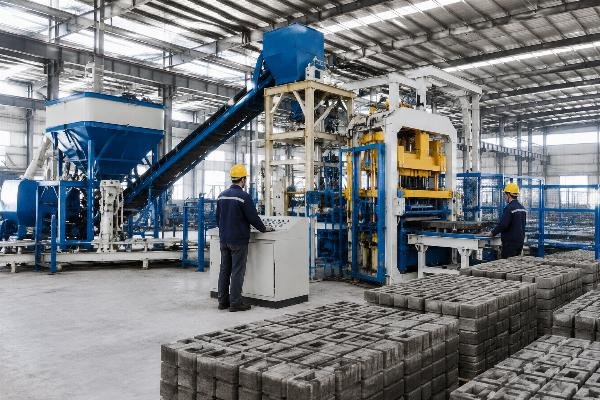
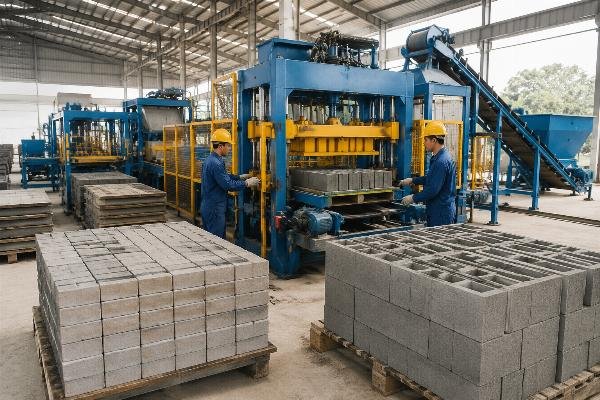
For a first-time investor with limited capital and a focus on standard hollow blocks and solid bricks, the entry-level semi-automatic range offers the shortest path to revenue. The equipment footprint is smaller, the power requirement is manageable even on constrained local grids, and the operational learning curve is gentle. Multiple clients across the MENA region have started with this tier and expanded to a full-auto line within a few years once cash flow was established.
For contractors bidding on government infrastructure projects — affordable housing compounds, road curbstones, municipal paving — the fully automatic lines with PLC control and automated stacking become essential. These lines deliver the volume consistency and documented quality that tender committees require. [NEED_CITE: automation requirements for certified concrete product manufacturing in public procurement]
A frequent mistake I see is investors who overestimate their initial demand and purchase a full-auto line before securing the contracts to fill it. The machine sits underutilized, the loan repayments accumulate, and the business struggles. The smarter path is to match the block machine supplier for Iraq’s recommendation to your confirmed order pipeline, then scale up with proven cash flow.
What Turnkey Services Should a Reliable Supplier Provide?
True turnkey delivery means the supplier takes responsibility from electrical customization through sea freight packaging to on-site installation and operator training — not just dropping a container at the port.
Many suppliers advertise "turnkey" but define it as "we ship you the machine." For the Iraqi market, where port handling conditions at Umm Qasr can be rough, where site power may not match the machine’s original configuration, and where operators may be encountering automated equipment for the first time, genuine turnkey service from a block machine supplier for Iraq must cover the entire chain.
Electrical and control customization. Before the machine leaves the factory, the control cabinet must be configured for the actual voltage range at your site. This means installing wide-voltage modules, verifying PLC firmware compatibility, and testing under simulated fluctuation conditions. [NEED_CITE: industrial electrical adaptation practices for equipment exported to grids with unstable voltage profiles]
Sea freight packaging for rough handling. Containers shipped to Umm Qasr endure long transit times, high humidity, and handling equipment that is not always gentle. Critical components — PLC boards, hydraulic valves, sensors — need individual moisture-proof wrapping and shock-absorbing mounting. Structural components need secure bracing that prevents shifting during crane lifts.
On-site installation and commissioning. An engineer from the supplier should be present to oversee assembly, connect hydraulics and electrical systems, verify vibration calibration, and run the first production batches. This is not optional — it is where the difference between a machine that performs and one that underperforms gets determined.
Operator and maintenance training. Your local crew needs to understand not just how to run the machine, but how to perform daily maintenance — checking hydraulic fluid levels, cleaning filters, inspecting mold wear, reading PLC fault codes. A supplier who trains your people properly reduces your dependence on expensive fly-in service calls for minor issues.
We have structured our own delivery process around these principles. Complete production lines move from order confirmation to on-site commissioning within a compressed timeframe. The wide-voltage modules and dust-proof hydraulic modifications that came from hard lessons in Baghdad and across the region are now standard in our Middle East configurations. Our engineers have spent extended periods on sites across the MENA region, and that field knowledge is built into every machine that ships.
Conclusion
The block machine supplier for Iraq who has field scars from the same environment you operate in will save you far more money than the one with the lowest quotation. Voltage instability, desert sand, extreme heat, and rough port handling are not abstract risks — they are daily realities that determine whether your production line earns money or burns it. Match the machine to your actual project scale, verify the supplier’s customization depth and on-site service capability, and insist on a delivery process that covers everything from electrical adaptation to operator training.
Leave a Reply