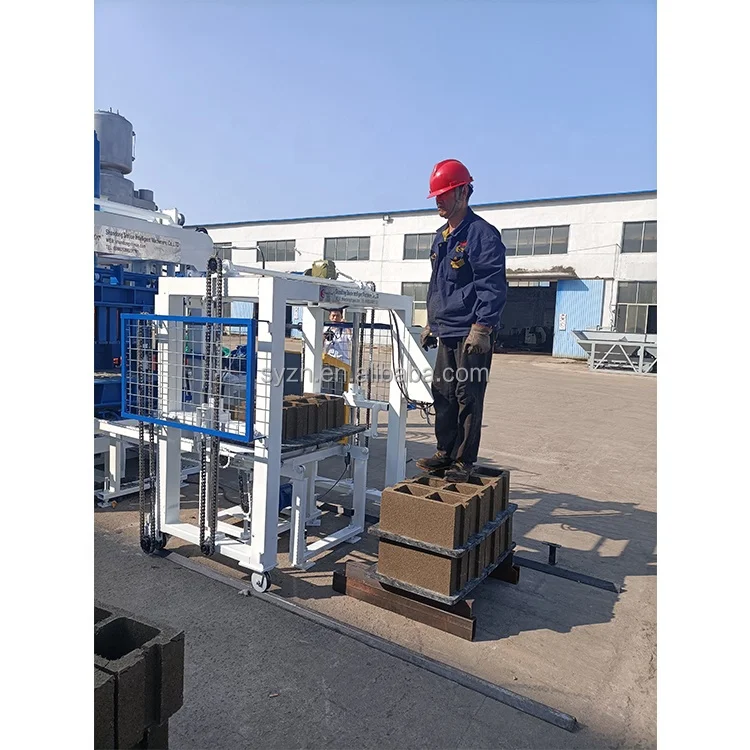
Description
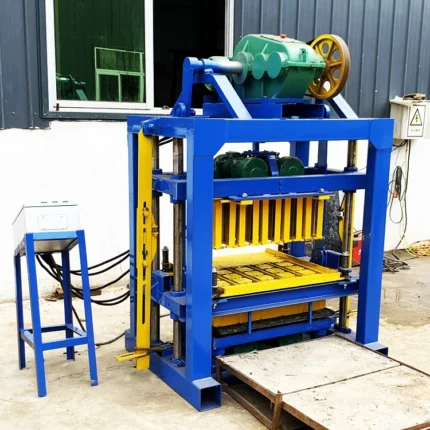
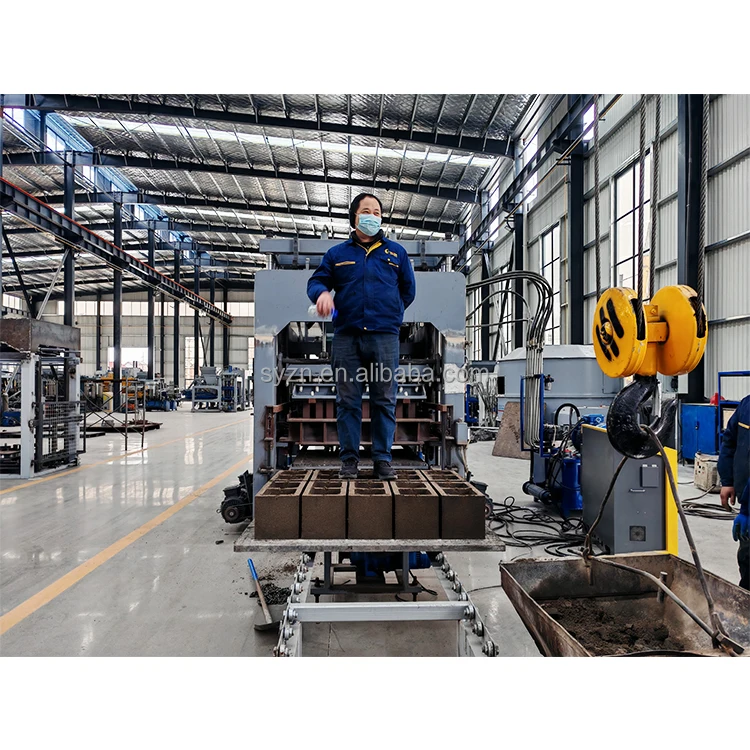
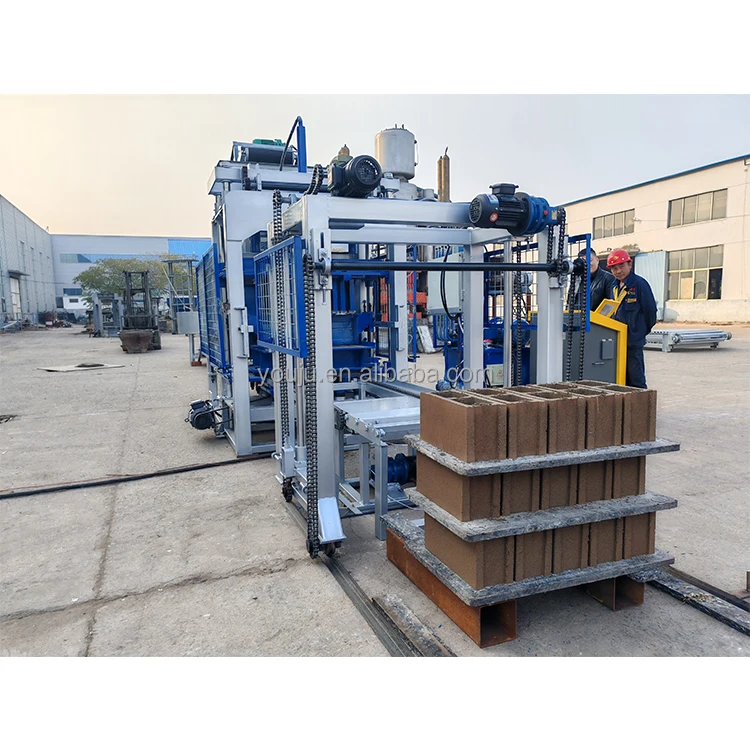
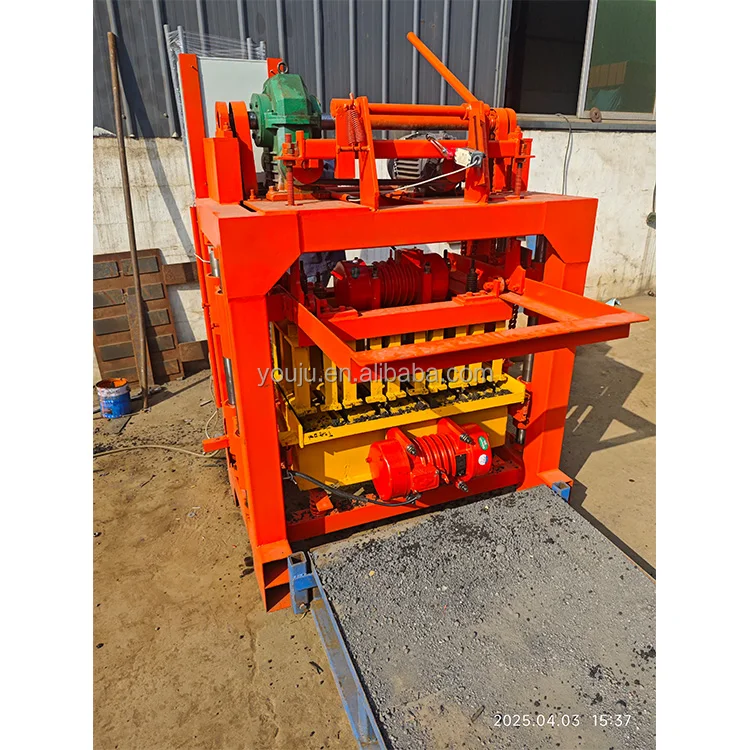
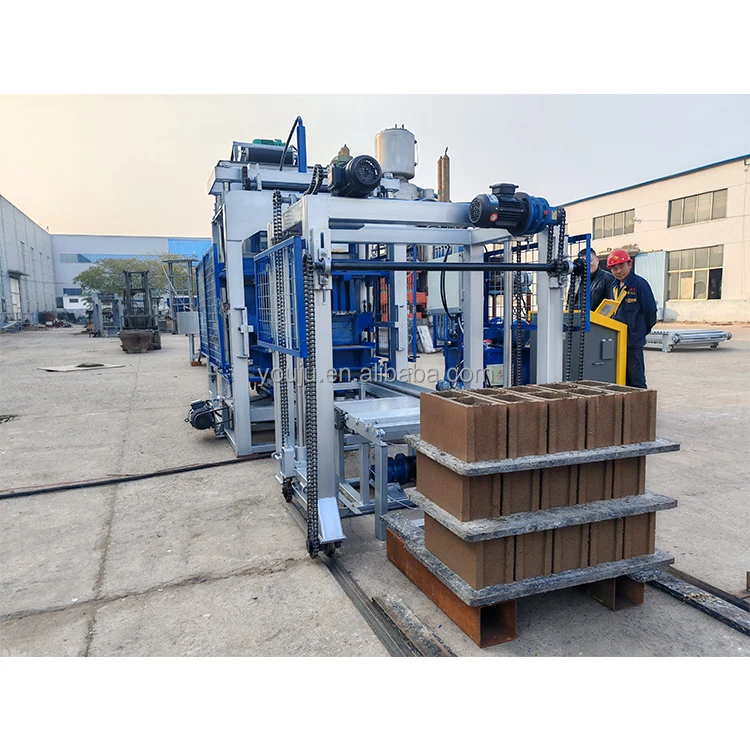
PLC-Driven Cycle Consistency — The QT4-18 block machine is configured as a matched system where press timing, pallet feeding, and stacking logic are locked into one PLC sequence, removing operator drift from the forming process.
Technical Specifications
| Parameter | Value |
|---|---|
| Model | QT4-18 |
| Product Type | Stationary Concrete Block Making Machine |
| Overall Dimensions | 3900×1600×2300 mm |
| Molding Cycle | 15–25 s |
| Vibration Force | 40–50 kN |
| Total Power | 24 kW |
| Mixer Model | JQ350 |
| Pallet Size | 850×550×25 mm |
| Total Weight | 3 T |
| Applied Products | Paver, solid block, hollow block, curbstone |
| Raw Materials | Crushed stones, sand, cement, dust, fly ash |
| Control System | PLC (basis not stated in source — confirm brand and language options) |
| Hydraulic Pressure | Basis not stated in source — confirm MPa rating |
| Voltage & Frequency | Basis not stated in source — confirm voltage, frequency and phase |
| Automation Level | Semi-automatic with automatic stacker option |
| Output Capacity | 1200–1680 pcs/hr based on 400×200×200 mm hollow block, 4 pcs/mould, 15–20 s cycle |
| Output Capacity | 1800–2400 pcs/hr based on 400×150×200 mm hollow block, 15–20 s cycle |
| Output Capacity | 3240 pcs/hr based on 240×115×53 mm solid brick, 15–20 s cycle |
| Mould Change Time | Basis not stated in source — confirm minutes per change |
| Assembly State | Basis not stated in source — confirm if shipped assembled or dismantled |
| Standards | Basis not stated in source — confirm CE or other certifications |
Application Suitability
| Application | Material or Output |
|---|---|
| Hollow block production for masonry walls | Crushed stone, sand, cement, fly ash mix on 850×550 mm pallets |
| Solid brick production for load-bearing structures | Cement and fine aggregate blend, 240×115×53 mm format |
| Paver production for walkways and yards | Dense aggregate mix with colour oxide, interlocking or rectangular formats |
| Curbstone production for road edging | High-cement-content mix, heavy-duty kerb profiles |
Why Cycle Repeatability Matters More Than Quoted Output
Capacity sheets often state a single pieces-per-hour number without naming the block format behind it — leaving buyers to discover the gap on their first production day.
The real output of any automatic QT4-18 block making machine depends on which mould is loaded, what the local aggregate allows, and whether upstream feeding keeps pace with the press cycle.
A 15–20 second cycle on a 400×200×200 mm hollow block yields a very different daily total than the same cycle on a small solid brick. When the PLC holds the cycle window steady, the variable shifts from operator timing to the physical limits of the mix and the pallet return speed. I have watched lines stall not because the press was slow, but because the curing rack handler could not accept pallets fast enough — creating a queue at the discharge end that forced the PLC to pause. [NEED_CITE: line balancing principles in concrete block production]
What the PLC Removes from the Operator
On a manual machine, the operator decides when to raise the upper mould, when to release vibration, and when to advance the pallet. Each decision drifts across a ten-hour shift as fatigue sets in. The PLC-controlled block machine replaces those decisions with fixed timing windows — vibration duration, compression stroke, and demoulding lift all execute within the same envelope every cycle.
This matters most when block strength is tied to density. If vibration runs two seconds short on one cycle and three seconds long on the next, the compacted height varies and the resulting blocks fail drop-test consistency. The automatic QT4-18 block making machine eliminates that scatter by holding each sub-step within a programmable tolerance band.
Where Automation Ends and the Line Begins
A PLC on the press alone does not make a line automatic. The stacker, pallet feeder, and mixer each have their own cycle time, and if those are not synchronised to the press output, the bottleneck simply moves downstream. I once saw a project in the Gulf where the press ran fine at its rated cycle, but the automatic stacker was set to a lift speed that could not match the pallet discharge rate — wet blocks piled at the transfer point and the operator had to intervene every few minutes.
We rewrote the timing ladder and adjusted the inverter parameters on the stacker motor so that pallet acceptance and stack descent were interlocked with the press discharge signal. The result was not a faster press, but a line that could run unattended for full shifts. [NEED_CITE: PLC interlock logic between block press and downstream handling]
Reading the Specs Against Your Actual Production
The 40–50 kN vibration force works in tandem with hydraulic compression to compact the mix into the mould cavity. Higher vibration alone does not guarantee stronger blocks — if the hydraulic pressure is insufficient to hold the upper mould against the vibration rebound, the mix liquefies rather than compacts. The two values must be evaluated together against your specific aggregate grading and cement ratio.
The 850×550×25 mm pallet size determines how many blocks form per cycle and what your curing area must accommodate. If your existing forklifts and curing racks are sized for a different pallet, the mismatch will surface on day one. The 24 kW total power draw requires a dedicated circuit with the correct voltage and frequency — a point that must be confirmed in writing before the machine enters production, because rewiring a control panel on site is both costly and delay-prone.
The Hidden Cost of Skipping the Automation Audit
Buying a PLC-controlled press and pairing it with manual pallet handling creates an island of automation that cannot deliver its full benefit. The press may hold its cycle perfectly, but if pallets are placed and removed by hand, the actual output depends on the slowest worker on the line. [NEED_CITE: labour allocation in semi-automatic block plants]
Equally, specifying the machine without confirming the PLC display language leads to commissioning delays — the operator cannot navigate fault menus in an unfamiliar script, and every alarm becomes a troubleshooting exercise. These are not machine defects; they are configuration gaps that surface only after the crate is opened.
Why This Configuration Approach Fits
Block machinery is our single focus, so the QT4-18 press, its moulds, pallets, and handling equipment are specified as one matched set rather than assembled from separate suppliers. The automation level is selectable — a buyer can commission in semi-automatic mode and add the automatic stacker and pallet feeder later without replacing the host machine.
Every configuration is set against the buyer’s actual mix design and local aggregate, not a catalogue default. Mould design covers the formats the buyer’s market actually sells, and custom mould drawings are available when standard profiles do not match. Voltage, frequency, and PLC language are confirmed before production begins, so the machine arrives ready to commission rather than waiting for an electrical retrofit.
Documentation & Verification
- Line layout and capacity calculation stating the block format assumed for each output figure
- Hydraulic and electrical schematic for local maintenance team reference
- PLC program logic diagram showing interlocks between press, stacker, and pallet feeder
- Factory test record on buyer’s specified block format before dispatch
- Voltage, frequency, and control language confirmation document signed before production
Installation, Commissioning & Support
- Foundation plan based on the 3900×1600 mm footprint and dynamic vibration load of the QT4-18
- Dedicated 24 kW circuit with confirmed voltage and frequency before cable termination
- Assembly state confirmed prior to shipment — dismantled or assembled depending on container loading plan
- PLC parameter set loaded and verified against buyer’s block format on first production run
- Operator training covering mould change procedure, fault menu navigation, and daily maintenance checkpoints
- Wear parts and mould list provided with recommended reorder intervals based on local aggregate abrasiveness
What to Include in Your Inquiry
To size the automation level correctly, share the block formats you currently sell and the daily volume each format requires. Confirm your site voltage, frequency, and preferred PLC display language so the control system is built to match. If you already operate a mixer, pallet system, or curing racks, provide their specifications so the QT4-18 can be integrated without creating a new bottleneck.
Frequently Asked Questions
Q: How do I verify real daily output for my specific block format?
A: Request a capacity calculation document that states the assumed block format, mould cavity count, and cycle time for each product. The QT4-18 produces 1200–1680 pieces per hour based on a 400×200×200 mm hollow block with a 15–20 second cycle, but switching to a paver or solid brick format changes both cavity count and cycle length. Daily output must be recalculated for each format you plan to run.
Q: What PLC details must be confirmed before production begins?
A: Voltage, frequency, phase, and PLC display language should all be agreed in writing before the machine enters assembly. The control system on the automatic QT4-18 block making machine is configurable, but changes after wiring are expensive and delay commissioning. Confirm whether the HMI text and alarm messages will appear in your operators’ working language.
Q: Where does semi-automatic end and full automation begin?
A: Semi-automatic operation means the PLC controls the press cycle but pallets are placed and removed manually. Adding an automatic stacker removes manual handling at the discharge end. Full automation extends to pallet feeding, stacking, and cubing — each station interlocked through the PLC so the line runs without manual pallet intervention between the mixer and the curing area.
Q: How long does a mould change take and what affects it?
A: Mould change time depends on the clamping system and operator familiarity. The QT4-18 supports hollow, solid, paver, and curbstone moulds on one host machine. If the change procedure is not documented and practised, a swap that should take minutes can consume most of a shift, negating the format flexibility the machine was purchased to provide.
Q: Can automation be added after the machine is installed?
A: Yes. The QT4-18 is designed with an upgrade path from semi-automatic to fully automatic stacking and cubing. The PLC architecture allows additional I/O modules and station interlocks to be added later. The mechanical interfaces for pallet feeders and stackers are included in the base frame so retrofitting does not require structural modification.