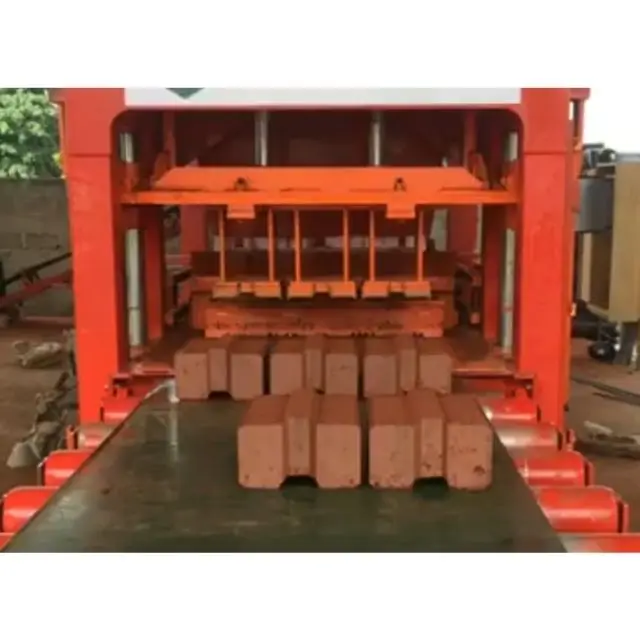


Description
Single-Focus System Matching — the LY4-10 press, moulds, pallets and PLC parameters are specified together against your clay mix, not assembled from disconnected suppliers.
Technical Specifications
| Parameter | Value |
|---|---|
| Model | LY4-10 |
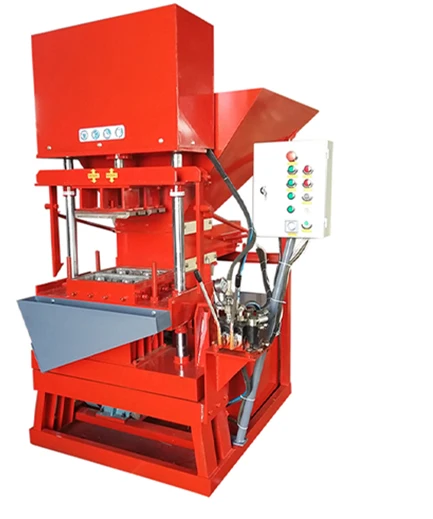
| Product Type | Automatic Soil Clay Interlocking Brick Making Machine |
| Control System | PLC controlled |
| Overall Dimensions (L×W×H) | 1600 × 1400 × 2100 mm |
| Net Weight | 1600 kg |
| Rated Power | 11 kW |
| Hydraulic Oil Capacity | 70 L anti-wear hydraulic oil |
| Mixer Gearbox Oil Capacity | 15 kg |
| Molding Cycle | 10 s (basis not stated — confirm block format and mix) |
| Output Capacity | 11,520 pcs/day (basis not stated — confirm format and shift hours) |
| Bricks per Cycle | 4 pcs (dependent on mould) |
| Hydraulic System | Integrated, maintains brick density and strength |
| Brick Height Adjustment | Adjustable via screws |
| Mould Change | Interchangeable moulds per customer format requirements |
| Basic Equipment | JQ350 concrete mixer, 6 m conveyor belt |
| Raw Materials | Clay, soil, cement or construction dregs |
| Voltage & Frequency | To be confirmed before order |
| PLC Display Language | To be confirmed before order |
Application Suitability
| Application | Material or Output |
|---|---|
| Interlocking brick production for housing projects | Local clay or soil blended with cement |
| On-site block making for remote construction | Soil excavated from the building site itself |
| Small-plant interlocking paver production | Clay-cement mix designs with local aggregate |
| Format diversification for existing brick makers | Swappable moulds for different interlocking profiles |
What the PLC Actually Removes From Your Operator’s Shoulders
Consistent cycle timing and pressing force, brick after brick, without the operator adjusting anything mid-shift.
Many semi-automatic clay brick lines still rely on the operator to judge when the mould is full, when to trigger the press, and when to release. That judgment drifts over a long shift, especially in hot climates where fatigue sets in early. The result is density variation you only discover when blocks break during curing or transport. With the LY4-10 automatic interlocking clay brick making machine PLC controlled, the sequence is locked in software — fill time, vibration duration, hydraulic pressure hold, and release all execute identically every cycle [NEED_CITE: PLC cycle repeatability standards in block forming equipment].
Removing Human Timing Drift From the Molding Cycle
The PLC governs the entire 10-second cycle sequence once the parameters are set for your specific interlocking format. Fill, vibrate, press, hold, release — each step runs for the programmed duration regardless of operator speed or fatigue. For a plant owner moving away from manual or relay-controlled presses, this is where batch-to-batch consistency actually originates. The automatic interlocking clay brick making machine PLC controlled sequence means your morning bricks and your afternoon bricks carry the same density.
Single-Operator Management Under Automated Control
The control panel consolidates start-stop, cycle parameters, and fault indication into one interface. One operator can manage the mixer feed, monitor the PLC display, and pull finished interlocking bricks from the mould station without juggling separate relay switches or manual valves. This matters on remote project sites where skilled electricians are not standing by — if the PLC flags a fault code, the operator reads it directly rather than tracing relay logic [NEED_CITE: on-site block production labour configurations in developing markets].
Reading the Press Parameters Before the Mix Parameters
The hydraulic system on the LY4-10 delivers consistent pressing force across every cycle, but the actual brick density depends on how that force interacts with your specific clay-cement ratio and moisture content. The PLC controls the hold time and pressure application, yet the mix design determines whether that pressure produces a sound interlocking brick or a cracked one. I spent three days in Colombia adjusting hydraulic pressure and vibration frequency on a clay interlocking line because the local red soil was far stickier than our test samples — the PLC ran perfectly, but the material fought back. That is why we ask every buyer to send a two-kilogram soil sample before we finalize the PLC parameters and hydraulic settings. The mould cavity depth, vibration frequency, and pressing sequence all need tuning to your actual clay, not a generic default.
What Wrong PLC Parameters Cost You Downstream
When the PLC display language is not confirmed before shipment, the operator on site cannot read fault codes or adjust cycle timing without calling someone who understands the original language. When voltage and frequency do not match the local supply, the PLC may power on but the hydraulic solenoids behave erratically, producing inconsistent pressing force that shows up as variable brick strength. These are not machine defects — they are configuration gaps that surface only after the line is installed [NEED_CITE: voltage and frequency mismatch incidents in exported machinery].
Why Source This Machine Through a Single-Focus Block Line Supplier
Block machinery is our sole product line, so the LY4-10 press, its moulds, the JQ350 mixer, and the conveyor are specified as one system rather than bolted together from separate catalogues. We configure the PLC parameters against your actual clay sample and target interlocking format, not a factory default. Mould design covers the interlocking profiles your market actually sells, with custom drawings when standard profiles do not match. The automation level is selectable — start with the PLC-controlled press and add pallet feeding or stacking automation later as your plant grows.
Documentation & Verification
- PLC parameter sheet listing cycle timing for your confirmed interlocking brick format
- Hydraulic and electrical schematics matched to your site voltage and frequency
- Factory test record using your soil sample before dispatch
- Voltage, frequency, and PLC display language confirmation document before production
- Operation and maintenance manual with PLC fault code reference list
- Wear parts and mould interchangeability list
Installation, Commissioning & Support
- Foundation pad sized to the 1600 × 1400 mm footprint with anchor bolt template
- Dedicated 11 kW circuit at your confirmed voltage and frequency for clean PLC power
- Hydraulic station filled with 70 L anti-wear oil and bled on site before first cycle
- PLC parameters loaded and verified against your clay mix during commissioning
- Operator training on PLC display navigation, fault codes, and cycle adjustment
- Mould change procedure and hydraulic seal replacement schedule covered on site
What We Need From You to Configure the Line Correctly
Send a two-kilogram sample of the clay or soil you plan to use, along with the specific interlocking brick profile and dimensions your market demands. Confirm your site voltage, frequency, and phase configuration so we match the electrical system before production begins. Let us know the PLC display language your operators need, and whether you plan to run the LY4-10 standalone or integrate it with existing mixing and curing infrastructure.
Frequently Asked Questions
Q: What PLC brand and display languages are available, and can the interface be set to my local language before shipment?
A: The PLC brand and available display languages are confirmed during the inquiry stage based on your preference and local support availability. We program the interface in your requested language before the machine leaves our factory, so your operators can read cycle parameters and fault codes from day one without translation delays.
Q: How is the daily output figure calculated — which interlocking brick format and wall thickness does it assume?
A: The 11,520 pieces per day figure depends on the specific interlocking brick format, mould cavity count, and shift hours assumed. We provide a capacity calculation that states the exact brick dimensions and cycle count per shift for your chosen mould, so the output number reflects your actual product rather than a catalogue generalization.
Q: What voltage, frequency, and phase configuration does the LY4-10 require, and is this confirmed before production?
A: Voltage and frequency are not fixed defaults — they are confirmed against your site electrical supply before production starts. We document the agreed voltage, phase, and frequency in writing, then configure the motor, hydraulic pump, and PLC power supply to match, preventing commissioning delays when the machine arrives.
Q: Can the automation level be upgraded later — for example, adding automatic pallet feeding or stacking?
A: The LY4-10 is designed so that pallet handling and stacking automation can be added as separate stations connected to the existing PLC. If you start with manual pallet placement, the control system supports future integration of feeding and stacking modules without replacing the press or rewriting the base program.
Q: What remote diagnostics or parameter adjustment capabilities does the PLC support after commissioning?
A: The PLC retains adjustable parameters for cycle timing, vibration duration, and hydraulic hold pressure, allowing fine-tuning as your clay mix or brick format evolves. Remote diagnostics capability depends on the PLC brand selected — we discuss connectivity options during configuration so post-commissioning support matches your site conditions.