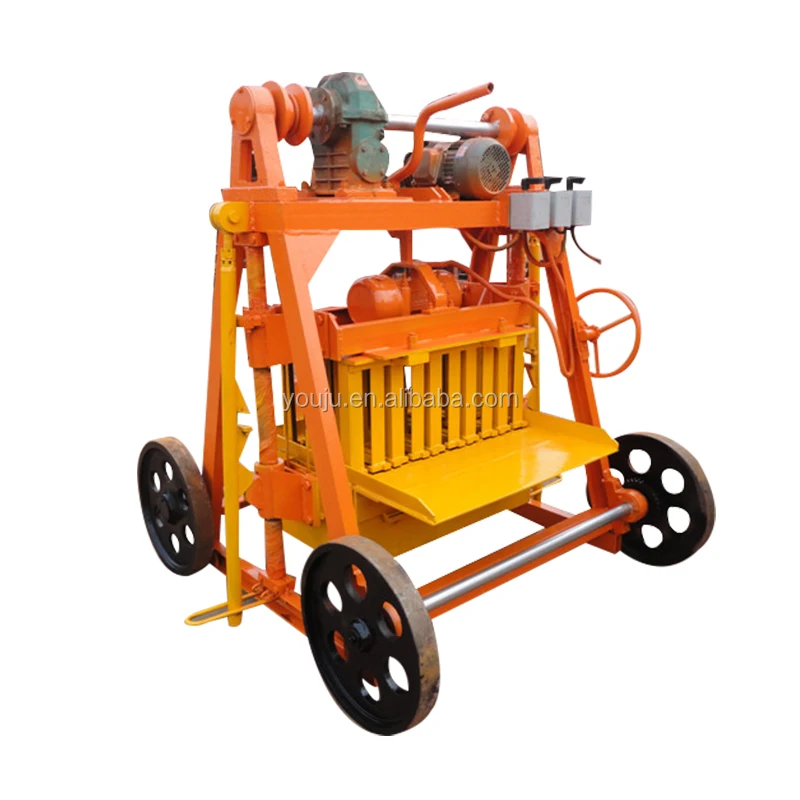
Description
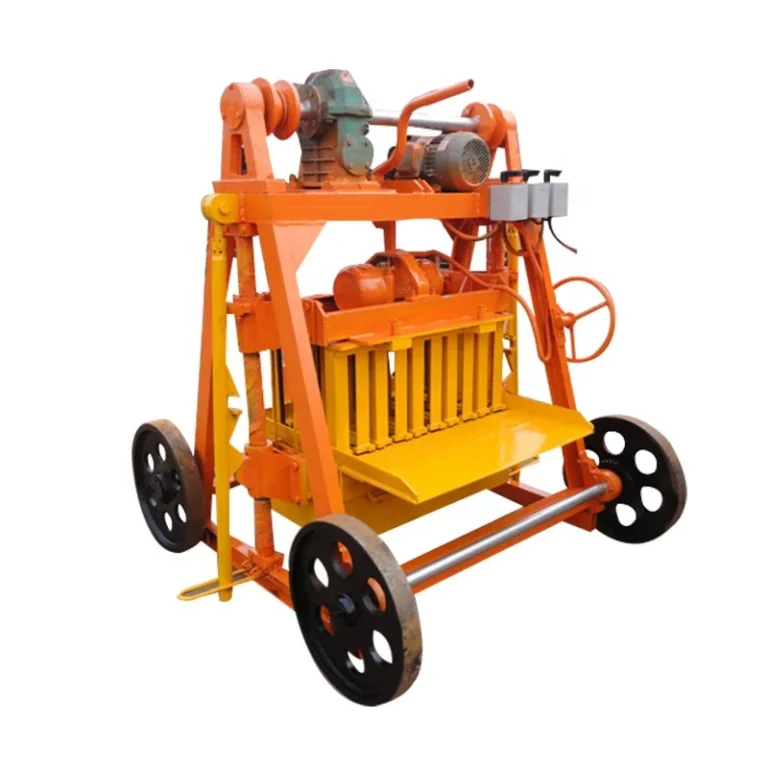
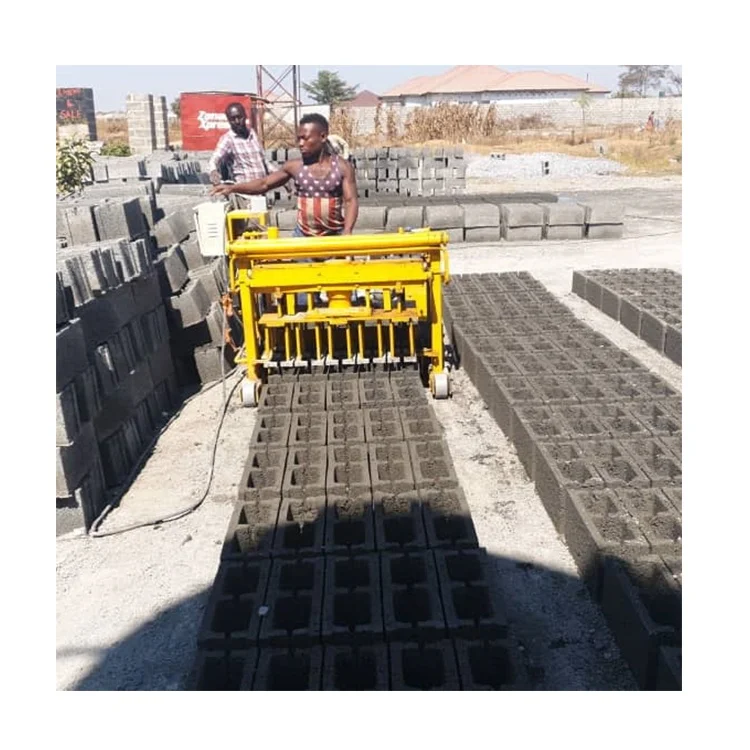
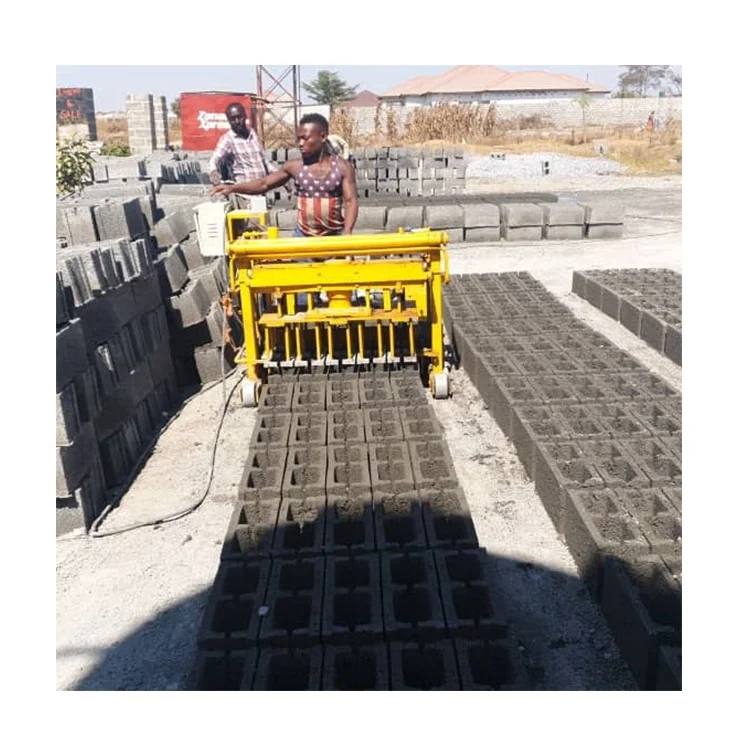
Engine-Powered Consistency — the QMJ4-45 mobile egg laying block machine pairs a diesel or petrol power source with a twice-vibration molding core, so off-grid block production keeps density and cycle timing under control rather than leaving both to operator habit.
Technical Specifications
| Parameter | Value |
|---|---|
| Model | QMJ4-45 |
| Product Type | Mobile Egg Laying Block Making Machine |
| Molding Capacity | 4 pcs/mold (basis: 400×200×200mm hollow block) |
| Vibration Frequency | 2400 r/m |
| Productivity (400×200×200mm hollow block) | 3000 pcs/day (8 hours) |
| Productivity (400×150×200mm hollow block) | 3500 pcs/day (8 hours) |
| Productivity (400×120×200mm hollow block) | 4500 pcs/day (8 hours) |
| Molding Cycle | 45 s |
| Vibration Type | Twice-vibration of molding core |
| Hydraulic Method | Mold vibration |
| Demold Method | Manual |
| Turning Method | Manual |
| Total Power | 6 kW |
| Power Resource | Diesel/Petrol engine |
| Automation Level | Manual operation, egg laying (pallet-free) |
| Pallet Requirement | None |
| Warranty | One year for the whole machine |
| Certification | CE |
Application Suitability
| Application | Material or Output |
|---|---|
| On-site hollow block production for housing projects | Cement, crushed stone, river sand or manufactured sand |
| Remote construction sites without grid electricity | Diesel- or petrol-powered operation, no fixed plant required |
| Small-scale entrepreneur block yards | Hollow blocks, multicellular bricks, standard bricks |
| Contractor-run temporary block production | Paving bricks and solid blocks laid directly on prepared ground |
What "3000 Blocks per Day" Actually Means on a Remote Site
Output figures only hold when the block format, mix design, and cycle timing stay exactly as tested — and on a mobile site, that is the first thing to drift.
When I was setting up block production for a housing contractor in Cambodia, we ran a QMJ4-45 mobile block machine on paper at 3000 hollow blocks per shift. The local river sand carried a clay content well above what the test samples showed, which doubled the vibration time needed to reach acceptable density. Daily output dropped sharply, the masonry crew ran out of blocks mid-week, and the whole construction sequence slipped. The lesson was not about the machine itself; it was about assuming a catalog number survives contact with local aggregate. Every automatic mobile block machine quote should state which format and which mix the capacity figure rests on [NEED_CITE: mix design impact on vibration cycle and block density].
How Engine Power Changes the Control Conversation
A diesel or petrol engine removes the voltage and frequency questions that delay commissioning on grid-powered equipment, but it introduces a different variable: throttle response. The twice-vibration molding core on this PLC controlled egg laying block machine depends on a steady rotational speed to deliver consistent density from the first block of the morning to the last. If the engine governor cannot hold rpm under the load spike of each mold cycle, vibration frequency drifts and block strength varies along the laying path. Specifying engine horsepower and fuel type against local ambient temperature and altitude is therefore part of the control discussion, not an afterthought.
Where Manual Operation Ends and Automation Begins
The QMJ4-45 ships as a manual egg laying unit — the operator controls feed, vibration start and stop, and demold. That baseline is deliberate: it keeps the machine affordable for a first-time block yard and strips the line down to a single moving press with no pallets, no curing racks, and no stacking station to maintain. When volume grows or labor availability tightens, the same 45-second molding cycle becomes the anchor point for adding controlled dosing, timed vibration, and eventually a PLC interface. The upgrade path works because the mechanical cycle is already fixed; what changes is who or what triggers each step.
Reading the Numbers Behind the Molding Cycle
The 45-second cycle, 2400 r/m vibration frequency, and 4 pcs per mold together define the realistic output envelope of this automatic mobile block machine. Four blocks per mold at a 45-second cycle yields a theoretical maximum that the published daily figures — 3000 for 400×200×200mm hollow blocks, 3500 for 400×150×200mm, 4500 for 400×120×200mm — already discount for loading, repositioning, and operator pace across an 8-hour shift. The twice-vibration system fires the molding core in two passes rather than one, which improves particle settlement in taller block formats where a single vibration pass leaves density gradients between the face and the core [NEED_CITE: vibration compaction principles in concrete block molding]. Total power at 6 kW covers the vibrator motor and any auxiliary feed motor, while the main motive force comes from the engine, keeping electrical demand within the reach of a small portable generator if site power is needed for lighting or a mixer.
The Cost of Skipping the Raw Material Sample
Sending a bag of local aggregate before the machine ships feels like an unnecessary delay when a project deadline is pressing. Skipping that step is how a contractor ends up with a PLC controlled egg laying block machine tuned for clean quartz sand while the site only has high-clay river sand available. The vibration time stretches, the engine works harder to hold rpm, fuel consumption climbs, and block-to-block weight variation shows up as inconsistent compressive strength once the masonry crew starts laying. The rework cost on a housing project — demolished walls, rejected batches, idle bricklayers — lands well above the freight cost of a sample bag sent two weeks earlier [NEED_CITE: aggregate variation and concrete block compressive strength testing].
Why This Sourcing Approach Fits Mobile Block Production
Block machinery is the only product line here, so the QMJ4-45 arrives as a matched unit — engine, vibrator, mold, and manual controls specified together rather than assembled from separate suppliers. The configuration conversation starts with the buyer’s actual block format, local aggregate, and site conditions instead of a default catalog entry. Molds for the formats the buyer’s market actually sells are designed and supplied in-house, including custom drawings when a housing project specifies a non-standard wall thickness. Automation level is selectable, so a buyer can commission the machine as a fully manual egg layer and add dosing or PLC control later without replacing the press. Installation support covers engine commissioning, vibration timing calibration, and operator training on the specific mix the yard will run.
Documentation & Verification
- Machine specification sheet listing engine model, vibration frequency, and cycle time per block format
- Capacity calculation stating the exact block format and mix assumed for each daily output figure
- Mold drawing and format list covering hollow, solid, paving, and multicellular brick options
- Hydraulic and electrical schematic for any auxiliary dosing or control components added to the base unit
- Voltage and control language confirmation when electric auxiliaries are included
- Factory test record run on buyer-supplied aggregate sample before dispatch
Installation, Commissioning & Support
- Prepared ground surface required — no fixed foundation, but the laying path must be level within tolerance for consistent block height
- Diesel or petrol engine commissioning includes throttle calibration to hold 2400 r/m under mold vibration load
- First-day production run verifies 45-second cycle timing with the buyer’s actual mix and aggregate source
- Operator training covers manual feed technique, vibration trigger discipline, and mold release timing
- Wear parts list and mold maintenance schedule provided at handover for the specific formats ordered
- One-year warranty covers the full machine including engine mount, vibrator assembly, and mold set
Before You Request a Quote
Send the block format your market sells most, the local aggregate type with a sample if possible, and whether diesel or petrol fuel is easier to source on your project sites. If you plan to add batching or dosing automation later, note the control language and any auxiliary voltage requirement so the wiring route is reserved during initial assembly.
Frequently Asked Questions
Q: Which block format does the daily output figure assume?
A: Each output number in the specification table is tied to a specific format: 3000 pieces per 8-hour day for 400×200×200mm hollow blocks, 3500 for 400×150×200mm, and 4500 for 400×120×200mm. These figures assume the 45-second cycle holds consistently and the mix design matches the tested aggregate. Confirm your primary format before comparing machines.
Q: Can the QMJ4-45 be upgraded from manual to semi-automatic later?
A: Yes. The fixed 45-second molding cycle provides a stable timing anchor for adding controlled dosing, timed vibration triggers, and eventually a PLC interface. Because the egg laying design eliminates pallets and curing racks, the upgrade focuses on the feed and vibration sequence rather than rebuilding the entire line.
Q: How do I choose between diesel and petrol engine power?
A: The choice depends on local fuel availability, ambient temperature, and altitude at your project sites. Diesel engines generally hold rpm more steadily under the cyclic load of vibration molding, while petrol units may suit smaller yards with existing petrol supply chains. Specify the engine type during the quotation stage so the mount and throttle linkage are matched.
Q: What control system is included if I add dosing automation later?
A: When dosing or batching automation is added, a PLC controls feed timing and vibration duration, with the operator interface language confirmed before assembly. The base QMJ4-45 ships without a PLC, so the control panel layout and wiring route are planned during the initial build to accept the upgrade without structural modification.
Q: How does twice-vibration improve block consistency?
A: The molding core fires in two vibration passes rather than one, which allows concrete particles to settle more uniformly through the full height of the mold cavity. This reduces density gradients between the block face and its internal webs, producing more consistent compressive strength across the day’s output — especially noticeable in taller hollow block formats.