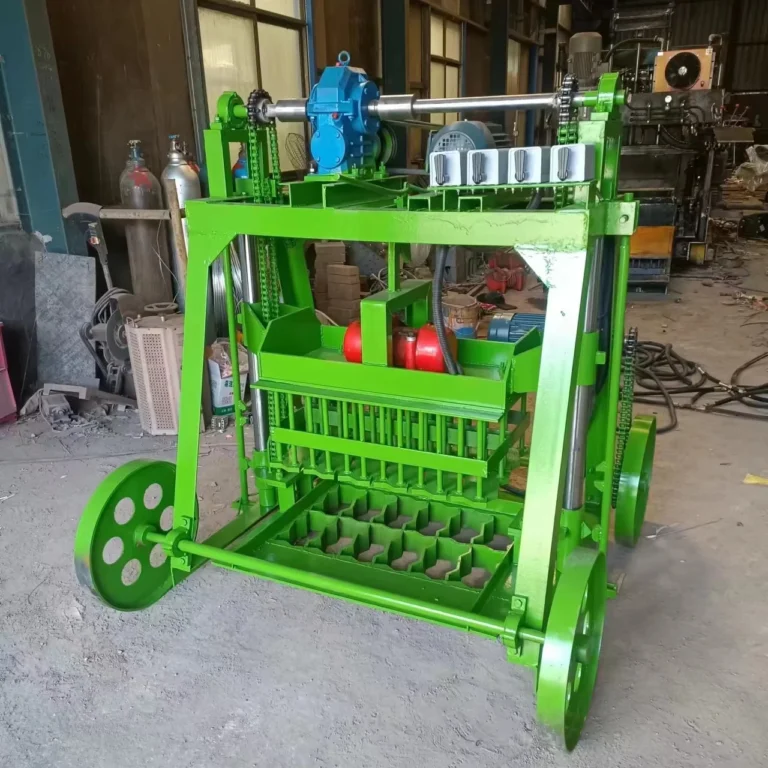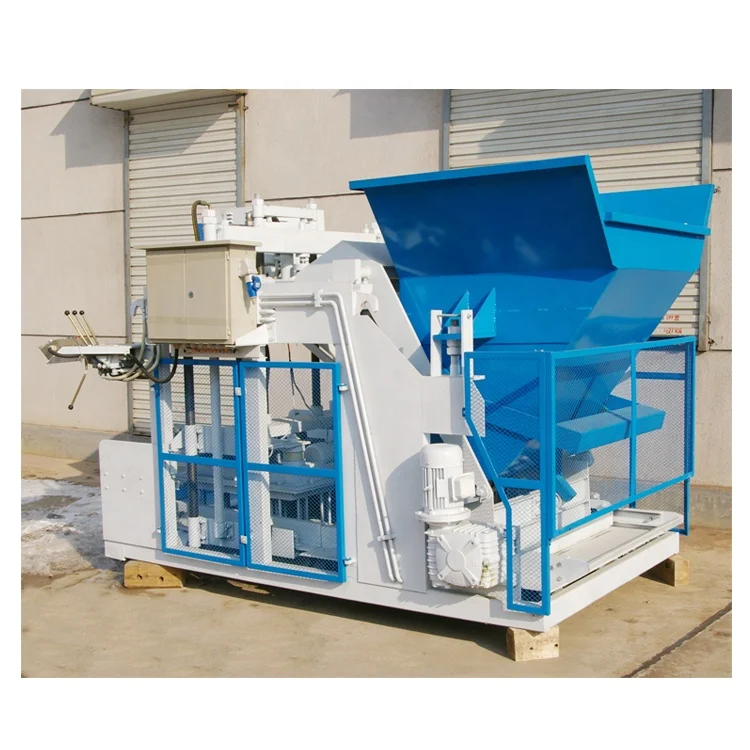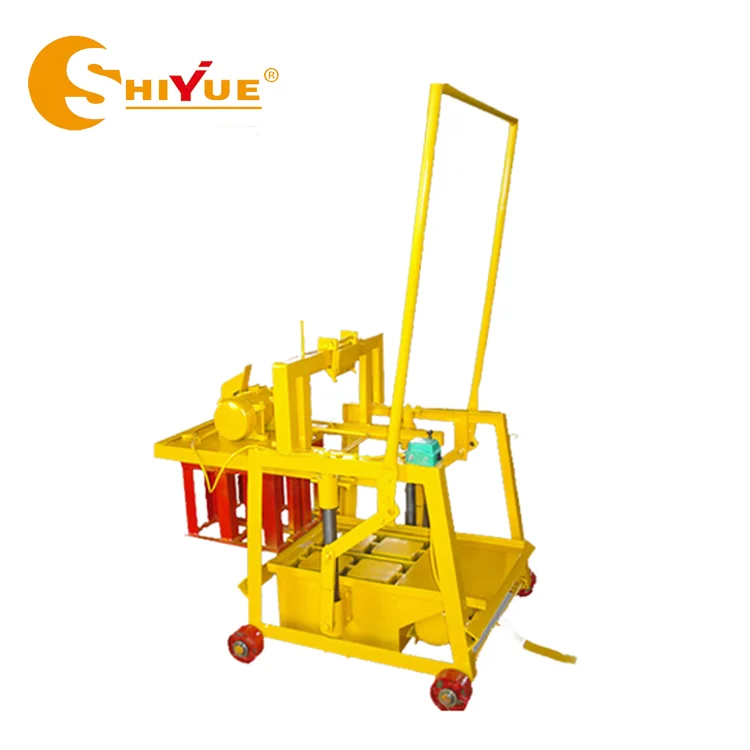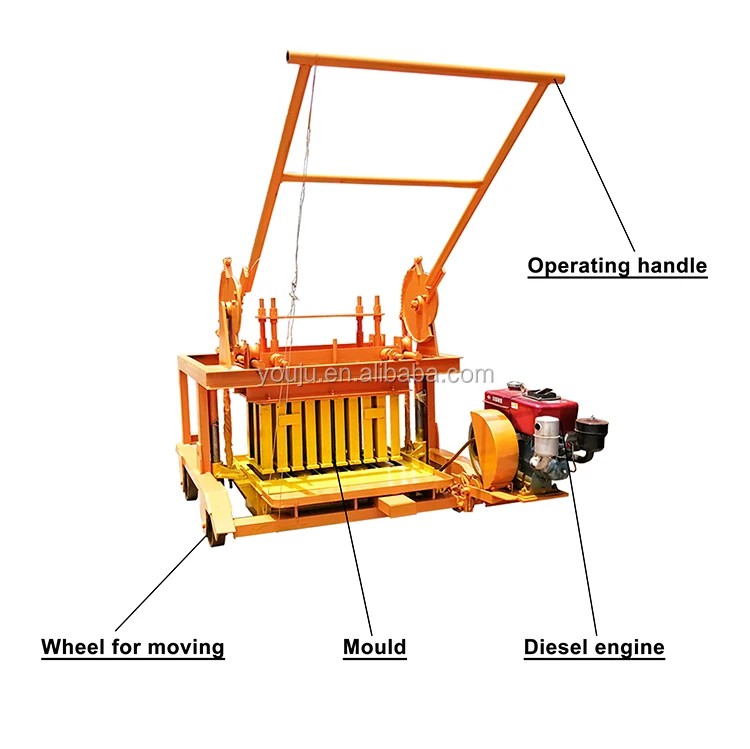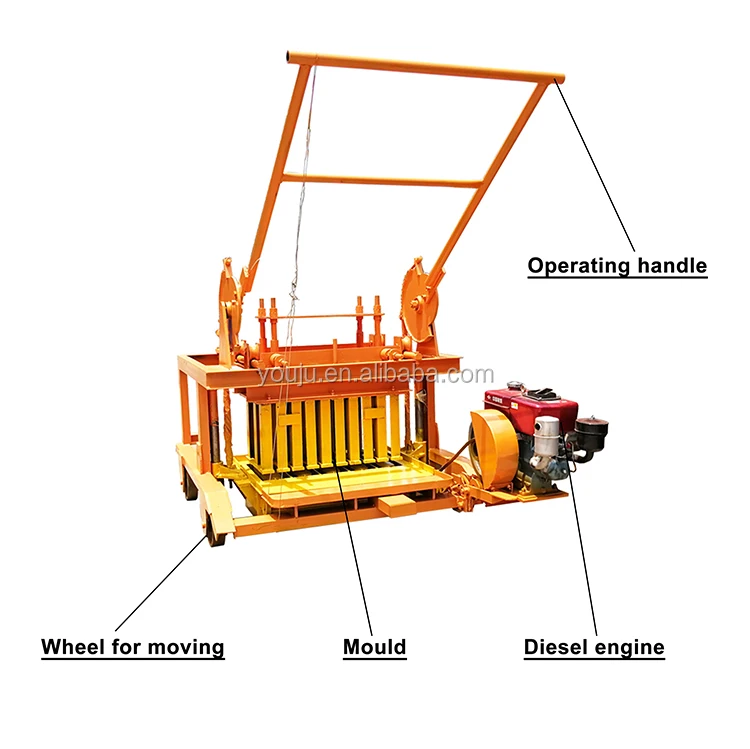


Description
Diesel-Powered Control — The QMR4-45 mobile egg-laying block machine pairs off-grid hydraulic operation with configurable control interfaces, ensuring operators read every fault code in their own language before the first block is laid.
Technical Specifications
| Parameter | Value |
|---|---|
| Model | QMR4-45 |
| Product Type | Mobile Egg-Laying Concrete Block Making Machine |
| Overall Dimensions (L×W×H) | 2420×1320×1650mm |
| Net Weight | 810kg |
| Power Source | Diesel engine, 6kW (6-8HP) |
| Voltage (auxiliary circuits) | 220V / 380V / configurable to local supply |
| Moulding Cycle | 40–45s per mould |
| Pallet Requirement | None (egg-laying type) |
| Output Capacity | Up to 3000 pcs/day based on 400×200×200mm hollow block (8-hour shift) |
| Mould Formats (standard) | 400×200×200mm (4 pcs/mould), 400×150×200mm (5 pcs/mould), 400×120×200mm (6 pcs/mould) |
| Control System | Available with manual switches or optional PLC with HMI |
| Assembly State | Single mobile unit, site-repositionable |
| Standards | CE |
Application Suitability
| Application | Material or Output |
|---|---|
| Remote construction sites without reliable grid power | Diesel-driven hollow block production on freshly poured concrete slabs |
| Contractor self-supply on housing developments | 400×200×200mm and 400×150×200mm hollow blocks from local crushed aggregate and cement |
| Small-scale block entrepreneurs starting production | 400×120×200mm hollow blocks with minimal infrastructure investment |
| Disaster-relief or temporary infrastructure projects | Rapid deployment block laying directly on prepared ground |
What "Automatic" Means When the Operator Cannot Read the Screen
Automation is only automatic if the interface speaks the operator’s language.
A mobile block machine can be the right answer for a site with no grid connection, but when the control panel displays fault codes in a language the crew does not read, commissioning stalls before the first block cures. I have stood beside a QMR4-45 diesel mobile egg-laying block machine on a project site where the foreman spent the entire morning pressing buttons he could not label, because the HMI defaulted to Chinese [NEED_CITE: HMI language localisation standards for exported machinery]. The output that day was zero — not because the hydraulics failed, but because the operator could not acknowledge a simple proximity-sensor alarm.
Removing the Language Barrier Before the Crate Closes
The automatic mobile block machine must ship with its HMI, push-button legends and operator manual all set to the buyer’s site language. On a PLC-controlled egg-laying block machine, this means locking the display dictionary, the fault-message library and the alarm-tone labels before the electrical panel is sealed. Voltage and frequency confirmation alone is not enough; the vocabulary the operator sees under stress is what determines whether a sensor fault is cleared in thirty seconds or thirty minutes.
Consistency That Does Not Depend on the Operator’s Memory
An egg-laying machine deposits blocks on the ground, so cycle discipline rests entirely on the operator watching the timer. A PLC-controlled egg-laying block machine removes that variable: the moulding cycle advances only when the vibration window, hydraulic settle time and travel distance all fall inside the programmed tolerance. Batch-to-batch block density then depends on the mix, not on how hurried the crew is before lunch [NEED_CITE: process-control requirements for concrete product consistency].
Reading the Numbers That Actually Shape Block Quality
The 6 kW diesel power unit must deliver enough hydraulic flow to reach full mould-fill pressure within the 40–45 second window; undersized pumps stretch the cycle and leave voids in the block web. Mould format matters as much as cycle time — four blocks per mould at 400×200×200mm versus six at 400×120×200mm shifts daily volume by a third, so capacity claims that ignore format are meaningless. The 810 kg net weight and 2420×1320 mm footprint let the unit roll on existing slabs, but every repositioning still requires a flat, cured concrete surface to avoid tilting the freshly laid block. Auxiliary voltage at 220 V or 380 V feeds only the vibrator and controls, yet a mismatched frequency will drop vibrator amplitude and cut block strength.
The Cost of Skipping the Control Conversation
Buyers who treat the control panel as an afterthought arrive on site to discover that mould-change instructions are embedded in a menu tree the operator cannot navigate, turning a feature that should take minutes into a half-shift project. Remote diagnostics also fail when the GSM module sends SMS alerts in a character set the local phone cannot render [NEED_CITE: cross-border telemetry character-encoding issues]. The machine sits idle while the site manager waits for an overseas video call at a time zone that does not overlap with the shift.
Why the Control Conversation Happens Here
Every QMR4-45 that leaves the workshop ships with a language and voltage confirmation sheet signed by the buyer, so the HMI dictionary matches the operator’s native terms. The PLC logic, where fitted, is tested against the buyer’s specific block format and cycle time, not a catalogue default. Moulds are supplied with dimensional drawings that match the PLC’s format library, so the operator selects the right programme with one touch. Factory test records include an electrical-load printout showing voltage, frequency and control language side by side. Spare-part lists cross-reference the exact PLC I/O map, so a replacement sensor is ordered by signal address, not by guesswork.
Documentation & Verification
- Electrical schematic showing diesel hydraulic circuit and auxiliary voltage taps
- PLC I/O map with signal labels in buyer’s confirmed language
- Factory test record covering 40–45 s cycle across all supplied mould formats
- Mould dimensional drawing matched to PLC format library entries
- CE declaration referencing machinery directive compliance for export
- Packing photographs of control panel with language label visible
Installation, Commissioning & Support
- Site must provide cured concrete floor, level to 5 mm over 2 m, for egg-laying travel
- Diesel fuel specification confirmed with buyer before first hydraulic pump run-in
- Auxiliary 220 V / 380 V circuit checked against control transformer rating plate
- HMI language and alarm dictionary verified with operator on commissioning day
- Mould changeover procedure trained against PLC format library, timed on site
- Wear-part list cross-referenced to PLC I/O addresses for fast re-order
What to Tell Us Before You Request a Quote
Send the exact hollow block dimension your market sells, the local aggregate type and cement grade, and the site altitude so the diesel engine can be tuned for air density. Confirm the auxiliary voltage, frequency and the language your operators speak, including any regional script requirements. If you plan to run multiple mould formats, list them so the PLC format library and hydraulic pressure table are built before the machine ships.
Frequently Asked Questions
Q: How is daily output verified per block format, and what mix design is assumed?
A: The capacity table states pieces per eight-hour shift for each of the three standard hollow block formats, assuming a conventional crushed-stone and cement mix at typical moisture. If your aggregate is lightweight or high-clay, a trial run adjusts the vibration window and hydraulic settle time before the final cycle figure is locked.
Q: Can the diesel engine be replaced with an electric motor later?
A: The hydraulic pump mount is dimensioned for both the 6 kW diesel unit and an equivalent electric motor. Swapping later requires only a motor, coupling and a confirmed three-phase supply at the site voltage; the mould and control logic remain unchanged.
Q: What automation options can be added to this mobile unit?
A: A PLC with HMI can replace manual push-buttons, adding cycle interlocks and fault logging. Automatic batching is possible if a stationary mixer feeds the machine, but the egg-laying travel function remains manual to preserve site mobility.
Q: How are voltage, control language and documentation confirmed before shipment?
A: A signed confirmation sheet records auxiliary voltage, frequency, HMI language and manual language. The factory test includes an electrical-load printout and a photograph of the control panel displaying the confirmed language before the crate is closed.