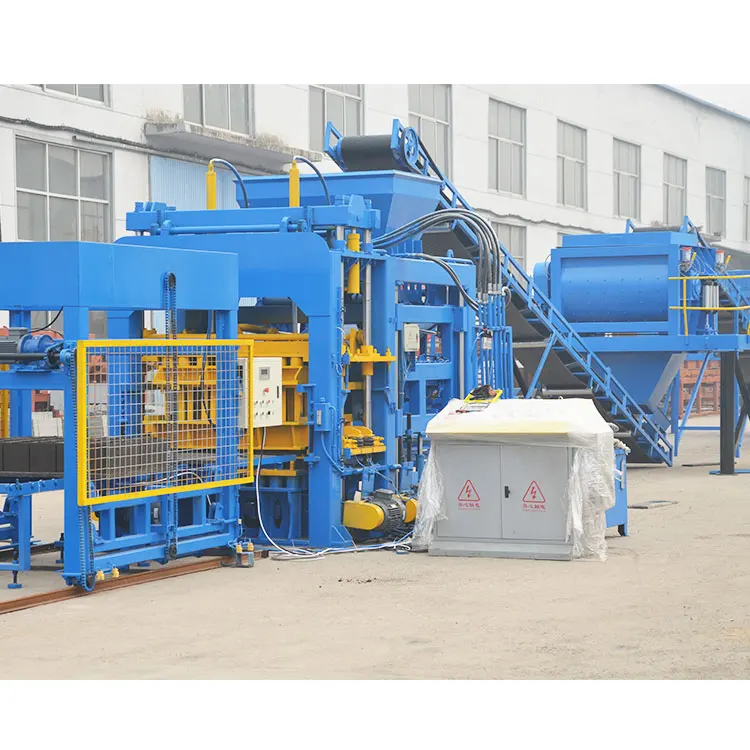
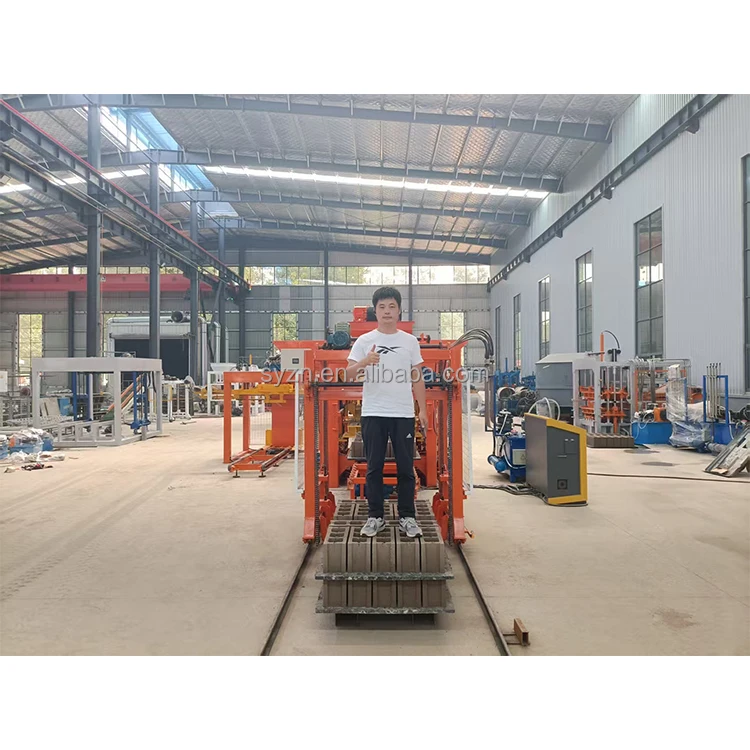


Description
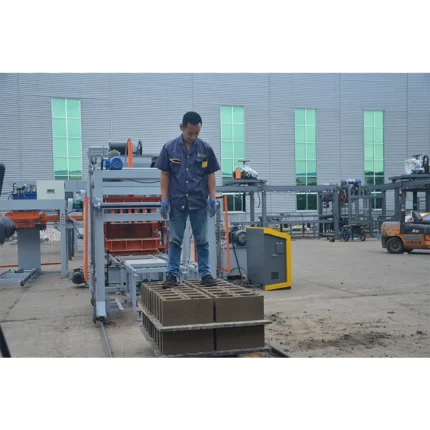
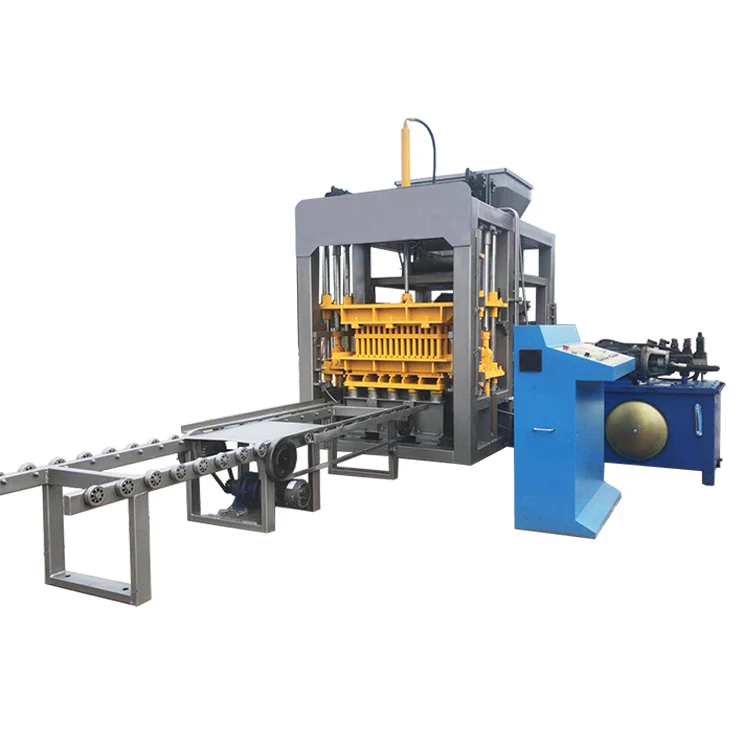
Matched Platform Vibration — the QT6-15 pairs 16–21 MPa hydraulic pressure with platform vibration governed entirely by PLC logic, removing operator pace from the consistency equation.
Technical Specifications
| Parameter | Value |
|---|---|
| Model | QT6-15 |
| Product Type | Automatic Concrete Block Making Machine |
| Rated Power | 31.25 kW |
| Voltage & Frequency | According to buyer local supply (basis to be confirmed) |
| Control System | PLC controlled (HMI language options to be confirmed) |
| Overall Dimensions (L×W×H) | 7100 × 1500 × 3000 mm |
| Net Weight | 8500 kg |
| Pallet Size | 850 × 680 mm |
| Main Vibration Form | Platform vibration |
| Hydraulic Pressure | 16–21 MPa |
| Mould Change System | Replaceable moulds for hollow, solid, porous, paver, interlocking and curbstone formats |
| Cycle Time (Hollow 400×200×200 mm) | 16–20 s |
| Cycle Time (Porous 240×115×90 mm) | 15–18 s |
| Cycle Time (Standard 240×115×53 mm) | 14–17 s |
| Output Capacity (Hollow 400×200×200 mm, 6 pcs/mould) | 8,640 pcs/day |
| Output Capacity (Porous 240×115×90 mm, 14 pcs/mould) | 22,400 pcs/day |
| Output Capacity (Standard 240×115×53 mm, 30 pcs/mould) | 54,400 pcs/day |
| Automation Level | Automatic (pallet handling, stacking and cubing scope to be confirmed) |
| Raw Materials | Crushed stone, sand, cement, dust, fly ash, gravel, slag |
| Mould Heat Treatment | Yes |
Application Suitability
| Application | Material or Output |
|---|---|
| Fixed block production plants | Hollow and solid blocks from crushed stone, sand and cement |
| Paver and curbstone manufacturing | Interlocking pavers and curbstones using fly ash or gravel mixes |
| Concrete product range expansion | Porous bricks and standard bricks on a single press platform |
| Housing project on-site production | Multiple block formats from locally sourced aggregate and cement |
| First automatic plant setup | Semi-automatic start with PLC-controlled upgrade path |
What the PLC Actually Controls on an Automatic Block Making Machine
Automation means different things on different lines, so the first question is where the PLC stops and manual work begins.
When a buyer sees "automatic" on an automatic block making machine PLC controlled specification sheet, the assumption is often that pallets feed in, blocks stack out, and curing racks move without anyone touching them. In reality, the automation scope varies considerably between quotations. Some lines automate only the press cycle and pallet indexing inside the machine, leaving stacking and curing rack handling to manual labour at the end of the line. Others extend PLC control through to the cuber and rack return conveyor. The gap between what a buyer expects and what the quotation covers is where most commissioning disputes start [NEED_CITE: typical automation scope gaps in block plant quotations].
Where PLC Logic Replaces Operator Judgement
On the QT6-15, the PLC governs the vibration duration, hydraulic pressure ramp and cycle timing for each block format. This matters because platform vibration at 16–21 MPa hydraulic pressure needs to be held for a precise number of seconds depending on whether the mould is producing a 400×200×200 mm hollow block or a 240×115×53 mm standard brick. An operator running the press manually will naturally drift — a few seconds shorter on one cycle, a slight pressure variation on the next. The automatic block making machine PLC controlled cycle removes that drift, which is where batch-to-batch density consistency actually comes from.
The Stations That Determine Your Real Labour Cost
Beyond the press itself, the stations that most affect daily labour are pallet feeding, green block stacking and curing rack handling. If the quotation covers only the press and pallet return inside the machine, you will still need workers at the stacking end moving loaded pallets onto curing racks and later returning empty pallets to the feed magazine. Clarifying which of these stations fall inside the PLC-controlled scope — and which remain manual — before the order is placed avoids the situation where an automatic block making machine PLC controlled system runs perfectly but the plant still relies on manual handling at both ends of the line [NEED_CITE: labour allocation across block plant stations].
Reading the Numbers Behind Block Density
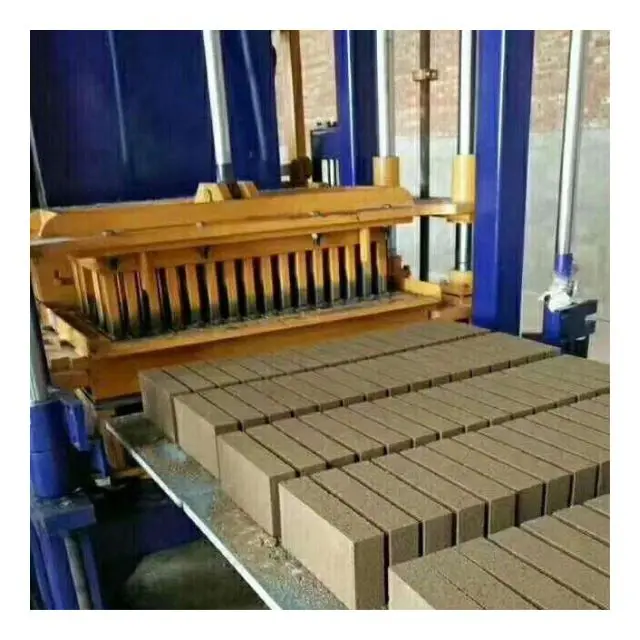
Hydraulic pressure at 16–21 MPa works together with platform vibration to compact the mix into the mould cavity. Higher pressure alone does not guarantee a stronger block; the vibration frequency must match the aggregate particle size so that finer material settles between larger stones before the pressure locks the matrix in place. The 850 × 680 mm pallet size defines how many blocks fit per cycle — six hollow blocks or thirty standard bricks per mould — and the pallet material must withstand repeated vibration and hydraulic loading without warping, since a warped pallet produces uneven block height across the surface.
What Happens When Automation Scope Is Left Unclear
A common outcome when pallet feeding, stacking or cubing is not specified in the quotation is that the press itself performs well, but daily output piles up at the end of the line waiting for manual handling. Workers move loaded pallets by hand to curing racks, and block damage during this transfer can offset the consistency the PLC-controlled press was supposed to deliver. In some cases, the buyer then invests in aftermarket stacking equipment that was never designed around the original pallet size or cycle time, creating a bottleneck that the press was never the cause of [NEED_CITE: downstream bottlenecks from unspecified automation scope].
What Shiyue Brings to This Platform
Block machinery is our single focus, which means the QT6-15 press, its moulds, pallets and any handling equipment are specified as one matched system rather than assembled from separate suppliers. Configuration is set against your actual mix design and local aggregate, not a catalogue default — we ask you to send your sand and stone samples before finalising vibration and pressure parameters. Mould design covers the formats your market actually sells, including custom drawings when standard moulds do not match. The automation level is selectable so you can start semi-automatic and add pallet feeding or stacking stations as your output grows, and voltage, frequency and HMI language are confirmed in writing before the machine enters production.
Documentation & Verification
- Line layout with capacity calculation stating the block format assumed
- Machine specification sheet with pallet size and cycle time per format
- Mould drawing and format list included with the quotation
- Voltage, frequency and PLC display language confirmed before dispatch
- Factory test record on your mix and target block format
- Operation and maintenance manual with wear parts and mould list
Installation, Commissioning & Support
- Foundation plan based on 7100 × 1500 mm footprint and 8500 kg operating weight
- Dedicated power circuit sized for 31.25 kW total draw at confirmed local voltage
- Machine arrives dismantled for container loading with reassembly on site
- PLC parameters calibrated to your aggregate sample during commissioning
- Operator training covers cycle adjustment, mould change and fault reading on the HMI
- Mould and hydraulic wear parts list provided with spare part recommendations
What We Need to Move Forward
To size the line correctly, share the block formats your market requires along with your target daily output for each format. Tell us the local aggregate types available and send material samples if possible so vibration and pressure can be matched before the machine is built. Confirm your site voltage, frequency and preferred PLC display language so that electrical panels and the HMI are configured before the QT6-15 leaves the factory, not after it arrives on your floor.
Frequently Asked Questions
Q: How is daily output calculated, and which block format is the figure based on?
A: Every output figure we quote states the block format and pieces per mould it assumes. For example, 8,640 pieces per day on the QT6-15 is based on 400×200×200 mm hollow blocks at 6 pieces per mould with a 16–20 second cycle. If your primary product is a different format, we recalculate based on that format’s cycle time and mould layout rather than quoting a single headline number.
Q: Which automation stations are included, and which are optional?
A: The press cycle, pallet indexing and mould vibration are always PLC-controlled. Pallet feeding magazines, green block stackers, cubing systems and curing rack return conveyors are configurable based on your budget and labour availability. We state in the quotation exactly which stations are included and which remain manual so there are no surprises at commissioning.
Q: How is voltage, frequency and PLC display language confirmed before dispatch?
A: During the order process we request your site electrical specification and operator language preference, then confirm these in writing before production begins. The electrical panel is built to match, and the HMI is loaded with your chosen language so the machine is ready to run on arrival without on-site reprogramming or transformer additions.
Q: What is the upgrade path from semi-automatic to fully automatic operation?
A: The QT6-15 platform allows stations to be added as your output grows. A buyer starting with manual pallet handling and stacking can later add an automatic pallet feeder, stacker or cuber without replacing the press itself. The PLC architecture supports additional I/O modules for these stations, and the mechanical interfaces are built into the base machine frame from the start.
Q: How is vibration force and hydraulic pressure matched to my local aggregate?
A: We ask buyers to send samples of their local sand, crushed stone or fly ash before finalising machine parameters. Different aggregate particle sizes and shapes require different vibration durations and pressure levels to achieve target block density. Matching these settings to your actual materials before the factory test avoids the situation where parameters need extensive re-tuning after the machine arrives on site.