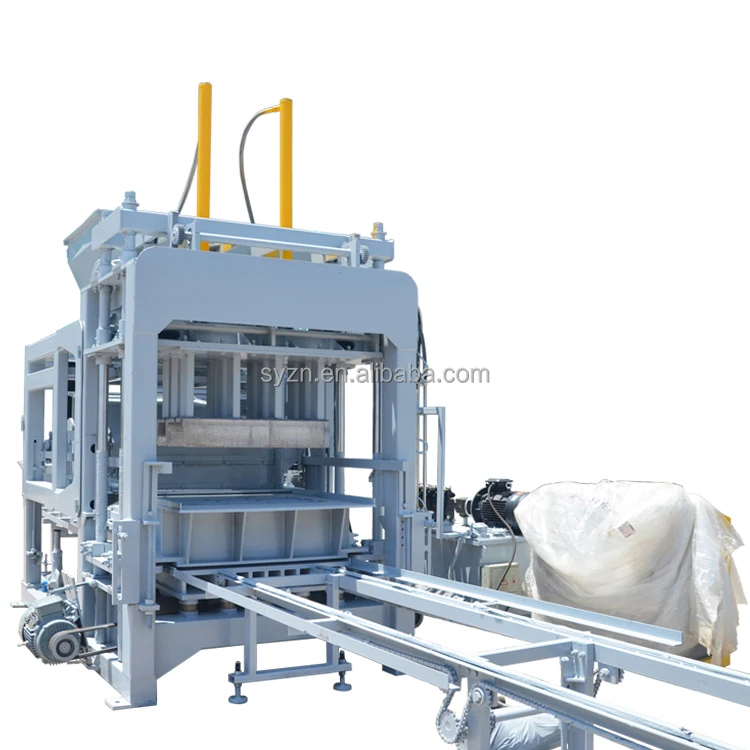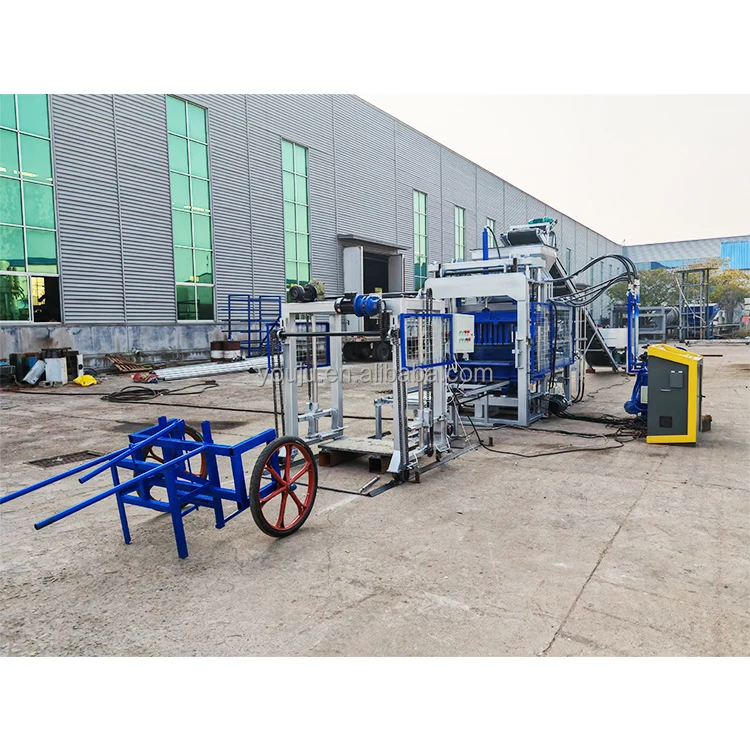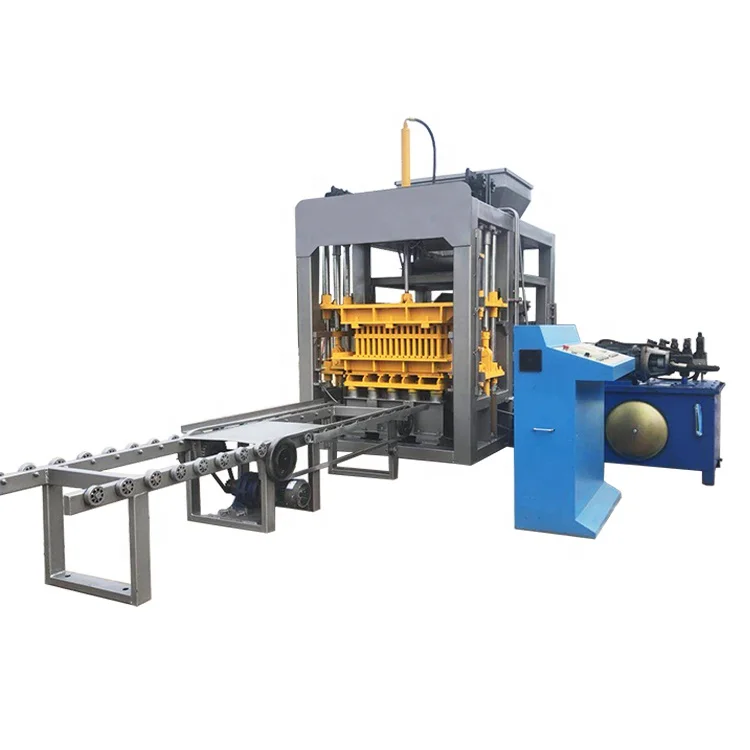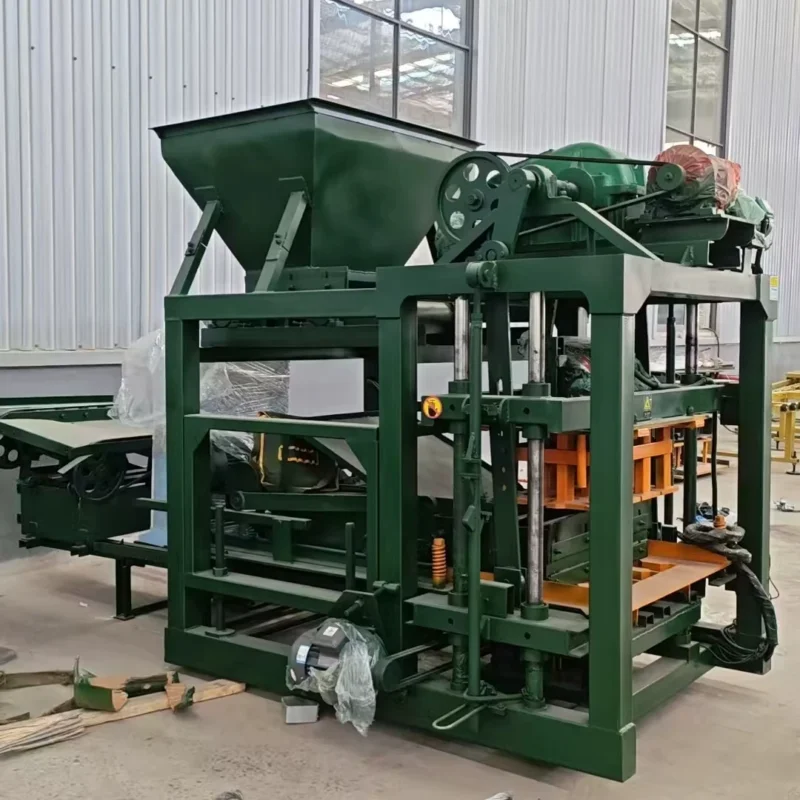


Description
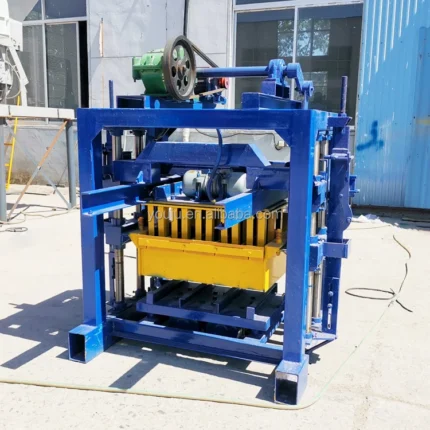
Matched Hydraulic-Vibration Cycles — Every QTJ4-25 parameter from PLC timing to exciting force is set against your specific block format and mix design before the machine leaves the factory, so density and strength remain uniform from the first pallet to the last.
Technical Specifications
| Parameter | Value |
|---|---|
| Model | QTJ4-25 |
| Product Type | Semi-Automatic Hydraulic Concrete Block Making Machine |
| Rated Power | 17.9 kW |
| Voltage & Frequency | Configurable per destination market (basis to be confirmed before order) |
| Control System | PLC with adjustable cycle parameters |
| Overall Dimensions (L×W×H) | 6400 × 1500 × 2700 mm |
| Net Weight | 2500 kg |
| Output Capacity | 960 pcs/h, 7680 pcs/day based on 400×200×200 mm hollow block, 4 pcs per mould |
| Molding Cycle | 25 s |
| Vibration Frequency | 2800 r/min |
| Vibration Force (Exciting Power) | 60 kN |
| Pallet Size | 850 × 550 × 20 mm |
| Mould Formats | Hollow, solid, paver, curbstone — interchangeable on one host machine |
| Automation Level | Semi-automatic (manual pallet handling) |
| Stacking Method | Manual pallet transfer via trolley |
| Configuration Included | Host machine 1 set, block mould 1 set, JQ350 mixer |
Application Suitability
| Application | Material or Output |
|---|---|
| Hollow block production for masonry walls | Crushed stone, sand, cement blends at standard ratios |
| Solid block manufacturing for load-bearing structures | Dense aggregate mixes requiring full hydraulic compaction |
| Paving block runs for walkways and yards | Fine-graded sand and pigment blends for surface finish |
| Curbstone forming for road and driveway edges | Coarse aggregate with higher cement content for impact resistance |
| First-plant entrepreneurial block production | Local aggregate and cement with semi-automatic throughput |
Why the Voltage Question Should Come Before the Price on Any automatic QTJ4-25 block making machine PLC controlled
Confirming power supply compatibility before confirming any other specification prevents weeks of idle equipment on site.
I once watched a fully automatic hydraulic line sit in a Nairobi yard for three weeks because the pump motor was wired for a voltage standard the site simply did not have. The cost of that delay far exceeded the machine price difference between suppliers. When you are evaluating an automatic QTJ4-25 block making machine PLC controlled system, the first document you exchange should be a single-line diagram of your site’s incoming supply [NEED_CITE: voltage and frequency standards by export market]. Frequency matters just as much as voltage — a motor rated for 50 Hz running on a 60 Hz grid will overspeed and burn out its windings within days. This is why the QTJ4-25 order process locks in electrical specifications before production scheduling begins.
How PLC Logic Removes Operator Guesswork from Each Cycle
The PLC on the QTJ4-25 stores the complete molding sequence — feed timing, vibration duration, hydraulic dwell, and demould lift — as a single callable program. When an operator selects the hollow block recipe, the controller executes the same sequence every cycle, eliminating the variation that occurs when different workers time the steps by feel. This repeatability is what separates a semi-automatic machine with real process control from one that simply adds electrical switches to a manual frame. The automatic QTJ4-25 block making machine PLC controlled logic also records fault codes, so maintenance staff can diagnose hydraulic or sensor issues without tracing every wire.
Where Semi-Automatic Stops and Full Automation Begins
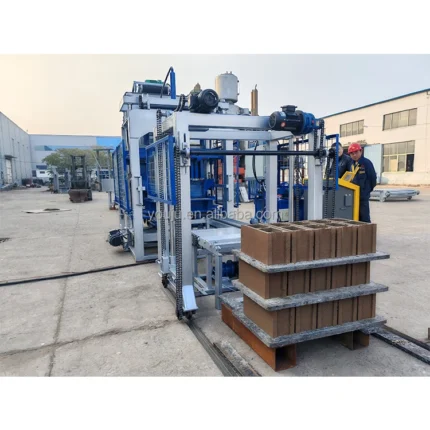
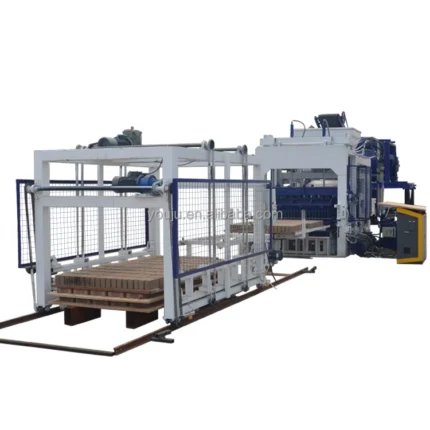
The QTJ4-25 handles the pressing, vibration, and demoulding stages under PLC control, but pallet feeding and stacked-block handling remain manual tasks performed by operators using a trolley. This division keeps the initial investment moderate while still delivering consistent block density through controlled hydraulic pressure and vibration. Plant owners who later need higher throughput can integrate automatic pallet feeders and stacking systems without replacing the press itself [NEED_CITE: typical automation upgrade paths in concrete block production]. The semi-automatic configuration suits operations where labour is available and the curing yard layout does not yet support conveyor-linked cubing.
Reading the Specifications That Actually Determine Block Quality
Vibration force at 60 kN combined with a frequency of 2800 r/min is the specification that most directly affects block density and compressive strength. The bed-mould vertical vibration and upper-mould compression vibration work simultaneously during the 25-second cycle to settle aggregate particles and eliminate voids. Hydraulic pressure must be matched to this vibration profile — too much pressure with insufficient vibration produces a dense surface over a weak core, while excessive vibration with low pressure causes edge crumbling. The 850 × 550 mm pallet size determines which mould formats can run, and buyers planning a curing yard must ensure their forklifts and rack spacing accommodate this pallet dimension. Pallet material — whether bamboo, steel, or composite — affects both vibration transmission and pallet lifespan under repeated cycles [NEED_CITE: pallet material selection criteria for concrete block plants].
The Hidden Cost of Ignoring Pallet and Curing Yard Compatibility
Buyers who focus solely on the press often discover after delivery that their existing pallets do not fit the machine’s feed mechanism, or that their curing racks cannot accept the pallet footprint the machine produces. Pallets that are too thin warp under vibration, causing uneven block bases and rejected output. When pallet handling and stacking are left out of the equipment budget, output piles up at the machine discharge faster than workers can move it, creating bottlenecks that negate the cycle time the press was selected for. These mismatches are avoidable when pallet size, material, and curing-area logistics are specified together with the press [NEED_CITE: common commissioning delays from mismatched auxiliary equipment].
What This Supplier Does Differently for Stationary Block Lines
Block machinery is the single production focus, meaning the QTJ4-25 press, mould, pallet, and handling accessories are specified as one matched system rather than assembled from separate vendor catalogues. Machine configuration is set against the buyer’s actual mix design and local aggregate, not a default setting that assumes ideal sand. Mould design covers the specific block formats the buyer’s market demands, including custom drawings when standard formats do not fit. The automation level is selectable, so a plant can start with semi-automatic operation and add automatic pallet feeding later without replacing the host machine. Installation support includes on-site commissioning with operator training covering PLC parameter adjustment, mould changeover procedure, and daily maintenance intervals.
Documentation & Verification
- Line layout showing the QTJ4-25 footprint with pallet flow and curing rack positions
- Capacity calculation sheet stating output based on 400×200×200 mm hollow block format
- Mould drawing and format list confirming achievable block sizes on the 850×550 mm pallet
- Hydraulic and electrical schematic for local maintenance troubleshooting
- Voltage, frequency, and PLC display language confirmation document before production
- Factory test record on the buyer’s specified block format before dispatch
Installation, Commissioning & Support
- Foundation plan sized for the 6400 × 1500 mm footprint with anchor bolt positions
- Dedicated circuit rated for the 17.9 kW total draw with correct voltage and frequency
- Machine shipped in modular sections for container loading and reassembly on site
- First-run commissioning with PLC cycle parameters set to the buyer’s confirmed block format
- Operator training covering mould swap procedure and vibration-pressure adjustment per format
- Wear parts list identifying hydraulic seals and vibration motor bearings for local sourcing
What to Prepare Before Requesting a Quotation
Provide the block formats your market currently demands along with target daily output for each format. Share a sample or description of your local aggregate and cement type so the mix-compatible vibration and pressure settings can be calculated. Confirm your site’s incoming voltage, frequency, and preferred PLC display language. If you already have pallets, forklifts, or curing racks in place, send their dimensions so the pallet specification can be matched rather than defaulted.
Frequently Asked Questions
Q: How do I verify the quoted 960 pieces per hour against my actual block format?
A: That figure is calculated based on a 400×200×200 mm hollow block with 4 pieces per mould and a 25-second cycle. Smaller solid blocks or pavers will yield different counts per mould and may require adjusted cycle times. Request a capacity sheet that states output specifically for each format you intend to produce before placing your order.
Q: What automation does the QTJ4-25 provide, and can it be upgraded later?
A: The machine automates the pressing, vibration, and demoulding sequence under PLC control while pallet feeding and block stacking remain manual. Automatic pallet feeders and stacking units can be integrated later without replacing the press, allowing a staged investment path as production volume grows.
Q: Is the PLC display language configurable for non-Chinese operators?
A: The PLC display language is confirmed during the order process and set before shipment. Buyers must specify the required language alongside voltage and frequency so the control panel is configured correctly before the machine leaves the factory, avoiding commissioning delays.
Q: How do hydraulic pressure and vibration settings change between hollow block and paver moulds?
A: Paver moulds typically require higher vibration force and longer dwell times than hollow block moulds to achieve the surface density needed for wear resistance. The PLC stores separate parameter sets for each format so operators can switch recipes without manually recalculating timing and pressure.
Q: What voltage and frequency must be confirmed before production begins?
A: Your site’s incoming supply voltage and frequency must be documented and confirmed before the motor and pump are sourced. A mismatch will prevent commissioning on arrival, and rewinding motors on site is costly and time-consuming compared to specifying the correct electrical standard at the order stage.