

Block Cuber for Curbstone Manufacturing Volume Wholesale
Bigger is not always better when it comes to curbstone automation.
Correctly sizing a block cuber for curbstone production requires prioritizing logistical compatibility and foundation alignment over raw output capacity, ensuring that container dimensions match disassembled modules and that site readiness prevents installation delays in emerging markets.
The assumption that a higher-capacity machine automatically translates to faster return on investment is a common trap for new plant investors. In reality, an oversized unit often creates bottlenecks if the upstream mixer or downstream forklift capacity is not perfectly matched. I have seen entire production lines stall because the cuber was too large for the pre-poured foundation or too complex to fit into standard shipping containers without expensive modifications. [NEED_CITE: common causes of installation delays in precast equipment imports] Proper planning involves verifying input and output conveyor heights, overall footprints including maintenance access, and disassembled module sizes for shipping before any civil work begins.
Understanding these logistical and technical nuances is critical for anyone looking to optimize their production line. The following sections break down why specific sizing matters, how to align your equipment with logistics, and what pitfalls to avoid during delivery.
Why Does Cuber Sizing Matter More for Curbstones Than Standard Blocks?
Curbstones demand specialized handling logic due to their irregular shapes and varying weights, which differ significantly from uniform hollow blocks.
Standard concrete blocks are rectangular and stack neatly, allowing for simple, high-speed stacking patterns. Curbstones, however, often feature curved edges, sloped faces, or interlocking profiles that require precise orientation during stacking. This complexity means that a generic block cuber may struggle with stability or speed when handling curbstones. [NEED_CITE: mechanical handling challenges for irregular precast concrete products]
In my experience, the weight distribution of curbstones also plays a crucial role. A cuber designed for lightweight hollow blocks might lack the necessary hydraulic pressure or structural rigidity to handle dense, solid curbstones efficiently. This mismatch can lead to frequent jams or misaligned stacks, reducing overall throughput. Therefore, selecting a block cuber for curbstone manufacturing specifically engineered for these heavier, irregular products is essential.
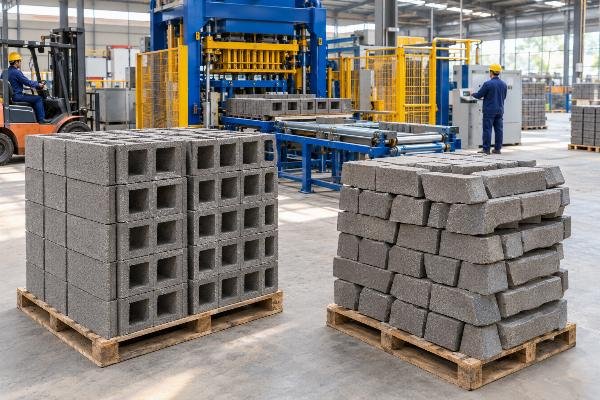
Furthermore, the surface texture of curbstones can affect gripping mechanisms. Smooth, finished curbstones may slip if the cuber’s clamps are not adjusted correctly, while rough-textured ones might require different pressure settings. These factors necessitate a more nuanced approach to sizing and configuring the equipment, going beyond mere output capacity.
What Are the Critical Dimensions for Logistics and Installation?
Matching machine modules to container limits and verifying foundation anchor points before shipment prevents costly on-site modifications.
One of the most frequent issues I encounter involves the discrepancy between the cuber’s physical dimensions and the available shipping space. Many buyers assume that all machinery fits into standard forty-foot high-cube containers. However, heavy-duty curbstone cubers often require specific disassembly plans or even open-top containers to accommodate their height or width. [NEED_CITE: ISO container specifications for heavy machinery transport]
For instance, a recent project in Southeast Asia faced significant delays because the cuber’s main frame could not be disassembled small enough to fit into a standard container. The buyer had to switch to a more expensive open-top container at the last minute, increasing freight costs substantially. To avoid this, it is vital to check the disassembled module sizes against standard container internal dimensions early in the procurement process.
Equally important is the foundation alignment. In West Africa, I witnessed a scenario where a cuber arrived on-site only to discover that the pre-poured foundation’s anchor bolt spacing did not match the factory drawings. The installation team spent several days cutting and re-welding steel bars, delaying the project start. This highlights the need to verify anchor bolt spacing and foundation load-bearing requirements per square meter before any civil construction begins. [NEED_CITE: foundation load-bearing standards for heavy industrial machinery]
When evaluating a block cuber for curbstone manufacturing, request detailed dimensional drawings that include both assembled and disassembled states. Compare these with your site’s logistical constraints and foundation plans. This proactive step ensures that the equipment arrives ready for immediate installation, minimizing downtime.
How to Align Cuber Capacity with Your QT Series Line?
Balancing the output of QT series block machines with cuber throughput avoids idle time and maximizes efficiency.
A common misconception is that the cuber should always have a higher capacity than the block machine. In practice, the cuber’s cycle time must align closely with the block machine’s output frequency. If the cuber is too slow, it becomes a bottleneck, forcing the block machine to wait. If it is too fast, it may sit idle, representing wasted capital. [NEED_CITE: production line balancing principles in concrete manufacturing]
For example, when pairing a cuber with a QT8-15 block machine, it is essential to calculate the exact number of cycles per hour the block machine produces and match it with the cuber’s stacking speed. The QT8-15 is a high-output machine, and its corresponding cuber must handle the volume without compromising stack stability. Mismatched speeds can lead to uneven wear on components and increased maintenance needs.
Additionally, consider the interface dimensions between the block machine’s output conveyor and the cuber’s input. Height mismatches can cause blocks to drop or jam during transfer. Ensuring that the conveyor heights are compatible is a simple yet critical detail that affects overall line performance.
At Shiyue, we emphasize pre-shipment dimensional verification for our turnkey solutions. This includes checking the compatibility of the block cuber for curbstone manufacturing with the specific QT series model being used. By customizing packing lists and verifying interface dimensions, we ensure seamless container loading and smooth integration on-site. This attention to detail helps clients avoid the common pitfalls of mismatched equipment.
Common Pitfalls in Turnkey Delivery and How to Avoid Them
Real-world lessons on documentation checks and on-site measurement verification can save weeks of delay.
Even with careful planning, unexpected issues can arise during turnkey delivery. One major pitfall is relying solely on basic FOB prices without accounting for specialized shipping requirements. As mentioned earlier, some cubers require open-top containers or specific disassembly procedures that are not included in standard quotes. Buyers should clarify these details upfront to avoid surprise costs.
Another common issue is incompatibility with existing infrastructure. In a MENA precast upgrade project, a new cuber was installed without considering the height of the existing conveyor system. The mismatch required extensive modification to the conveyor, delaying production restart. This underscores the importance of conducting a thorough site audit before purchasing new equipment. [NEED_CITE: best practices for integrating new machinery into existing production lines]
To mitigate these risks, always request a comprehensive packing list and dimensional verification report from the manufacturer. Verify anchor bolt spacing, conveyor heights, and container loading plans against your site’s specific conditions. Engaging with a supplier who provides turnkey solutions, including installation and training, can also help identify and resolve potential issues before they become costly problems.
When sourcing a block cuber for curbstone manufacturing, look for partners who offer remote diagnostic assistance and multi-language technical support. This ensures that any issues arising during installation or operation can be addressed quickly, minimizing downtime.
Conclusion
Proper sizing and logistical planning are as critical as mechanical performance for successful curbstone production.
Avoiding installation delays and operational bottlenecks requires a holistic approach that considers container dimensions, foundation alignment, and capacity matching. By focusing on these practical details, investors can ensure a smoother setup and faster return on investment. A well-chosen block cuber for curbstone manufacturing integrates seamlessly into the production line, enhancing efficiency rather than creating new challenges.
Leave a Reply