

Block Machine Manufacturer Philippines: QT Series for Sale
Most buyers think the most expensive block machine guarantees the best output. The real reason lines fail in the Philippines is mismatch with local grid frequency and raw material moisture — not brand prestige.
The block machine market Philippines is expanding rapidly in 2026, driven by a structural housing deficit and infrastructure spending. Buyers succeed by matching voltage stabilization, local aggregate ratios, and after-spare localization to their specific site — not by chasing the highest-spec model.
I started welding frames on the shop floor in Dongguan, then moved to export sales after a few trade shows in Southeast Asia. Once, we shipped a QT6-15 line to a private block plant near Manila. The quotation skipped a careful check on local voltage fluctuation. Within days of commissioning, the inverter burned out twice. The client called at midnight, furious. When our engineer flew over, the root cause was grid instability — only a voltage stabilizer cabinet solved it. Since that day, the first question I ask any Philippines buyer is about substation capacity and generator backup. No more guessing from experience alone. [NEED_CITE: Philippines grid frequency standard and voltage fluctuation range per Department of Energy]
That lesson shaped how I evaluate every inquiry for the block machine market Philippines. Let’s walk through what actually drives demand, what pitfalls destroy ROI, and how to pick the right line.
Why Is the Philippines Block Machine Market Growing in 2026?
A structural housing gap and sustained infrastructure allocation make block demand highly predictable through the medium term.
The Philippines continues to face a cumulative housing backlog measured in millions of units, concentrated in Metro Manila, Central Luzon, and CALABARZON. Government programs like the Pambansang Pabahay para sa Pilipino initiative keep public housing tenders active, while private developers fill the middle-income segment. Cement consumption and construction starts have shown a steady upward trajectory, with periodic spikes tied to election-cycle infrastructure acceleration. [NEED_CITE: Philippine Statistics Authority housing backlog and construction start trends]
From what I’ve seen on the ground, two buyer profiles dominate the block machine market Philippines. First, government-adjacent contractors bidding on public housing and road paving projects — they need fully automatic PLC lines, CE/SGS certification, and turnkey delivery with formal tender documentation. Second, private entrepreneurs setting up neighborhood block yards — they prioritize quick payback, entry-level packages, and hands-on operator training.
A contractor based in Cebu once won a mid-size government housing tender. The challenge wasn’t the machine itself — it was the documentation timeline. Preparing CE certificates, SGS test reports, and localized compliance files took substantially longer than the machine production cycle. Buyers who start certification preparation early avoid delivery bottlenecks. [NEED_CITE: CE/SGS certification requirements for construction equipment imported into the Philippines]
The demand side is clear. The question is whether your line can survive Philippine site conditions.
What Voltage & Site Pitfalls Must Buyers Avoid?
Unstable grid supply is the hidden killer of block machines in the Philippines — not mechanical design flaws.
The Philippine power grid operates at 60Hz, but voltage fluctuation is a daily reality outside major industrial zones. Frequency dips, phase imbalance, and sudden surges are common in peri-urban areas where most private block plants locate for cheaper land. [NEED_CITE: Philippines electrical grid frequency standard and typical voltage fluctuation range]
I’ve seen inverters fry within the first week of operation because buyers assumed the machine’s standard electrical cabinet could handle local conditions. The fix is never optional — it’s a voltage stabilizer cabinet sized to the line’s total motor load, plus a phase monitor relay to shut down safely during imbalance. Skipping this component saves a small amount upfront but multiplies downtime costs later.
Beyond electricity, site layout matters more than buyers expect. A block plant near Manila once arranged the batching area uphill from the mixer. During rainy season, aggregate moisture content swung wildly, wrecking the water-cement ratio and producing blocks that cracked during curing. The machine was fine; the site engineering was not. [NEED_CITE: typical aggregate moisture variation in tropical Southeast Asian block production]
Here’s what a responsible block machine manufacturer Philippines should verify before quotation:
- Substation capacity and distance from the plant site
- Backup generator rating and automatic transfer switch availability
- Rainy season drainage plan for aggregate storage
- Local sand type — river sand, crushed sand, or volcanic ash — each demands a different mix recipe
These are not afterthoughts. They are pre-commissioning requirements.
How to Choose the Right Block Machine for Your Philippines Project?
Match output capacity, raw material availability, and budget to the correct QT model — overspecifying wastes capital, underspecifying kills throughput.
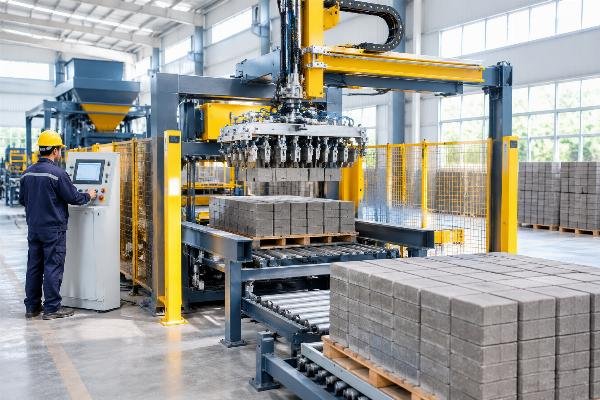
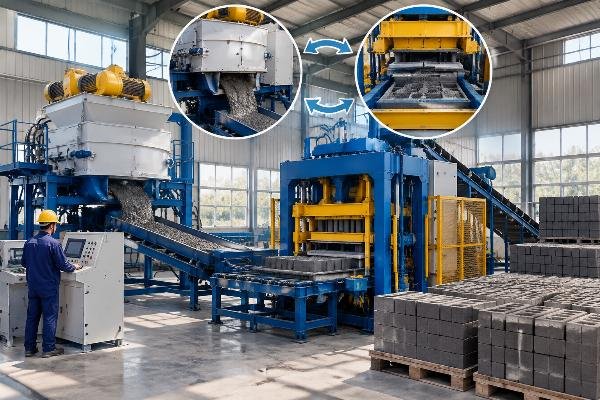
The QT series covers the full spectrum of the block machine market Philippines, from manual egg-laying units for micro-enterprises to fully automatic lines for industrial-scale plants. The wrong choice in either direction costs real money.
A first-time investor in Davao started with a mobile egg-laying machine — the right call for a low-volume trial. Once demand stabilized, upgrading to a stationary QT6-15 with a pallet circulation system doubled daily output without doubling the workforce. The key was staging investment to match verified demand, not projected demand.
For medium to large operations, the comparison looks like this:
| Factor | QT4-15 / QT6-15 | QT10-15 / QT12-15 | QT15-15 |
|---|---|---|---|
| Automation Level | Semi-auto | Fully automatic PLC | Fully automatic PLC |
| Daily Output Range | Moderate | High | Very high |
| Operator Requirement | Noticeably higher labor | Standard crew | Standard crew |
| Voltage Stabilization Need | Standard | Controlled | Controlled |
| Raw Material Flexibility | Robust | Robust | Requires consistent supply |
| Suitable Buyer Profile | Private yard, starter plant | Established plant, tender projects | Industrial-scale manufacturer |
[NEED_CITE: typical output capacity ranges for semi-auto vs fully automatic block machines in Southeast Asian markets]
A distributor in Southeast Asia once placed a trial order of QT6-15 units. The critical decision was spare parts ratio — how many molds, sensors, and hydraulic seals to include in the first container. Buyers who stock a meaningful spare parts buffer avoid extended downtime when a component fails. The block machine market Philippines rewards preparedness, not just machine price.
The right model is the one that matches your verified daily output target, your local aggregate supply chain, and your realistic maintenance capability.
What Documentation & Certification Do Philippine Buyers Need?
CE and SGS certification are not optional extras — they are baseline requirements for customs clearance and government tender eligibility.
Importing construction machinery into the Philippines involves Bureau of Customs processing, and certain government projects explicitly require CE marking or SGS test reports in the bid package. Buyers who discover this after the machine arrives at the port face demurrage charges and delayed commissioning. [NEED_CITE: Philippines Bureau of Customs import documentation requirements for construction machinery]
The documentation checklist typically includes:
- Commercial invoice and packing list matching the bill of lading
- Certificate of Origin for tariff preference claims
- CE declaration of conformity or SGS inspection report
- Electrical schematic diagrams with 60Hz compatibility noted
- Operator manual in English
- Spare parts list with part numbers
A government contractor in the Philippines once lost a bidding round because the competitor’s SGS report covered the specific machine model, while theirs only covered a "similar series." The lesson: certification must match the exact model and configuration being shipped, not a generic product family.
Start certification preparation at the inquiry stage, not after production is complete.
How to Ensure After-Sales Support in the Philippines?
Local spare parts availability and engineer response speed determine long-term ROI — not the initial machine price.
The block machine market Philippines is price-competitive, but repeat purchases and referrals go to suppliers who solve problems on-site within days, not weeks. A burned-out hydraulic valve or a cracked mold shouldn’t shut down a plant for a month waiting for a replacement from China.
A responsible supplier approach includes stocking fast-wear components — molds, pallets, sensors, hydraulic seals — in quantities that cover extended operation between resupply shipments. For distributors, this means negotiating a spare parts package alongside the initial machine order, sized to cover at least the first operating cycle independently.
On-site installation and commissioning by the manufacturer’s engineers is another non-negotiable. I’ve watched lines sit idle for extended periods because local technicians tried to debug PLC logic without the original parameter files. Proper commissioning includes not just mechanical assembly, but operator training on daily maintenance, mix ratio adjustment, and basic fault diagnosis. [NEED_CITE: importance of on-site commissioning and operator training for block machine productivity in emerging markets]
Shandong Shiyue Intelligent Machinery approaches the block machine market Philippines with this philosophy: every line shipped includes on-site installation, commissioning, operator training, and lifetime after-sales technical support. The goal is not just to deliver a machine, but to ensure it runs profitably from day one — and stays running through local grid quirks, tropical humidity, and the inevitable wear of high-cycle production.
Conclusion
The block machine market Philippines rewards buyers who validate site conditions before selecting equipment. Voltage stabilization, raw material matching, certification readiness, and spare parts localization separate profitable operations from costly failures. Choose a manufacturer who treats these as pre-sale engineering tasks, not post-sale surprises.
Leave a Reply