

Buy Interlocking Brick Machine Price Guide | Wholesale Supplier
The cheapest interlocking brick machine on paper often becomes the most expensive on site.
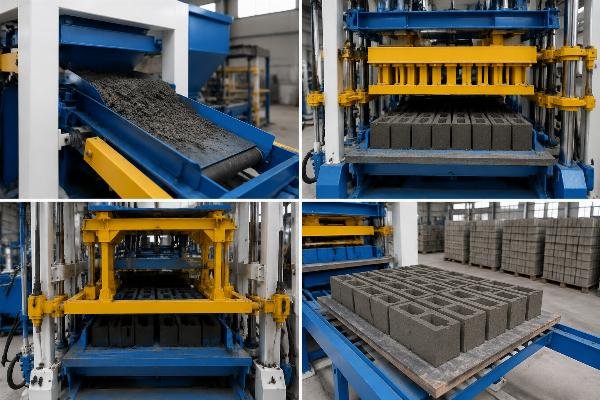
Interlocking brick machine price ranges from entry-level manual egg-laying units to fully automatic PLC-controlled production lines, with total investment determined by automation level, mold configuration, raw material adaptation, and site-specific customization rather than base unit cost alone.
I still remember a container we shipped to a buyer in the Red Sea coastal region. The machine ran beautifully in our Linyi factory during pre-shipment testing. Three weeks after installation, the buyer was calling daily—their desert sand carried far more clay and silt than our standard test material, and the hopper kept bridging, the mixer kept choking. We had to retrofit a reinforced hopper with a vibrating screen, which added material cost and delayed production by weeks. The machine itself was priced competitively, but the total project cost climbed noticeably because nobody asked about the raw material profile upfront. That is the reality of interlocking brick machine price that most quotation sheets never reveal. [NEED_CITE: raw material compatibility as a primary variable in block machine total cost of ownership]
Let me walk you through what actually drives the numbers, how to match a model to your real output needs, and where hidden costs typically appear.
What Factors Determine Interlocking Brick Machine Price?
Automation level, mold configuration, and site-specific customization are the three variables that move interlocking brick machine price more than any single spec on a brochure.
Most buyers start by comparing base unit prices across suppliers. That is a reasonable starting point, but it rarely reflects what you will actually pay to get bricks out the other end. Here is what the quotation sheet usually breaks down, and what it quietly omits:
| Factor | Entry-Level Manual | Semi-Automatic | Fully Automatic PLC |
|---|---|---|---|
| Automation degree | Manual mold change, hand feeding | Semi-auto material feeding, hydraulic pressing | Full PLC control, auto pallet cycling |
| Daily output capacity | Low batch output | Moderate continuous output | High-volume continuous output |
| Mold flexibility | Single mold, limited swap | Multiple molds, moderate swap time | Quick mold change system |
| Raw material adaptation | Standard hopper only | Reinforced hopper optional | Customizable feeding and mixing system |
| Operator requirement | Multiple skilled workers | Reduced crew needed | Minimal crew, trained technician |
| Price positioning | Budget entry point | Mid-range investment | Premium tier |
[NEED_CITE: block machine automation levels and corresponding price tiers per industry classification]
The hydraulic system alone creates meaningful price separation. A manual interlocking brick machine relies on mechanical leverage and basic vibration, keeping the price low but limiting density consistency. Move to a hydraulic interlocking brick machine price tier, and you gain controlled pressing force—critical when your mix design varies batch to batch, which it will in most emerging market settings where cement quality fluctuates. [NEED_CITE: hydraulic pressing advantage in variable cement quality environments]
Then there is the mold. A standard rectangular interlocking block mold costs a fraction of a decorative paver mold with complex geometric patterns. Buyers requesting multiple mold types—say, interlocking blocks, paving stones, and curbstones—should expect the interlocking brick machine price to reflect each additional mold set. Some suppliers bundle two or three molds; others quote them separately. Always confirm.
Customization is where budgets get stretched unexpectedly. If your site runs on a voltage grid that fluctuates wildly, you need a voltage stabilizer. If your raw material has high moisture content, the mixing system needs modification. If your facility lacks a hardened floor, the foundation work adds cost. None of these appear in a standard FOB price, yet they are unavoidable in real installations.
How to Choose the Right Model for Your Budget and Output?
Matching daily output demand to machine capacity—not buying the largest machine you can afford—determines whether your interlocking brick machine price delivers a reasonable return.
I have seen investors purchase fully automatic lines for markets where demand only justifies semi-automatic output. The machine sits idle half the day, the operator costs remain fixed, and the payback period stretches well beyond what a brochure promised. Conversely, I have seen buyers start with a small egg-laying unit, build a customer base, and upgrade to a larger line within a couple of seasons—financing the upgrade from operating profit.
Here is how the typical model progression looks from a buyer perspective:
| Scenario | Recommended Model Type | Rationale |
|---|---|---|
| First-time investor, limited capital, testing market | Manual or semi-auto egg-laying unit | Lowest entry cost, fast payback, scalable |
| Established demand, steady orders, expanding crew | Semi-automatic stationary line | Balanced output and cost, mold flexibility |
| Government tender, large housing project, high volume | Fully automatic PLC line | Maximum output, minimal labor dependency, certification compliance |
| Distributor stocking multiple product types | Semi-auto with multiple mold sets | Product variety without overcommitting capital |
[NEED_CITE: ROI comparison between semi-automatic and fully automatic block machines at partial utilization rates]
A private investor in East Africa came to us wanting the largest automatic line available. After discussing his actual daily sales volume and available working capital for raw materials, we recommended a semi-automatic setup instead. He was initially disappointed—the interlocking brick machine price for the automatic line was only moderately higher. But when we mapped out his raw material procurement cycle, labor costs, and realistic daily sales, the semi-automatic unit would reach payback noticeably faster. He later placed a second order for an additional mold set to offer paver products alongside interlocking blocks, expanding his product range without the burden of an underutilized automatic line.
The key question is never "what is the biggest machine I can buy?" It is "what is the smallest machine that reliably meets my confirmed demand with room for modest growth?"
What Is Included in the Total Investment Beyond Machine Cost?
The interlocking brick machine price on a Proforma Invoice typically covers the machine and standard accessories—but shipping, installation, raw material adaptation, spare parts, and site preparation form the complete investment picture.
Buyers who budget only for the machine cost frequently encounter surprises. Let me break down the components that sit outside the base quotation:
-
Shipping and trade terms. FOB, CIF, and DDP produce dramatically different landed costs. A CIF quote to a landlocked destination in Central Africa includes inland freight that can rival the machine cost itself. Always request the supplier to calculate based on your actual delivery point, not just the nearest port. [NEED_CITE: trade term impact on total landed cost of construction machinery in emerging markets]
-
Installation and commissioning. Some suppliers include technician dispatch in the machine price; others charge separately for travel, accommodation, and daily rates. A typical installation runs across multiple weeks depending on line complexity. Budget for this explicitly.
-
Raw material testing and mix design adaptation. Your local sand, stone dust, fly ash, or laterite will behave differently from the supplier’s test material. A competent supplier will request material samples before shipment and adjust the machine settings accordingly. If they do not offer this, consider it a red flag.
-
Spare parts package. Wear parts—mixer blades, vibration motors, hydraulic seals, mold liners—will need replacement. Ordering a starter spare parts kit with the machine saves shipping cost and avoids production downtime later.
-
Site preparation. Foundation work, electrical wiring, water supply, and material storage areas are the buyer’s responsibility in most cases. A supplier who provides a site layout drawing before shipment helps you avoid costly rework.
When we prepare a project quotation, we walk buyers through each of these line items before they sign. It takes longer to produce the quotation, but it eliminates the phone calls that start with "you did not tell me this would cost extra." Transparency at the quotation stage builds trust that carries through the entire project lifecycle.
How to Verify Supplier Quotation and Avoid Hidden Costs?
Requesting a detailed itemized quotation, confirming technical compatibility, and verifying certification documentation are the three steps that separate a reliable interlocking brick machine price from a misleadingly low number.
The lowest quotation is not always the best deal, and the highest is not always the most honest. Here is what I recommend buyers do before committing:
Step one: demand an itemized quotation. The interlocking brick machine price should be broken into machine body, mold sets, hydraulic station, control panel, auxiliary equipment (mixer, conveyor, pallet feeder), and any customization charges. If a supplier provides only a single lump-sum figure with no breakdown, ask why. Legitimate manufacturers have no reason to hide component-level pricing.
Step two: confirm technical compatibility in writing. Specify your raw material composition, local voltage and frequency, desired product dimensions, and daily output target. The supplier should respond with a written confirmation that their standard configuration matches these parameters—or should propose specific modifications with associated cost adjustments. [NEED_CITE: technical specification confirmation checklist for block machine procurement]
Step three: verify certification and compliance. For buyers in regulated markets or those bidding on government tenders, CE, SGS, or ISO certification is not optional—it is a contract requirement. Request copies of certificates and verify them against the issuing body’s database. A supplier who hesitates to provide certification documentation is signaling a risk you do not need.
| Verification Item | What to Request | Red Flag |
|---|---|---|
| Price breakdown | Itemized quotation with component costs | Lump-sum only, no detail |
| Technical match | Written confirmation of voltage, material, output compatibility | Verbal assurance only |
| Certification | Scanned CE/SGS/ISO certificates with verification method | Refusal or delay in providing |
| After-sales terms | Written scope of installation support and spare parts supply | Vague promises |
| Reference projects | Contactable buyer references in similar markets | No verifiable references |
[NEED_CITE: procurement verification checklist for construction machinery imports]
I once reviewed a quotation from a competitor that was noticeably below our interlocking brick machine price for an equivalent configuration. The buyer asked me why. I requested the competitor’s quotation and found that the hydraulic station was excluded, the mold was quoted separately, and installation support was listed as "available at additional cost." When all items were added, the total cost was comparable to ours—but the initial impression was of a significantly cheaper machine. This is not necessarily dishonest, but it makes direct comparison impossible unless you normalize the scope.
Conclusion
Interlocking brick machine price is a function of configuration, adaptation, and total project scope—not a single number on a quotation. Evaluate automation level against confirmed demand, budget for shipping and installation alongside the machine cost, and verify every technical assumption in writing before committing. The right machine at a transparent price will outperform the cheapest machine that arrives unprepared for your actual site conditions.
Leave a Reply