

Buy Paver Block Machine Full Line Package from Manufacturer
Most buyers assume a full line package costs more upfront, but piecing together individual machines from different vendors often inflates total project cost by a third or more once integration failures, delayed commissioning, and downtime losses are tallied.
A paver block machine full line package is a single-source, factory-integrated production system covering raw material batching, mixing, forming, conveying, curing, and pallet circulation—all controlled under one unified PLC architecture, delivered with matched mechanical interfaces, standardized electrical protocols, and coordinated on-site commissioning.
Back when I was sourcing equipment for a client in Lagos, we split the order across three separate factories to shave costs on the invoice. The main host arrived from one province, the batcher from another, and the stacker from a third. When everything landed on site, the conveyor belt width did not align with the mold indexing station, and the stacker’s communication protocol spoke a different language than the host machine’s controller. The commissioning team spent weeks trying to bridge gaps that should never have existed. [NEED_CITE: integration failure root causes in multi-vendor production lines] That project taught me something no brochure mentions: the hidden cost of mismatch sits in the field, not on the purchase order. Now, when I walk buyers through a paver block machine full line package, the first thing I check is not the host machine’s cycle time—it is whether every subsystem shares the same signal bus.
Let me break down what actually goes into a real full line package, where the money traps hide, and how to separate a genuine turnkey solution from a catalog bundle.
What Exactly Is Included in a Paver Block Machine Full Line Package?
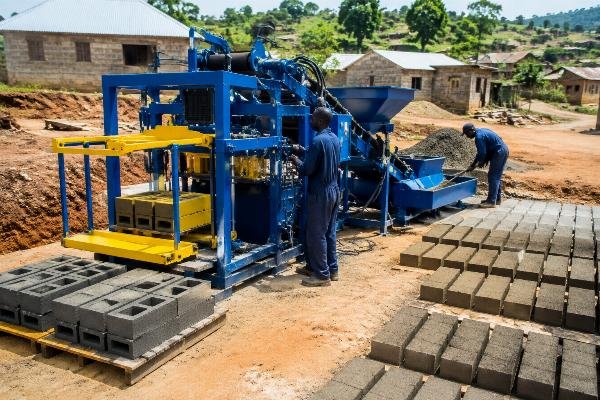
A genuine paver block machine full line package covers the entire production chain from aggregate storage to finished product stacking, not just the forming host machine that appears in promotional photos.
Many first-time buyers confuse "full line" with "host machine plus a mixer." In reality, a properly scoped package includes the following subsystems working as one coordinated unit:
| Subsystem | Core Components | Integration Requirement |
|---|---|---|
| Raw Material Batching | Aggregate bins, cement silo, screw conveyors, weighing hoppers | Unified weight calibration protocol |
| Mixing | Pan mixer or twin-shaft mixer, water additive system | Synchronized cycle timing with host |
| Forming Host | Vibration table, mold box, feeder box, hydraulic station | Central PLC master control |
| Wet Product Conveying | Chain or belt conveyor, pallet return loop | Speed-matched to host output节拍 |
| Curing System | Racking machine, curing chamber or yard layout, climate control | Temperature and humidity sensor network |
| Stacking and Cubing | Finger car, stacker, wrapper | Pallet size and product pattern registry |
| Control Cabinet | Centralized PLC, HMI touch screen, remote diagnostics port | Single communication bus across all stations |
[NEED_CITE: standard subsystem classification per concrete block machinery industry guidelines]
The critical point is the control layer. If the batcher uses one brand of PLC and the stacker uses another, you will need a gateway translator sitting between them—adding latency, creating fault points, and making troubleshooting a guessing game. A true paver block machine full line package runs every subsystem on the same controller family, so the operator sees one interface and the service engineer reads one diagnostic log.
I once reviewed a quotation where the seller listed "full line" but excluded the pallet circulation system. The buyer only discovered this when the pallets piled up behind the host machine on day two of trial runs. Always confirm the pallet loop is included—without it, the host stops every few minutes waiting for manual pallet feeding.
Full Line Package vs. Piecing Together Individual Machines: Which Saves More?
The invoice price of a paver block machine full line package typically looks higher than a self-assembled line, but the total cost of ownership tells the opposite story once commissioning delays, interface rework, and single-source accountability are factored in.
Here is how the two approaches compare across the dimensions that actually determine whether your plant runs profitably by month three:
| Evaluation Dimension | Full Line Package (Single Source) | Pieced-Together Line (Multiple Vendors) |
|---|---|---|
| Mechanical Interface Match | Factory-matched before shipment | Discovered on site, rework required |
| PLC Communication Protocol | Unified bus, single diagnostic view | Gateway translators needed, latency added |
| Commissioning Duration | Coordinated team, compressed timeline | Sequential vendor visits, extended downtime |
| Warranty Accountability | One entity responsible for entire line | Vendors blame each other across boundaries |
| Spare Parts Compatibility | Standardized wear parts across subsystems | Mixed part numbers, multiple suppliers to manage |
| Future Expansion | Pre-engineered capacity upgrade path | Ad hoc modifications with uncertain fit |
[NEED_CITE: total cost of ownership comparison between integrated and multi-vendor block production lines]
Consider a buyer in East Africa who initially sourced the host machine from one supplier and the batching plant from another to save on the initial quote. When the batcher delivered aggregate at a rate that exceeded the mixer’s intake capacity, the excess material spilled onto the floor every cycle. Fixing it meant either slowing the batcher—which killed throughput—or upgrading the mixer—which the mixer vendor said was outside the original scope. The buyer ended up paying for a second mixer installation and lost weeks of production during the retrofit.
With a paver block machine full line package from a single manufacturer, the throughput of every station is balanced at the design stage. The batcher feeds at the exact rate the mixer can handle, the mixer discharges in sync with the host’s mold cycle, and the stacker picks at the pace the conveyor delivers. No station starves, no station overflows.
The accountability question matters just as much. When a fault alarm triggers on a unified line, one service team diagnoses it. When five machines come from five factories, every vendor’s technician insists the problem originates in someone else’s equipment. I have watched commissioning teams spend days on conference calls just to establish who owns the fault.
How to Evaluate a Supplier’s Turnkey Capability Before You Buy?
A supplier’s ability to deliver a paver block machine full line package is proven not by their catalog breadth, but by their track record of coordinated installations in markets with conditions similar to yours.
Start your evaluation with three verifiable checkpoints:
First, request a complete reference list of full line installations—not just host machine sales—in your target region or a comparable environment. A supplier who has shipped host machines to dozens of countries but only delivered a handful of complete lines is telling you something about their integration depth. Ask for contact references from at least two buyers who received a full package and are past their first year of operation.
Second, verify the supplier’s in-house engineering scope. Some "full line" sellers are actually trading companies that source subsystems from different factories and bolt a brand label on the cabinet. Ask specifically which components are manufactured in their own facility versus subcontracted. A genuine turnkey supplier designs the control architecture, fabricates the structural frames, and programs the HMI in-house. [NEED_CITE: verification criteria for turnkey block machine supplier capability]
Third, confirm the on-site commissioning and training protocol. A real paver block machine full line package includes factory-trained engineers who travel to your site, install every subsystem, run dry cycles, conduct load trials, calibrate the entire line, and train your operators until they can run independent shifts. The supplier should provide a written commissioning checklist—not a vague promise of "technical support."
I worked with a West African government contractor evaluating bids for a public housing block plant. One bidder’s proposal looked comprehensive on paper, but when we asked for their commissioning timeline, they could not specify how many engineers would be on site or for how long. Another bidder provided a detailed day-by-day installation schedule covering mechanical alignment, electrical termination, dry-run testing, wet-cycle calibration, and operator certification. The second supplier won the contract—and their line reached rated output within the projected window.
What Local Conditions Must Your Full Line Adapt To?
A paver block machine full line package must be engineered around your site’s specific voltage profile, raw material characteristics, and climate conditions—not adapted as an afterthought once the container arrives.
Voltage instability is the single most underestimated variable in emerging markets. Grids that nominally supply the correct voltage can swing widely under load, causing motor stalls, PLC resets, and hydraulic valve misfires. A properly configured full line package includes voltage tolerance specifications matched to local reality: oversized transformers, soft-start circuits on high-draw motors, and UPS-backed control power for the PLC so that a momentary dip does not erase production recipes or trigger a full-line fault reset. [NEED_CITE: electrical infrastructure adaptation requirements for concrete block machinery in unstable grid environments]
Raw material variation is the second hidden challenge. The same mold producing blocks from river sand in one region will yield different density, surface finish, and cycle time when switched to crushed stone dust or laterite aggregate. A competent supplier adjusts the vibration frequency profile, feeder box geometry, and mix water dosing to match your specific aggregate—not just the generic parameters programmed at the factory.
Climate protection matters more than buyers realize. In coastal or high-humidity zones, electrical cabinets need higher ingress protection ratings and internal heaters to prevent condensation short circuits. In arid, dusty environments, air filtration on the control cabinet and sealed bearing housings on conveyors extend service life substantially. These are not optional accessories—they are design specifications that should be written into the paver block machine full line package contract before production begins.
A buyer in a Latin American coastal city learned this the hard way. Their line, configured for a temperate inland factory, developed PLC faults within months because salt-laden humidity corroded contacts inside the cabinet. The retrofit—adding dehumidifiers, replacing terminal blocks, and resealing every junction box—cost nearly as much as the original electrical package should have cost if specified correctly from the start.
What After-Sales Support Should You Expect from a Full Line Supplier?
The long-term value of a paver block machine full line package is determined less by the day-one installation and more by the supplier’s spare parts availability, remote diagnostics capability, and response speed when production stops unexpectedly.
A production line is only profitable when it runs. Every hour of unplanned downtime erodes the return on your capital investment. The after-sales framework you negotiate at purchase directly determines how quickly your line recovers from inevitable wear events and occasional faults.
Your supplier should provide three layers of support:
Remote diagnostics. Modern PLC systems in a paver block machine full line package can transmit fault codes and operational logs over the internet. When an alarm triggers, the supplier’s engineers can often identify the issue remotely—whether it is a sensor misalignment, a hydraulic pressure drop, or a software parameter drift—and guide your local technician through the fix without waiting for a visa and a flight. [NEED_CITE: remote diagnostics effectiveness in reducing block production line downtime]
Spare parts availability. Confirm that the supplier maintains a stocked inventory of wear parts—mixer liners, vibration motor bearings, hydraulic seals, conveyor belt segments—and can ship them within days, not weeks. A full line with proprietary components that only the original manufacturer can supply creates a dangerous single point of failure if that manufacturer’s logistics stall.
Scheduled field service. Beyond emergency response, a serious supplier offers periodic on-site inspections—annually or semi-annually—where their engineers review wear patterns, recalibrate sensors, update software, and recommend preventive replacements before components fail in production.
A buyer operating a paver block machine full line package across two shifts in a high-demand market told me their supplier’s remote diagnostics resolved a hydraulic pressure fault in under an hour by adjusting a parameter from overseas. Without that capability, they would have waited days for a technician to fly in while the line sat idle. That single incident justified the entire after-sales service investment for the year.
Conclusion
A paver block machine full line package is an integrated production system, not a collection of machines—its value lies in subsystem coordination, local adaptation, and accountable long-term support. Buyers who evaluate suppliers on integration depth rather than unit price consistently reach rated output faster, avoid multi-vendor blame cycles, and protect their investment through structured after-service frameworks. The cheapest line on paper rarely produces the cheapest block in the yard.
Leave a Reply