

Buy QT12-15 Block Machine Full Line Package from China Manufacturer
Most buyers think the block machine is the core investment—real cost driver is the curing and material handling system.
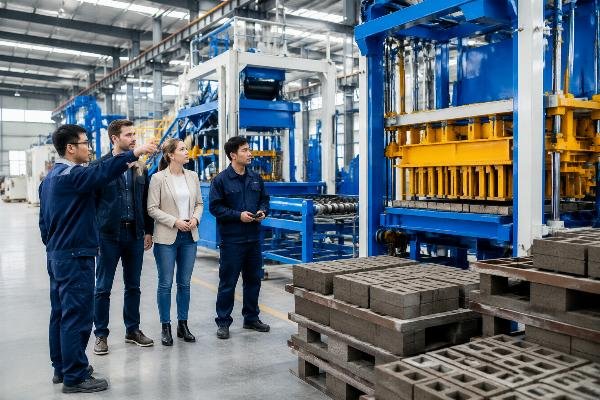
A QT12-15 block machine full line package covers the entire production ecosystem: raw material batching, concrete mixing, block forming, pallet circulation, curing, and finished product stacking—not just the main hydraulic press. Skipping any segment creates bottlenecks that silently destroy output, block strength, and return on investment.
I still remember flying to Lagos a few years back because a Nigerian client blamed our QT6-15 machine for failing strength tests. When I walked onto their yard, they were mixing concrete by wheelbarrow and curing blocks directly on bare soil under the sun. The machine was fine. The system around it didn’t exist. That’s the reality across emerging markets: buyers sign contracts for a QT12-15 block machine full line package, then discover halfway through installation that the "full line" label was marketing—critical peripherals were excluded from the quotation. [NEED_CITE: common procurement pitfalls in turnkey concrete block plant projects]
Let me walk you through what a real full line looks like, how to size each segment, and what to verify before you sign anything.
What Does a QT12-15 Full Line Package Actually Include?
A true full line package covers four functional zones: material preparation, forming and circulation, curing, and finishing—each with matched capacity.
Many suppliers label their quotation as a QT12-15 block machine full line package while only including the main press, a basic mixer, and a short conveyor. The missing pieces—batching accuracy, pallet volume, curing space, and stacking automation—are exactly where production collapses under real-world conditions.
A properly configured QT12-15 block machine full line package should contain:
| Segment | Core Equipment | Function |
|---|---|---|
| Material Preparation | PLD series batching machine, cement silo, screw conveyor, pan or twin-shaft mixer | Proportioned aggregate and cement feeding with consistent moisture control |
| Forming & Circulation | QT12-15 main hydraulic press, pallet loader, wet product conveyor, pallet return system | High-pressure vibration forming with continuous pallet recycling |
| Curing | Curing chamber or open-yard racks, optional steam or mist system | Controlled hydration environment for strength development |
| Finishing | Cube cutter, finger car stacker, face mix feeder optional | Product dimensioning and automated palletized stacking |
A West African buyer once purchased what was sold as a complete line but arrived without a proper batching plant. They improvised with volume-based mixing. Block compressive strength dropped noticeably within the first month. Re-ordering the missing batching segment and recalibrating the mix design cost several times the original savings—and delayed revenue generation by months. [NEED_CITE: impact of inaccurate batching on concrete block compressive strength]
The lesson: if your supplier’s quotation doesn’t itemize each segment with model numbers and quantities, you don’t have a QT12-15 block machine full line package—you have a machine order with accessories.
How to Match Batching Plant Capacity to QT12-15 Output?
Undersized batching is the single most common bottleneck in QT12-15 installations—the main press waits for material instead of running.
The QT12-15 main press produces a large volume of blocks per cycle. If your mixer discharge volume and batching cycle time cannot feed the press continuously, the machine sits idle between cycles. This is a sizing calculation, not a guess.
Here is the methodology we use when configuring a QT12-15 block machine full line package:
- Calculate press consumption per cycle. The QT12-15 mold box handles a substantial concrete volume per shot. Multiply this by the target cycle time to get hourly concrete demand.
- Match mixer discharge volume. A twin-shaft mixer must discharge enough mixed material per batch to cover multiple press cycles. If one batch only covers one press shot, the mixer becomes the ceiling.
- Size the batching hopper compartments. Aggregate compartments must hold enough material for extended continuous runs without reloading from the stockpile—otherwise loader downtime interrupts the entire line.
- Verify cement silo and screw conveyor throughput. Cement must arrive at the mixer at a rate that matches the batch cycle, not lag behind it. [NEED_CITE: concrete batching plant capacity matching principles for block making lines]
A MENA contractor upgrading from a smaller model to the QT12-15 kept their existing mixer. The mixer discharge was adequate for the old machine but fell short for the QT12-15’s demand. The result: the press idled between batches, and daily output stayed well below nameplate capacity. Upgrading the mixer and adding a properly sized batching machine restored the line to expected throughput.
When evaluating any QT12-15 block machine full line package, ask the supplier for the batching-to-press ratio calculation in writing. If they can’t show it, the line wasn’t engineered—it was assembled from catalog parts.
QT12-15 Full Line: Chinese vs. European vs. Turkish Package Comparison
Price gaps between regions are substantial—but the real differences hide in peripheral inclusion rates, delivery timelines, and after-sales responsiveness.
Buyers comparing quotations for a QT12-15 block machine full line package often see European quotes at the top, Turkish in the middle, and Chinese at the bottom. The price difference is real. But the decision matrix goes far beyond the machine price tag.
| Comparison Factor | European Package | Turkish Package | Chinese Package |
|---|---|---|---|
| Base Price Level | Substantially higher | Moderately high | Noticeably lower |
| Delivery Lead Time | Extended | Moderate | Relatively short |
| Peripheral Inclusion Rate | Typically comprehensive | Varies by supplier | Requires careful verification |
| Customization for Local Conditions | Limited standard options | Moderate flexibility | High flexibility for voltage, raw material, site layout |
| After-Sales Response in Emerging Markets | Slow unless local partner exists | Moderate | Fast with direct manufacturer support |
| Certification Scope | Full CE coverage | Partial CE common | CE/SGS/ISO available from established manufacturers |
[NEED_CITE: comparative market positioning of concrete block machinery manufacturers by region]
A Southeast Asian distributor once compared a European turnkey quote against a Chinese QT12-15 block machine full line package from a Linyi manufacturer. The Chinese package came in substantially lower, with delivery completed in weeks rather than months. The European quote included more peripherals as standard—but the Chinese supplier matched the peripheral list once the buyer itemized exactly what was needed. The delivery speed difference alone saved the distributor months of lost selling season.
The critical point: a cheaper quotation doesn’t automatically mean better value. You must verify that every segment is included, that certifications cover the actual equipment shipped, and that the manufacturer has field experience in your specific market conditions—unstable grids, high dust environments, and local aggregate variations.
What Should You Verify Before Signing a Full Line Contract?
An itemized bill of materials is your only protection against the "full line" label being used as a marketing term rather than a technical commitment.
Before signing any contract for a QT12-15 block machine full line package, insist on the following verifications:
- Itemized BOM with model numbers and quantities. Every component—from the batching hopper sensors to the pallet return chain—must be listed. Vague descriptions like "conveyor system" or "electrical panel" are red flags.
- Certification scope matching. CE or SGS certificates must list the specific machine models included in your package, not a generic product family. [NEED_CITE: CE certification scope requirements for concrete block making machinery exports]
- Installation and commissioning terms. Confirm whether the supplier sends engineers on-site, for how long, and whether operator training is included. A QT12-15 block machine full line package without commissioning support is a risk—hydraulic and vibration calibration require hands-on expertise.
- Spare parts list with the initial order. Wear parts—mold liners, vibration motor bearings, pallet surfaces—should be quoted alongside the main order. Sourcing these later from a different supplier introduces compatibility issues.
- Pallet specification alignment. Pallet material, thickness, and total quantity must match the press specification and the stacking system. A MENA contractor upgrading to the QT12-15 discovered that their existing pallets didn’t match the new loader and stacker specs, causing repeated misalignment and extended downtime until matched pallets were procured.
[NEED_CITE: procurement checklist for turnkey concrete block production line contracts]
If a supplier hesitates on any of these points, the hesitation is your answer. A properly configured QT12-15 block machine full line package from an experienced manufacturer will come with all of this documented before the contract is signed.
How Long Until a QT12-15 Full Line Pays for Itself?
ROI speed depends on three variables you can control: block selling price, daily output consistency, and operating cost discipline—not just the machine’s nameplate capacity.
The QT12-15 is a high-output machine. When the entire QT12-15 block machine full line package is properly configured and the market absorbs the output, payback in emerging markets can happen within a reasonable timeframe. But "nameplate capacity" and "actual daily output" are very different numbers.
The ROI framework works like this:
- Revenue side: Multiply daily block output by local selling price per block. Daily output depends on shift hours, mold changeover frequency, and—critically—whether the batching and curing segments keep the press running continuously.
- Cost side: Raw material cost per block, labor per shift, electricity consumption, and pallet replacement frequency. Electricity costs in markets with unstable grids can be significant if the line draws heavy load without power factor correction. [NEED_CITE: operating cost structure of fully automatic concrete block production in emerging markets]
- Payback calculation: Total investment divided by monthly net profit gives the payback period in months.
The West African buyer mentioned earlier—after re-ordering the full batching segment and commissioning the complete QT12-15 block machine full line package—saw their ROI recovery timeline compress to a range that made the initial delay look like an expensive lesson. Block quality stabilized, rejection rates dropped, and the line began producing at consistent daily volumes.
A government contractor in Latin America running the QT12-15 on a public housing project reported that the line’s output consistency allowed them to commit to delivery schedules that smaller machines simply couldn’t support. The contract volume justified the full line investment, and the payback came well within the project timeline.
[NEED_CITE: return on investment analysis methodology for concrete block manufacturing plants]
The takeaway: the QT12-15 block machine full line package pays for itself when the system runs as a system—not when the press runs alone.
Conclusion
A QT12-15 block machine full line package is an integrated production ecosystem, not a single machine with add-ons. Every segment—batching, forming, curing, stacking—must be matched in capacity, verified in specification, and documented in the contract. The difference between a profitable block plant and a costly installation lesson comes down to whether the buyer treats the full line as a system from day one.
Leave a Reply