

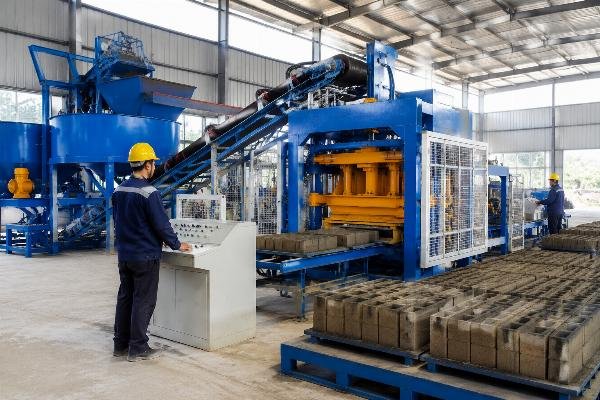
Buy QT6-15 Block Machine Wholesale Supplier
The cheapest QT6-15 quote you receive today will almost certainly cost you more than the most expensive one within a single production season.
Wholesale pricing for QT6-15 block machines varies drastically not because of brand premiums, but because of hidden configuration gaps in motors, hydraulic cooling, mould steel thickness, and PLC components. True cost-effectiveness comes from matching component durability to your local power stability, raw material abrasiveness, and maintenance capability—not from chasing the lowest sticker price.
I still remember a caller from Lagos who forwarded me a competitor’s quotation for a QT6-15 semi-automatic line. The number on the page looked attractive—several thousand dollars below what we typically quote. When I asked him to share the configuration sheet, the gaps appeared within minutes. The motor was listed without a brand name, the hydraulic station had no cooling circuit specified, and the mould steel thickness was omitted entirely. I told him plainly: that machine would burn out its moulds before the rainy season ended, and every day of downtime would swallow the savings many times over. He paused, then asked me to walk him through what actually separates a reliable wholesale package from a hollow one. That conversation reinforced a pattern I see across emerging markets—buyers comparing spec sheets that look identical on paper, yet perform completely differently once concrete dust and voltage spikes enter the picture [NEED_CITE: root cause distribution of block machine downtime in emerging markets per industry maintenance surveys].
Let me break down exactly what you need to verify before signing a wholesale purchase order.
Why Do Wholesale Quotes for QT6-15 Vary So Much?
Price gaps between suppliers stem almost entirely from hidden component configurations, not from differences in brand reputation or marketing spend.
When you request quotations from multiple sources, the spec sheets often appear interchangeable. Same cycle time, same block output per mould, same nominal power rating. Yet the invoices can differ by several thousand dollars. The discrepancy lives inside the machine, in areas that generic brochures rarely detail [NEED_CITE: component-level cost structure analysis of semi-automatic block making machines].
Consider the motor. A branded, new-manufacture motor with proper insulation class and thermal protection costs substantially more than a refurbished unit rewound in a small workshop. Both will spin the mixer on day one. The refurbished unit, however, will overheat and fail under continuous tropical ambient temperatures—often within a few months. The replacement cost, plus the concrete that hardens inside the mixer during the stoppage, erases the initial savings entirely.
The hydraulic station tells a similar story. A system without an oil cooler may function adequately in temperate climates. Ship it to West Africa or the Middle East, where ambient temperatures regularly exceed forty degrees Celsius, and the hydraulic fluid degrades rapidly. Seals harden, valves stick, and the vibration table loses synchronization. Suppliers who omit the cooler from their quotation are not being clever—they are shifting the failure cost to you.
Mould steel thickness is perhaps the most frequently obscured variable. A difference of just two millimetres in the wear plate determines whether the mould survives tens of thousands of cycles or warps after a few thousand. Abrasive raw materials—common in regions where river sand is replaced with crushed granite dust—accelerate wear dramatically. The thinner plate saves the supplier a modest amount per unit, but it forces you into a mould replacement cycle that halts production and multiplies logistics expense [NEED_CITE: relationship between mould steel thickness and service life under abrasive aggregate conditions].
| Configuration Element | Budget-Oriented Quote | Transparent Wholesale Quote |
|---|---|---|
| Motor Origin | Unspecified or Refurbished | Branded, New-Manufacture, Verifiable |
| Hydraulic Cooling | Not Included | Integrated Oil Cooler as Standard |
| Mould Steel Thickness | Omitted from Spec Sheet | Explicitly Stated with Grade |
| PLC Controller | Generic or Unbranded | Recognized Brand with Local Support |
| Voltage Adaptation | Fixed Rating Only | Customizable to Local Grid Range |
A distributor in South America once stocked a batch of machines sourced purely on price. Within a single dry season, voltage fluctuations in inland provinces damaged control boards across multiple installations. The machines lacked surge-tolerant electrical components. The distributor’s reputation in the region took far longer to rebuild than the procurement savings were worth.
What Critical Configurations Must You Verify Before Buying?
Focus your due diligence on four non-negotiable elements: motor traceability, hydraulic thermal management, mould steel specification, and control system provenance.
Before committing to any wholesale purchase, request a detailed configuration breakdown—not a marketing brochure. A serious manufacturer will provide component-level documentation that lets you verify exactly what you are paying for. If a supplier hesitates or redirects you to generic performance claims, treat that as a warning signal [NEED_CITE: procurement checklist for concrete block machinery component verification].
Motor Quality and Traceability
The motor drives every critical motion: mixing, vibration, and material feeding. Insist on knowing the brand, manufacture date, insulation class, and whether the unit is new or refurbished. A verifiable motor carries a nameplate with traceable serial information. Refurbished motors may lack this entirely. In dusty production environments, the motor’s IP protection rating matters as much as its power output. Without adequate sealing, concrete dust infiltrates the windings and causes premature insulation failure.
Hydraulic Station Thermal Management
Hydraulic systems generate heat continuously during operation. In warm climates, ambient temperature compounds this thermal load. An integrated oil cooler—whether air-cooled or water-cooled—maintains fluid viscosity within the design range, preserving seal integrity and valve responsiveness. Ask specifically whether the cooler is included as standard or offered as an optional upgrade. Some suppliers list the hydraulic station as "complete" while excluding the cooler from the base package, then charging extra later.
Mould Steel Thickness and Material Grade
The mould is the heart of the block machine. Its wear plates contact abrasive aggregates on every cycle. Request the exact thickness in millimetres and the steel grade. High-carbon or manganese-alloy steels resist abrasion far better than mild steel. The difference in service life is substantial—often measured in multiples rather than percentages. A transparent supplier will state these figures openly and explain the trade-offs between different grade options for your specific raw material profile.
PLC and Electrical Control System
The programmable logic controller governs cycle timing, vibration patterns, and safety interlocks. A recognized brand ensures that replacement modules are available locally or can be shipped quickly. Generic controllers may work initially but become impossible to service when a component fails. Additionally, verify that the electrical cabinet is rated for your local voltage range and includes surge protection. Grid instability is a reality across many emerging markets, and control boards are among the most vulnerable components [NEED_CITE: electrical failure modes in block making machines under unstable grid conditions].
When I prepare a configuration for a buyer in Southeast Asia upgrading from manual production, I always ask about their local electrician’s familiarity with PLC diagnostics. If the answer is limited, I specify a controller brand with multilingual interface support and widely available replacement modules. The machine must be maintainable in its actual operating environment, not just in the factory where it was assembled.
How to Match the Machine Configuration to Your Local Site Conditions?
Unstable power grids, high dust concentrations, and limited technical maintenance infrastructure demand specific protective configurations that standard quotations often overlook.
A QT6-15 block machine is not a universal product. It operates inside a specific physical and logistical context—your site. Ignoring that context is the single most common reason why machines underperform or fail prematurely in emerging markets [NEED_CITE: site-condition adaptation requirements for construction equipment in tropical and arid climates].
Voltage Stability and Electrical Protection
In many regions across Africa, Latin America, and parts of Southeast Asia, industrial power supply fluctuates well beyond the tolerance ranges of standard electrical components. Voltage sags, phase imbalances, and sudden surges are routine rather than exceptional. A machine configured for a stable European grid will suffer repeated control board failures in such conditions. The solution is not simply a voltage stabilizer—it is specifying contactors, relays, and PLC power modules rated for a wider input range, combined with industrial-grade surge arrestors inside the control cabinet. When sourcing from a wholesale supplier, confirm explicitly that the electrical configuration matches your site’s actual voltage profile, not a generic international standard.
Dust and Ambient Temperature Sealing
Concrete block production generates enormous quantities of cement dust. In dry, windy environments, this dust permeates every exposed surface. Electrical cabinets, motor housings, and hydraulic valve banks need enhanced sealing—higher IP ratings, filtered ventilation ports, and protective covers on sensitive connectors. Similarly, hydraulic hoses and seals must be specified for the ambient temperature range of your location. Standard rubber compounds harden and crack in sustained high heat, leading to leaks and pressure loss. A supplier who asks about your local climate and dust conditions before finalizing the configuration is demonstrating the kind of attention that prevents field failures.
Maintenance Skill Level and Component Accessibility
Not every production site has access to technicians trained in hydraulic diagnostics or PLC troubleshooting. If your local maintenance capability is limited, prioritize machines with mechanical simplicity where possible, modular electronic components that can be swapped without reprogramming, and widely available consumable parts. Complex proprietary systems may perform beautifully in a showroom but become liabilities when the nearest qualified technician is hours away. During my time on the assembly floor, I watched machines return from markets where operators had no access to diagnostic tools—entire hydraulic blocks had to be replaced because a single seal could not be sourced locally. Modular design and standardised fittings matter more than marginal performance gains in such contexts.
A contractor in the Philippines, transitioning from manual block making to semi-automatic production, needed a machine that his existing workshop staff could maintain. We specified a configuration with mechanical adjustment points instead of fully digital calibration, standard hydraulic fittings available in Manila, and a controller with a simplified local-language interface. The machine has run through multiple typhoon seasons without a single electronics-related stoppage.
How to Calculate the True Total Cost of Ownership?
The purchase price is only the entry point. A rigorous total cost of ownership calculation must incorporate spare parts consumption rates, expected downtime losses, and logistics expenses over the machine’s first several years of operation.
Buyers focused exclusively on the initial invoice figure routinely underestimate the financial impact of component failures and production interruptions. A machine that costs less upfront but requires frequent mould replacements, hydraulic repairs, or electrical replacements will generate a total expenditure that dwarfs the original savings [NEED_CITE: total cost of ownership methodology for construction machinery in developing economies].
Spare Parts Lifecycle and Replacement Frequency
Moulds, vibration motors, hydraulic seals, and mixer blades are consumable components. Their replacement intervals depend directly on the quality of materials used and the abrasiveness of your raw aggregates. A mould fabricated from thin mild steel may need replacement after a relatively short production run, while a thicker manganese-alloy mould continues producing dimensionally accurate blocks for a substantially longer period. Calculate the per-block cost of mould wear, not just the per-unit purchase price. Factor in the shipping weight and import duties for replacement parts—these logistics costs accumulate quickly across multiple replacement cycles.
Downtime Loss Quantification
Every hour the machine is stopped represents lost production, idle labour, and delayed order fulfilment. In project-driven markets—road paving contracts, government housing programmes—delivery delays can trigger penalty clauses that far exceed the machine’s value. A single major hydraulic failure during a critical production window can generate losses measured in multiples of the component’s replacement cost. When comparing wholesale quotations, ask the supplier for documented mean time between failures for key components, or at minimum, request references from buyers operating in similar conditions [NEED_CITE: downtime cost impact analysis in block production operations].
Logistics and Import Cost Visibility
The machine’s FOB price is not your landed cost. Freight, port handling, customs duties, inland transport, and insurance vary significantly by destination. A heavier machine with thicker steel components costs more to ship but may last considerably longer. Conversely, a lighter machine with thinner materials may appear cheaper to transport but will demand earlier replacement. Ensure your wholesale supplier provides transparent packing dimensions and weight data so you can calculate landed costs accurately before comparing offers.
An investor in Ghana was evaluating two quotations for a complete block production line. One was noticeably cheaper on paper. When we modelled the three-year operating cost—including two mould replacement sets, hydraulic seal overhauls, and an estimated production loss from downtime—the cheaper option’s total cost exceeded the more robustly configured alternative by a substantial margin. The investor chose the higher-initial-cost package and later confirmed that the machine operated through the peak rainy season without a single mould-related stoppage.
Conclusion
Wholesale procurement of QT6-15 block machines demands configuration literacy, not just price comparison.
The gap between the lowest quotation and the most economical machine over its operating life is determined by motor traceability, hydraulic thermal management, mould steel specification, electrical adaptation to local grids, and a realistic assessment of spare parts and downtime costs. Verify every component, match the configuration to your actual site conditions, and calculate ownership cost over multiple years rather than judging solely by the invoice figure. The right wholesale supplier will welcome these questions—because transparency in configuration is the only honest foundation for a lasting business relationship.
Leave a Reply