

Commercial Pallet Return System for Panama: Factory-Direct Wholesale Supplier
Most buyers assume ISO or Euro pallets are universal standards; in Panama, informal wooden pallets vary significantly in width, causing jams in rigid European-style sorters.
Selecting a Commercial Pallet Return System for Panama requires strict adherence to local non-standard pallet dimensions and high-humidity operational adjustments, not just generic European specifications. The core challenge is not motor power but the sensor logic’s ability to handle dirty, wet, or broken pallets common in tropical construction sites, combined with belt materials that resist moisture-induced slippage.
I recall a specific incident involving a client in the Colon Free Zone who ordered a standard recycling line. The machine arrived with sorter rails calibrated for strict Euro-pallet widths. However, the local wooden pallets used in their block plant were consistently wider by a small but critical margin. This mismatch caused frequent jamming at the转弯 curves, halting production during peak hours. The retrofit required cutting new guides on-site to accommodate a width variance tolerance of roughly 20-30mm. This experience highlighted that importing a system without first measuring the top five most common local pallet dimensions is a recipe for operational bottlenecks.
To avoid such costly sizing errors, investors must prioritize systems that offer adjustable guide rails and robust climate-resistant components. This guide details how to match your Commercial Pallet Return System for Panama to local realities, ensuring seamless integration with concrete block manufacturing lines.
Why Do Generic Pallet Systems Fail in Panama?
The primary reason for failure is the assumption of uniformity in pallet dimensions. In many European markets, pallet pools enforce strict size controls. In Panama, especially among smaller suppliers and informal logistics networks, wooden pallets are often built to fit specific cargo loads rather than international standards. This results in significant width and length variations.
When a rigid Commercial Pallet Return System for Panama is installed, these variances cause misalignment. Sensors may fail to detect the pallet edges correctly, leading to missed sorting cycles or mechanical jams. Furthermore, the tropical climate introduces another layer of complexity. High humidity levels can cause wooden pallets to absorb moisture, making them heavier and more prone to warping. A system designed for dry climates may struggle with the increased friction and weight.
[NEED_CITE: impact of tropical humidity on wooden pallet structural integrity and weight variance]
Another critical factor is the condition of the pallets. Construction sites in humid regions often see pallets exposed to rain and mud. Generic systems with sensitive optical sensors can be blinded by dirt or water droplets, leading to false readings. Therefore, the reliability of a Commercial Pallet Return System for Panama depends heavily on its ability to tolerate imperfect input conditions.
Buyers should verify that the system uses mechanical or inductive sensors rather than purely optical ones, as these are less affected by surface contaminants. Additionally, the control logic must include delay timers and error recovery protocols to handle occasional misfeeds without shutting down the entire line.
Key Specs: Matching Sorter Width to Local Wood Pallets
Before placing an order, it is essential to conduct a physical audit of the pallets currently in use. This involves measuring the width, length, and height of the most frequently used pallets. The sorter width must be adjustable to accommodate the maximum observed width plus a safety margin.
| Feature | Generic Euro-Spec System | Adapted Panama-Spec System |
|---|---|---|
| Guide Rail Adjustability | Fixed or minimal adjustment | Wide-range manual or auto-adjustment |
| Tolerance for Width Variance | Low (strict ISO compliance) | High (accommodates informal sizes) |
| Sensor Type | Primarily optical | Hybrid (mechanical/inductive/optical) |
| Frame Material | Standard steel | Galvanized or stainless for humidity |
A case from a mid-sized block plant illustrates this point. The owner initially opted for a lower-cost imported unit with fixed rails. Within weeks, the team spent hours daily clearing jams caused by slightly wider pallets. After switching to a system with wide-range adjustable guides, the jamming incidents dropped noticeably. The key was allowing for a variance that exceeded standard ISO tolerances.
[NEED_CITE: common dimensional variances in Latin American wooden pallet pools]
When evaluating a Commercial Pallet Return System for Panama, ask the supplier for the exact range of adjustability for the side guides. If the system cannot accommodate a variance of at least 30mm, it is likely unsuitable for local conditions. Also, check the height clearance. Local pallets may be thicker due to the use of rougher lumber, requiring higher clearance to prevent scraping against the conveyor frame.
Furthermore, consider the entry angle of the pallets into the sorter. A steeper angle may cause lighter or warped pallets to tip over. A gradual entry with roller supports helps stabilize the pallet before it reaches the sorting mechanism. This simple design tweak can significantly reduce early-stage failures.
Climate Considerations: Belt Materials for High Humidity
Panama’s coastal humidity poses a unique challenge to conveyor systems. Standard rubber belts tend to absorb moisture, which reduces their coefficient of friction. This leads to slippage, especially when carrying heavy, wet wooden pallets. Slippage not only reduces efficiency but also causes uneven wear on the belt and drive motors.
In one instance, a client reported that their standard rubber belts required frequent tightening and eventually failed prematurely. Switching to textured PVC belts resolved the issue. PVC is less susceptible to moisture absorption and maintains consistent friction levels in humid environments. The textured surface provides additional grip, preventing pallets from sliding back on inclined sections.
[NEED_CITE: material science comparison of rubber vs PVC friction coefficients in high humidity]
Maintenance frequency is another critical metric. Systems using inappropriate belt materials may require maintenance intervals that are substantially shorter than expected. This increases downtime and labor costs. When selecting a Commercial Pallet Return System for Panama, specify that the belts must be suitable for tropical climates. Ask for data on the material’s resistance to hydrolysis and microbial growth, as mold can degrade certain polymers over time.
Additionally, electrical components must have a high IP rating to protect against moisture ingress. Coastal air contains salt, which can accelerate corrosion of unprotected metal parts and circuit boards. Ensure that all motors, sensors, and control boxes are sealed to at least IP54 standards, with IP65 preferred for areas directly exposed to spray or washdowns. This protection extends the lifespan of the electronics and reduces the risk of short circuits.
Integration with Block Machines: Syncing with QT Series Output
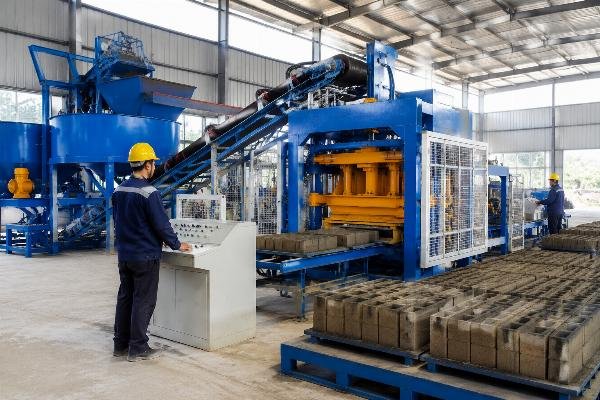
The pallet return system does not operate in isolation; it is part of a larger production line. Its throughput must match the output of the block machine. For example, if you are using a QT10-15 block machine, the palletizer and return system must handle the corresponding number of pallets per hour. A mismatch here creates a bottleneck, forcing the block machine to stop waiting for empty pallets.
Shiyue’s QT series block machines are designed with integrated pallet handling in mind. The control systems can communicate with the pallet return unit to synchronize operations. This ensures that pallets are returned at the exact rate they are consumed. Without this synchronization, operators may need to manually intervene, negating the benefits of automation.
[NEED_CITE: typical cycle times and pallet consumption rates for QT series block machines]
When designing the layout, consider the path length of the return loop. A longer loop allows for more pallets to be in circulation, acting as a buffer during temporary stops. However, too long a loop increases cost and floor space requirements. The optimal length depends on the production speed and the number of pallets needed for curing. A balanced design ensures continuous flow without excessive inventory of empty pallets.
For established manufacturers upgrading their lines, it is crucial to measure the current pallet cycle time. This data helps in sizing the new Commercial Pallet Return System for Panama correctly. Under-sizing leads to bottlenecks, while over-sizing wastes capital. The goal is to achieve a smooth, continuous flow that maximizes the utilization of the block machine.
ROI Calculation: Labor Savings vs. Import Costs
Investing in automation involves balancing upfront costs with long-term savings. In Panama, labor costs for manual pallet handling can add up quickly, especially when considering the physical strain and potential for injury. A semi-automatic or fully automatic pallet return system can replace a team of workers who would otherwise manually stack and transport empty pallets.
A practical ROI analysis should include not just labor savings but also reduced pallet damage. Automated systems handle pallets more gently than manual throwing or dragging, extending the life of the wooden pallets. This reduction in replacement costs contributes to the overall return on investment. Additionally, faster cycle times mean higher production output, which directly impacts revenue.
[NEED_CITE: average labor cost trends for manual material handling in Central American construction sectors]
Consider the import duties and shipping costs when calculating the total landed cost. Working with a supplier who offers turnkey solutions can simplify this process. Shiyue provides comprehensive support, including installation and training, which reduces the risk of costly errors during setup. A properly installed system starts generating value immediately, whereas a poorly installed one may require expensive corrections.
For private block plant investors, the payback period is a key decision factor. By eliminating the need for a large manual handling team, the system can pay for itself within a reasonable timeframe. The exact duration depends on production volume and local wage rates, but the trend towards automation is driven by the clear economic advantage of consistency and speed. Selecting the right Commercial Pallet Return System for Panama is thus not just a technical choice but a strategic financial decision.
Conclusion
Success lies in adapting global technology to local constraints.
Choosing a Commercial Pallet Return System for Panama demands a departure from generic specifications. By accounting for local pallet dimensions, humidity-resistant materials, and synchronized integration with block machines, manufacturers can avoid operational pitfalls. This approach ensures a robust, efficient, and economically viable production line tailored to the unique conditions of the region.
Leave a Reply