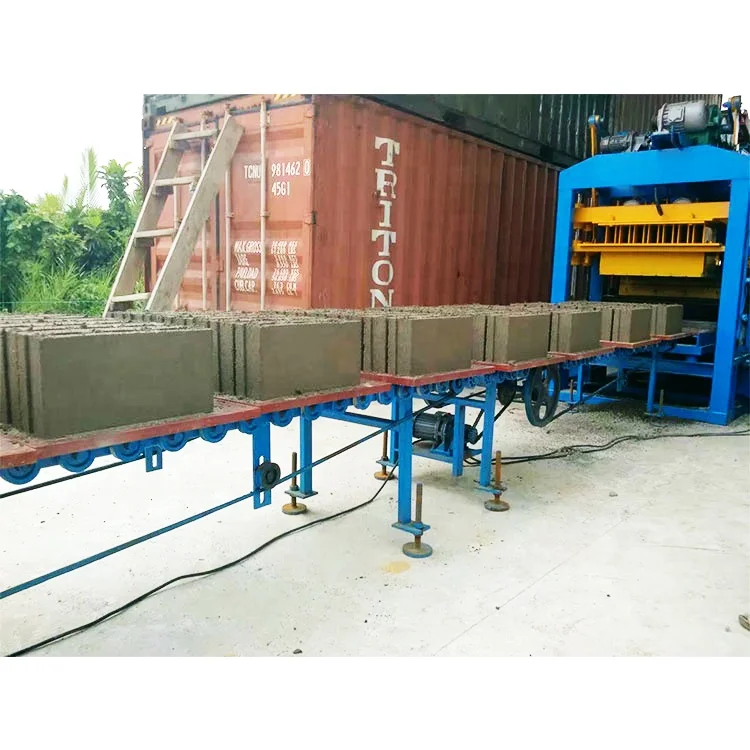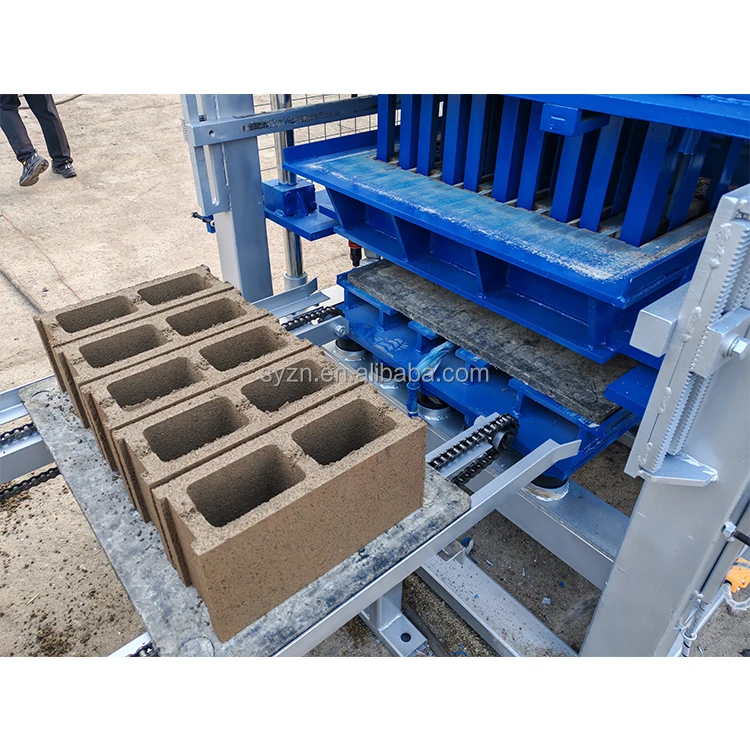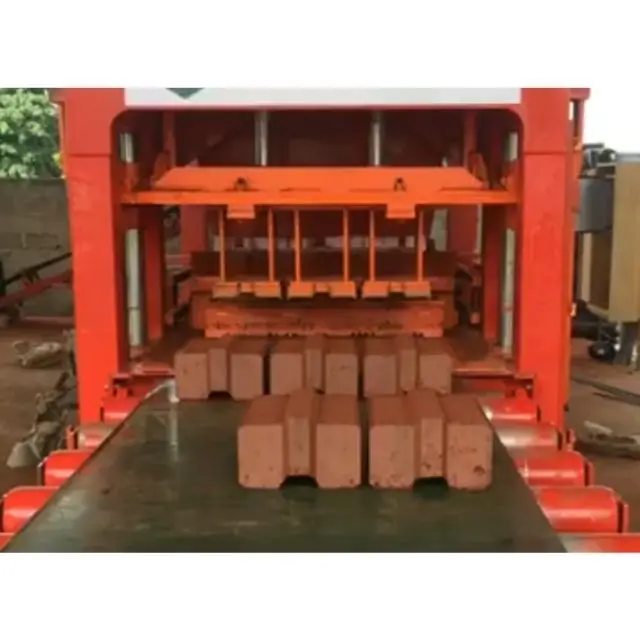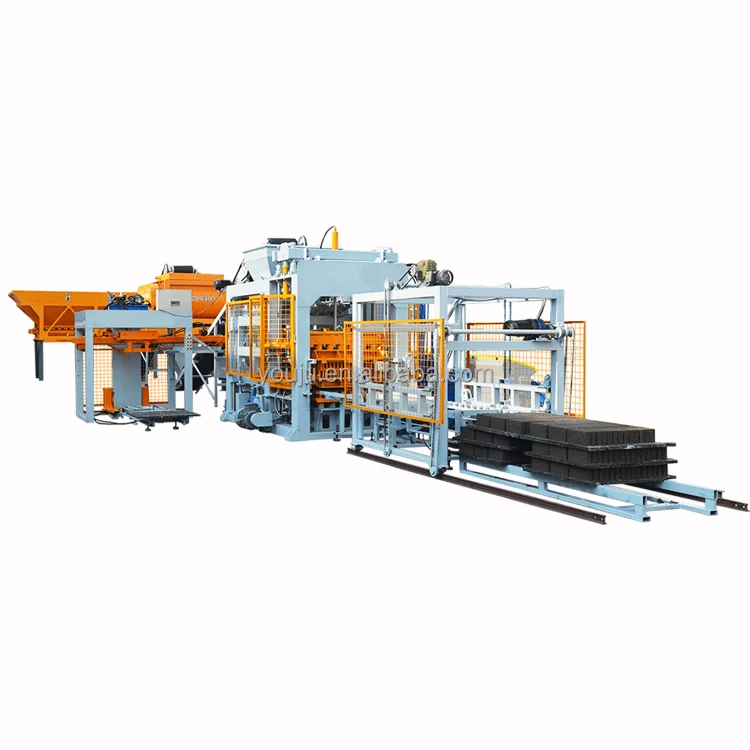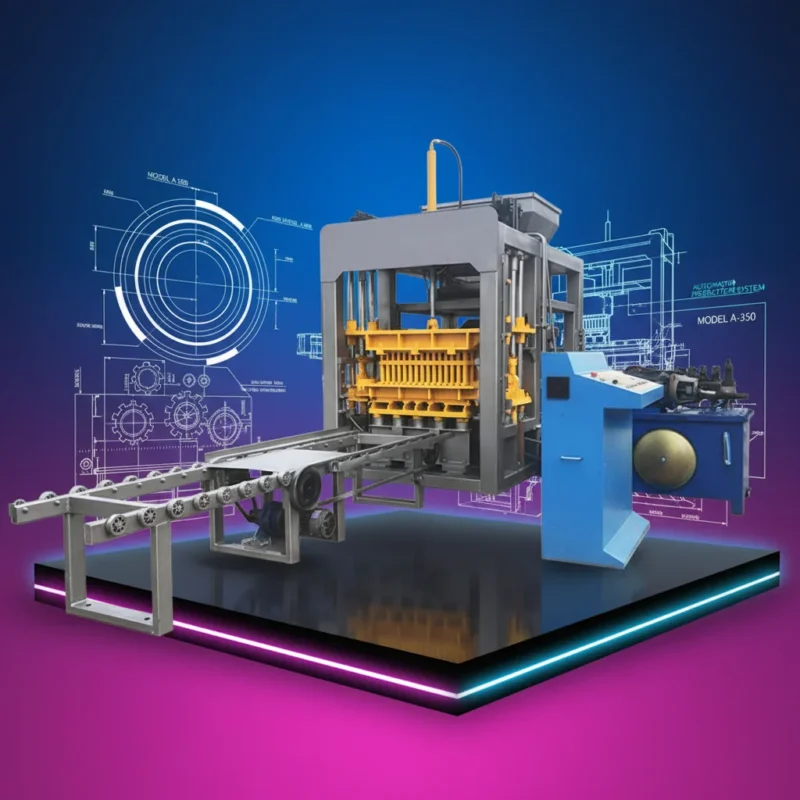

Description
Integrated Control Systems — The QT5-15 pairs PLC logic with hydraulic and vibration stations so pallet feeding, material dosing, and demoulding follow one programmed sequence rather than relying on separate manual triggers.
Technical Specifications
| Parameter | Value |
|---|---|
| Model | QT5-15 |
| Product Type | Automatic Hydraulic Block Making Machine |
| Overall Dimensions (L×W×H) | 7400 × 1950 × 2800 mm |
| Total Mass | 5000 kg |
| Overall Power | 32 kW |
| Vibration Frequency | 0–60 Hz |
| Vibration Force | 80 kN |
| Vibration Form | Platform Vibration |
| Moulding Mode | Automatic loading with vibration moulding |
| Pallet Size | 1100 × 550 mm |
| Molding Cycle | 15–20 s (basis to be confirmed per block format and material) |
| Demolding Method | Hydraulic |
| Control System | PLC with touch screen interface |
| Hydraulic System | Independent integrated hydraulic station |
| Mould Change System | Quick replacement for format switching |
| Block Compressive Strength | ≥ 15 MPa |
| Factory Area Required | 1000 m² |
| Output (Hollow block 400×200×200 mm) | 900–1200 pcs/h based on 5 pcs/mould at 15–20 s cycle |
| Output (Hollow block 400×150×200 mm) | 1080–1440 pcs/h based on 6 pcs/mould at 15–20 s cycle |
| Output (Solid brick 240×115×53 mm) | 5760–7680 pcs/h based on 32 pcs/mould at 15–20 s cycle |
| Output (Rectangular paver 200×100×60 mm) | 3600–4500 pcs/h based on 25 pcs/mould at 20–25 s cycle |
| Output (Zigzag paver 225×112.5×60 mm) | 2304–2880 pcs/h based on 16 pcs/mould at 20–25 s cycle |
| Raw Material Compatibility | Fly ash (up to 70%), slag, gangue, sand, crushed stone, cement, water |
| Fault Diagnostics | Remote control and fault diagnosis capability |
| Standards | CE |
Application Suitability
| Application | Material or Output |
|---|---|
| Hollow block production for masonry walls | Crushed stone, sand, cement with fly ash or slag |
| Solid brick production for load-bearing structures | Sand, cement, gangue or slag aggregate |
| Rectangular and zigzag paving for walkways and yards | Fine aggregate with cement binder |
| Interlocking brick production for retaining walls | Crushed stone and cement at higher compaction |
| On-site block production for housing projects | Locally sourced river sand or crushed stone with cement |
Why a PLC-Controlled Machine Still Produces Inconsistent Blocks
Automation removes operator variability only when the vibration and hydraulic parameters are matched to the actual mix on the factory floor.
I have walked into plants where a brand-new automatic block machine PLC controlled setup was churning out hollow blocks that crumbled at the edges. The PLC was doing exactly what it was told — running the same cycle time, the same vibration duration, the same hydraulic pressure — but the local river sand had a much higher clay content than the factory test mix. The vibration force and hydraulic pressure were never adjusted for that material. The machine cycled perfectly; the blocks failed anyway. [NEED_CITE: effect of aggregate clay content on concrete block compressive strength]
What the PLC Actually Takes Over
On the QT5-15, the programmable logic controller manages pallet feeding, material dosing from the storage hopper, vibration frequency ramp-up, hydraulic press engagement, and demoulding in one continuous loop. The touch screen stores process data for each block format, so switching from 400×200×200 mm hollow blocks to 200×100×60 mm pavers means recalling a saved recipe rather than asking the operator to remember every timing adjustment. Remote fault diagnosis means the control cabinet can be queried off-site when something stops cycling correctly.
Where the Upgrade Path Starts and Ends
Plant owners moving from manual pallet handling typically start with the QT5-15 in a semi-automatic configuration where pallets are fed by hand but the press cycle itself runs under PLC control. The system supports adding automatic pallet feeding, stacking, and eventually cubing as separate stations that plug into the same control logic. The key point is that each added station must have its cycle time synchronised to the press — a faster stacker that outruns the moulding cycle simply creates a bottleneck at the wrong end of the line. [NEED_CITE: block production line synchronisation between press and downstream handling]
Reading the Specifications That Actually Matter
The 80 kN vibration force and 0–60 Hz frequency range define how densely the mix is compacted before the hydraulic system applies final press pressure. These two values must be set against the buyer’s specific aggregate grading and cement ratio, not left at a catalogue default. The independent hydraulic station is physically separated from the vibration platform, which keeps hydraulic oil temperature and seal wear from being accelerated by constant shaking. Platform vibration rather than mould-only vibration means the entire pallet receives uniform energy distribution, reducing the thickness variation between blocks at the centre versus the edges of the pallet.
The Cost of Skipping Configuration Verification
Buyers who confirm nothing beyond the headline cycle time often discover that the 15–20 second moulding figure was measured on a mix the local supplier cannot replicate. Pallet size arrives mismatched to the curing racks already installed. The PLC display language is set to a default the operators cannot read, and commissioning stalls until the software is reloaded. [NEED_CITE: common commissioning delays in exported concrete block machinery]
Why Shiyue Machinery Fits the Automation Decision
The QT5-15 is specified as one matched system — press, mould, pallet, and handling stations share a single control logic rather than being assembled from unrelated suppliers. Vibration force and hydraulic pressure are set against the buyer’s actual mix sample and target block format before the machine leaves the factory. Mould design covers the formats the buyer’s market actually sells, with custom drawings available. The automation level is selectable, so a buyer can start semi-automatic and add stacking or cubing stations later without replacing the press. Installation support includes operator training on the PLC interface and recipe storage.
Documentation & Verification
- Line layout showing pallet flow from feed through press to stacking area
- Capacity calculation sheet stating block format assumed for each cycle time
- PLC program language and voltage confirmation signed off before production
- Factory test record on buyer’s specified block format and mix design
- Hydraulic and electrical schematic with component part numbers
- Operation manual covering recipe storage and format changeover steps
Installation, Commissioning & Support
- 1000 m² factory area required with level concrete floor rated for 5000 kg static load
- 32 kW total power draw requires dedicated circuit breaker and stable voltage supply
- Multi-station assembly: pallet feeder, press, hopper, conveyor, hydraulic unit, and PLC cabinet connected on site
- First-run commissioning includes PLC parameter tuning for local aggregate and mix ratio
- Operator training covers touch screen navigation, recipe recall, and fault code interpretation
- Wear parts list identifies mould liners, hydraulic seals, and vibration springs with replacement intervals
What to Send with Your Inquiry
To configure the QT5-15 correctly, provide the target block formats and required daily output per format, the locally available aggregate type and grading, site voltage and frequency, and the preferred PLC display language. If existing curing racks or forklifts are already on site, send their dimensions so pallet size can be matched before production begins.
Frequently Asked Questions
Q: How is the PLC display language and voltage confirmed before shipment?
A: Voltage, frequency, and PLC display language are confirmed in writing during the quotation stage and locked into the production order. The touch screen is loaded with the agreed language before the factory test, so operators see their own language the first time the machine powers on at the destination site.
Q: What automation level does the QT5-15 ship with by default?
A: The base configuration includes PLC-controlled press cycling with automatic material dosing and vibration. Pallet feeding, stacking, and cubing are available as add-on stations that integrate into the same PLC loop, allowing a phased upgrade from semi-automatic to fully automatic handling.
Q: How is cycle time verified for each block format?
A: The factory test runs each mould the buyer has ordered, and the actual cycle time is recorded per format. The capacity calculation sheet lists output based on that recorded cycle time for each block type, not a single generic figure.
Q: What remote diagnostics does the PLC system provide?
A: The PLC supports remote fault diagnosis, allowing the control system to be queried off-site when a fault code appears. This reduces downtime by identifying the fault source before a technician needs to travel to the plant.
Q: How are vibration force and hydraulic pressure matched to local materials?
A: The buyer provides a sample of the local aggregate and the intended mix ratio. Vibration frequency and hydraulic pressure are adjusted during the factory test to achieve the target block compressive strength with that specific mix.