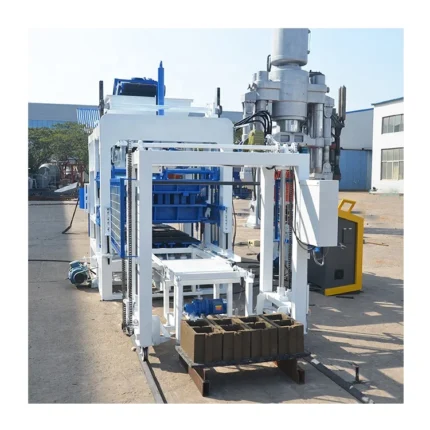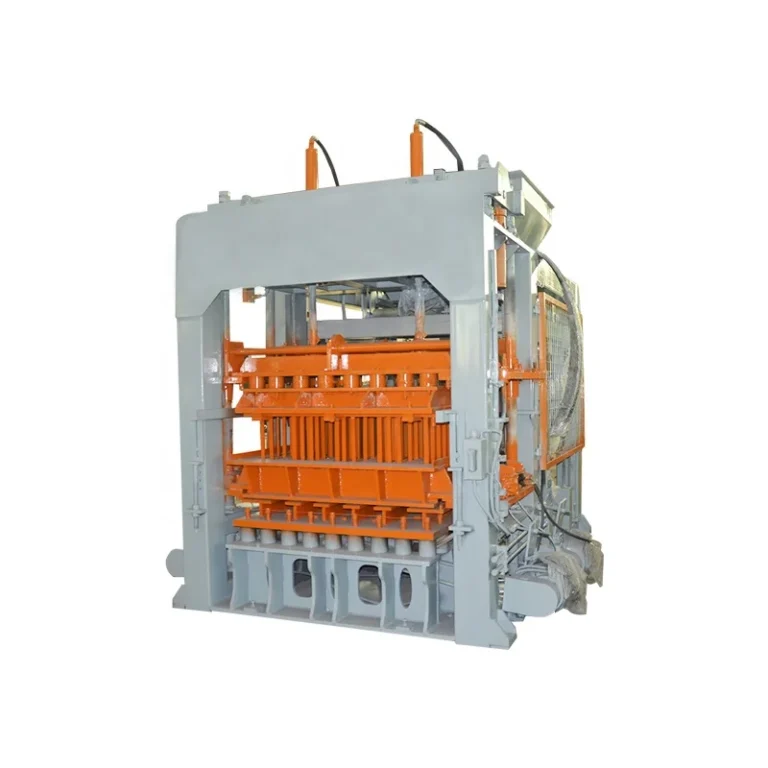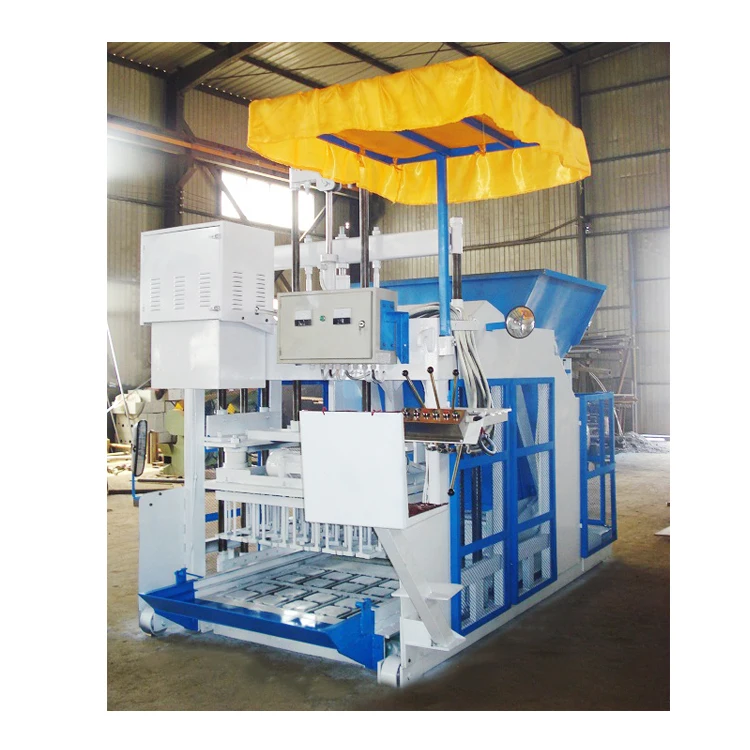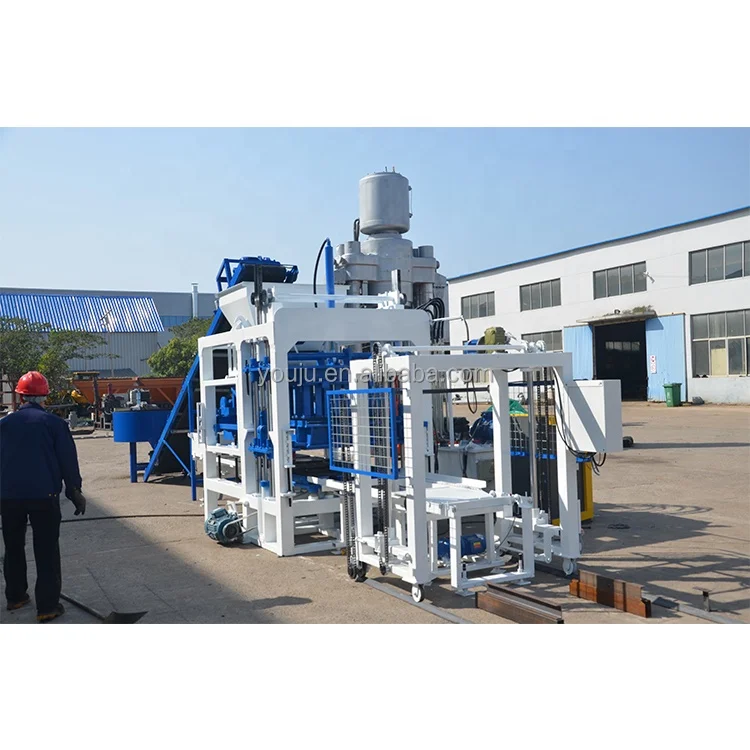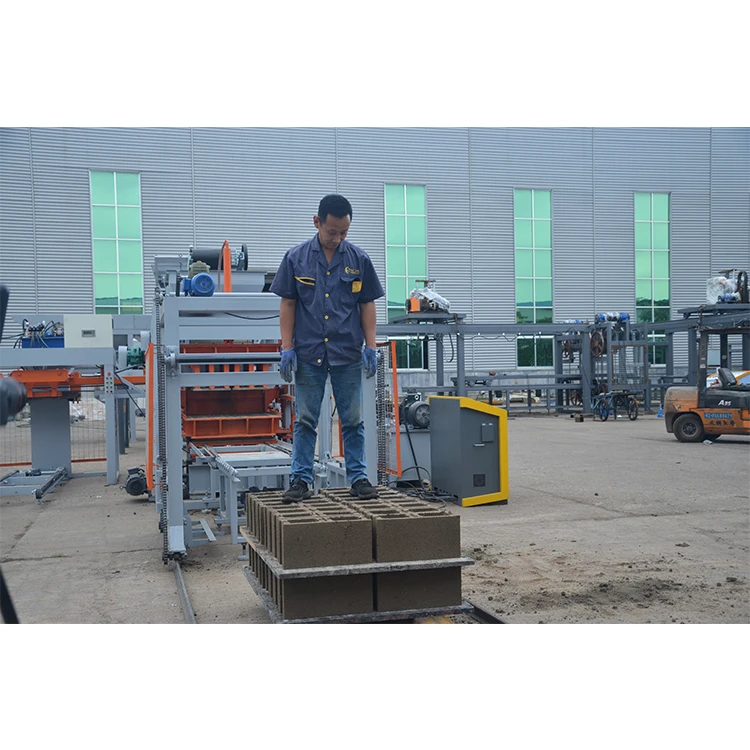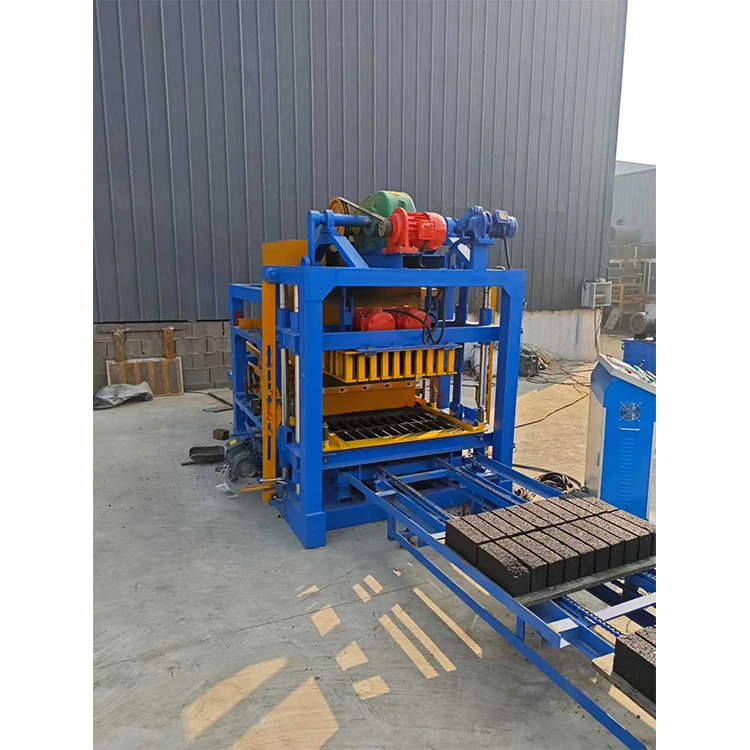


Description
Integrated System Matching — the QTJ4-25 PLC-controlled automatic block machine is specified against your actual mix design, local aggregate, and target block format rather than a catalogue default, ensuring that automation, vibration force, and pallet handling work as one matched line.
Technical Specifications
| Parameter | Value |
|---|---|
| Model | QTJ4-25 |
| Product Type | Automatic Concrete Block Making Machine |
| Control System | PLC controlled, fully automatic |
| Rated Power | 16.58 kW |
| Molding Cycle | 25 seconds |
| Output Capacity | 4600 pcs / 8 hours (basis not stated in source — confirm block format) |
| Pallet Size | 850 × 480 mm |
| Overall Dimensions | 6400 × 1500 × 2700 mm |
| Net Weight | 5000 kg |
| Vibration System | Vibration motor with large vibration box (non-hydraulic) |
| Automation Level | Fully automatic — pallet feeding, material feeding and scraping, block stacking |
| Frame Construction | Thickened steel frame |
| Main Drive Motor | Siemens motor |
| Voltage & Frequency | Configured to local supply (to be confirmed before production) |
| Raw Materials | Concrete, sand, cement, fly ash, crushed stone, lime, water |
| Block Formats | Hollow blocks, solid blocks/bricks, paver stone bricks |
| Warranty | One year, free parts supply during warranty period |
Application Suitability
| Application | Material or Output |
|---|---|
| Hollow block production for commercial and residential building walls | Crushed stone, cement, sand with fly ash or lime as binder |
| Solid brick production for load-bearing and partition structures | Concrete mix with graded aggregate up to coarse sand |
| Paver stone brick production for walkways, driveways, and yard surfaces | Fine aggregate concrete with cement-rich face mix |
| Medium-output block plant serving local construction contractors | Daily output matched to 850 × 480 mm pallet and 25-second cycle |
What "4600 Pieces per 8 Hours" Actually Means for Your Line
A capacity figure without a block format is a number, not a plan. I have watched buyers in West Africa receive their automatic concrete block making machine PLC controlled line only to discover the quoted output assumed a small solid brick they never intended to sell. The QTJ4-25 cycles at 25 seconds, but a 200 mm hollow block and a 60 mm paver occupy the same pallet differently, draw different compaction energy, and leave the curing yard at different densities. When the block format is not locked into the quotation, the daily output you actually achieve can fall noticeably short of what was discussed on paper. Always ask for a capacity calculation sheet that names the exact block dimensions and mix ratio behind the number [NEED_CITE: capacity calculation methodology for block machines].
Automation That Removes Three Manual Stations
The QTJ4-25 takes pallet feeding, material feeding and scraping, and block stacking out of the operator’s hands. On a semi-automatic line those three stations demand a worker each, and their pace dictates whether the press waits or overruns. The PLC sequence times each station to the 25-second molding cycle so the press is never starved of a pallet or left holding a finished block too long. For a plant owner moving up from manual operation, this is where labour consistency begins — the automatic concrete block making machine PLC controlled sequence does not slow down in the eighth hour the way a tired worker does.
Vibration Without Hydraulics — Simpler Maintenance, Honest Density
Instead of a hydraulic press head, the QTJ4-25 uses a vibration motor paired with a large vibration box to compact the mix against the mould walls. On installation sites across South Asia and sub-Saharan Africa, I have seen hydraulic lines fail within weeks when the local maintenance crew lacked the fittings and seals to repair them. A vibration-based system trades peak compaction force for dramatically simpler upkeep — no hydraulic pumps, no proportional valves, no oil contamination of the product [NEED_CITE: vibration versus hydraulic compaction in block making]. The trade-off is acceptable when your local service network is limited and your block strength requirement sits within the range vibration alone can reach.
Reading the Spec Sheet Against Your Actual Site Conditions
The 16.58 kW rated power covers the vibration motor, material feeder, pallet conveyor, and control panel together. Before the machine leaves the factory, you need to confirm that your local supply matches the configured voltage and frequency — a 50 Hz motor rewired for a 60 Hz grid will run faster, vibrate harder, and wear its bearings sooner than expected. The Siemens main drive motor is specified for continuous duty, but continuous duty only holds if the electrical supply is stable. The 850 × 480 mm pallet size must also match your existing curing racks and forklift; a pallet that does not fit the rack forces hand-stacking in the curing yard, undoing the automation you paid for inside the machine.
The Cost of Skipping the Configuration Conversation
Buyers who order from a catalogue without confirming their aggregate grading, target block format, and local voltage often arrive at commissioning with a machine that runs but does not produce sellable block. The mix may be too wet for the vibration force available, the pallets may not fit the curing yard, and the PLC display may show text the operator cannot read. Each of these is a solvable problem if caught before production — and an expensive delay if discovered on the container-opening day [NEED_CITE: commissioning delays in exported machinery]. The QTJ4-25 line is configurable; the question is whether configuration happens in the factory or on your shop floor.
Why Sourcing This Machine Here Makes Sense
Block machinery is our single focus, so the QTJ4-25 press, moulds, pallets, and handling equipment are specified as one matched system rather than assembled from separate suppliers. We set the configuration against your actual mix design and local aggregate, not a catalogue default. Mould design covers the formats your market sells, including custom drawings when standard formats do not match. The automation level is selectable — you can start with the full PLC package and add or remove stations as your plant grows. Installation support includes on-site commissioning and operator training so the PLC sequence is understood from the first shift. Documentation arrives with the machine, not weeks later by email.
Documentation & Verification
- Factory test record run on your specified block format before dispatch
- PLC program printout with display language confirmed to your operator’s requirement
- Pallet specification sheet matched to your curing rack dimensions and forklift capacity
- Electrical schematic with voltage and frequency noted per your local grid standard
- Mould drawing and format list covering every block type in your quotation
- Wear parts list with part numbers for first-year replacements
Installation, Commissioning & Support
- 6400 × 1500 mm footprint requires a level concrete slab with anchor bolt provisions
- 16.58 kW total draw needs a dedicated breaker and stable supply at confirmed voltage and frequency
- Machine ships dismantled for container loading; reassembly supervised on site
- First-day PLC parameter setting covers cycle timing, feeder gate position, and vibration duration
- Operator training includes mould change procedure and fault code reading on the confirmed display language
- One-year warranty with free parts supply and remote diagnostic support for PLC faults
What We Need From You to Build the Right Line
Send us the block formats you intend to sell — dimensions, wall thickness for hollow blocks, and surface finish for pavers. Tell us what aggregate you can source locally and its typical grading. Confirm your site voltage, frequency, and the language your operators read. With those three inputs we can return a capacity calculation that names a real block and a real mix, not a catalogue assumption.
Frequently Asked Questions
Q: How is the 4600 pcs/8h capacity calculated, and which block format does it assume?
A: That figure is based on a 25-second molding cycle across an 8-hour shift, but the exact block format and mix assumed are not stated in the source data. Before ordering, request a capacity calculation sheet that names the specific block dimensions and material ratio so you can compare it against the formats your market actually buys.
Q: What automation level does the QTJ4-25 include by default, and what is the upgrade path?
A: The default configuration covers automatic pallet feeding, material feeding and scraping, and block stacking under PLC control. If you are moving from a semi-automatic line, the upgrade removes three manual stations. Further stations such as automatic cubing or curing rack handling can be added as your plant volume grows.
Q: How are voltage, frequency, and PLC display language confirmed before shipment?
A: These are locked during the quotation stage, not at commissioning. You provide your local grid specification and preferred operator language; the electrical schematic and PLC program are set accordingly before production. This avoids the situation where a machine arrives with a display your operators cannot read.
Q: What is the mould change procedure, and how long does a format changeover take?
A: Mould change on the QTJ4-25 involves releasing the clamping bolts, lifting the old mould, seating the new one, and updating the PLC parameters for the new format’s cycle timing and feeder gate position. Actual changeover time depends on mould weight and crane availability on your site.
Q: Which spare parts should be stocked for the first year?
A: The wear parts list supplied with the machine identifies high-consumption items such as vibration motor bearings, feeder scraper blades, and pallet guide rollers. Stocking these before the first replacement is due prevents unplanned downtime while waiting for international shipping.