

Block Machine Manufacturer in Colombia: QT10-15 for Sale
Buying the cheapest block machine for Colombia usually costs more in the long run. Voltage mismatches alone can triple your inverter replacement bills within the first year.
The block machine market Colombia is expanding fast, driven by affordable housing mandates and road paving programs, but buyers must clear three gates before a single pallet is poured: certification compliance for customs, voltage customization for local grids, and raw material adaptation for regional clay content.
I remember loading a QT6-15 for a buyer in Valle del Cauca. The machine reached site, powered up, and the inverter burned out twice in the same week. The client called me at two in the morning, shouting in Spanish I barely understood. The root cause was not the machine quality; it was a grid fluctuation we had not spec’d for. Since that night, I check voltage stability, altitude, and clay silt content before I ever quote a configuration [NEED_CITE: Colombian grid voltage fluctuation standards per CREG regulation].
That story is the reason I walk every client through a site-condition checklist before talking price. Let me break down what is actually happening in this market, what import rules you will face, and how different buyers should pick their configuration.
Where Is Colombia Block Machine Demand Coming From?
Colombia’s construction investment has been climbing steadily, with affordable housing and infrastructure forming the backbone of block demand.
The national statistics authority tracks building permits and housing starts closely, and the trend lines point upward for mid-tier residential units and municipal paving projects [NEED_CITE: Colombian housing construction investment trend per DANE annual report]. Private developers in cities like Barranquilla, Medellín, and Cali are bidding on government-subsidized housing tenders, while smaller entrepreneurs are opening neighborhood block yards to serve local masons.
From what I see on inquiry volume, two buyer profiles dominate the block machine market Colombia right now. The first group is private investors setting up their first production yard. They want a semi-automatic line, care deeply about payback speed, and ask me how many thousand blocks per day they can realistically ship. The second group is government-linked contractors executing public housing or road projects. They need a fully automatic PLC line, formal tender paperwork, and certification stamps on every document.
I worked with a contractor based on the Caribbean coast who won a municipal paving tender. Their spec sheet demanded CE-marked equipment, documented operator training, and a commissioning engineer on site within a fixed window. We supplied a fully automatic line with color feeders for interlocking pavers, and the commissioning team finished installation and sign-off inside the required timeframe. The contractor’s project manager later told me that without the certification package, their bid would not have passed the first review round [NEED_CITE: Colombian public procurement certification requirements for construction equipment].
The demand pattern is clear: volume is there, but the entry ticket is paperwork and technical compliance, not just the machine itself.
What Import Policies and Certification Gates Must Buyers Clear?
CE or SGS certification is not optional for Colombia; customs will hold your container without it, and voltage customization must be locked before the machine leaves the factory floor.
Colombian import regulations for construction machinery require documented safety compliance, and the most commonly accepted stamps are CE for European-standard alignment and SGS for third-party inspection verification [NEED_CITE: Colombian customs certification requirements for imported machinery]. I have seen containers sit at Buenaventura port for weeks because the paperwork was incomplete or the certification mark was missing from the nameplate.
The voltage question deserves its own warning. Colombia runs on a 60 Hz grid with regional variations, and industrial zones in certain cities experience noticeable fluctuation. A standard 50 Hz motor paired with a generic inverter will overheat and fail repeatedly under those conditions. The fix is specifying a voltage-stabilized configuration at the ordering stage, including a dedicated stabilizer and inverter rated for 60 Hz operation.
I keep a short checklist for every Colombia-bound order:
- Grid voltage range at the exact site location
- Altitude above sea level, because motor cooling derates at elevation
- Raw material source and typical silt content
- Required certification marks for customs clearance
- On-site commissioning window tied to project milestones
A distributor in Bogotá once ordered a batch of semi-automatic machines without confirming altitude. The site sat above two thousand meters, where air density drops noticeably and standard motor fans cannot cool properly. We had to swap the motors and add forced-air kits after the machines arrived, which cost the distributor both shipping time and rework expense [NEED_CITE: Motor derating factors at high altitude per IEC standard].
Get these items confirmed in writing before production starts. Retrofitting later is always more expensive than specifying correctly upfront.
How Should Different Investors Choose Their Block Machine Configuration?
Private investors chasing fast payback should look at semi-automatic lines, while government contractors bidding on public tenders need fully automatic PLC systems with full certification packages.
The block machine market Colombia splits cleanly along buyer type, and the right configuration follows directly from the project structure.
For a first-time private investor setting up a neighborhood block yard, the priority is return on investment speed. A semi-automatic line with a mobile egg-laying unit or a stationary semi-auto setup keeps the capital outlay manageable while still producing enough volume to serve local demand. The QT4-25 mobile egg-laying machine works well for buyers who want to move between sites or start with a smaller footprint. The QT6-15 stationary semi-automatic line suits investors who have a fixed yard and want higher daily output with a modest team. I usually walk these buyers through a simple ROI model covering machine cost, mold sets, raw material per block, labor headcount, and local selling price. The payback direction typically lands in the range of several months to about a year, depending on local block pricing and utilization rate.
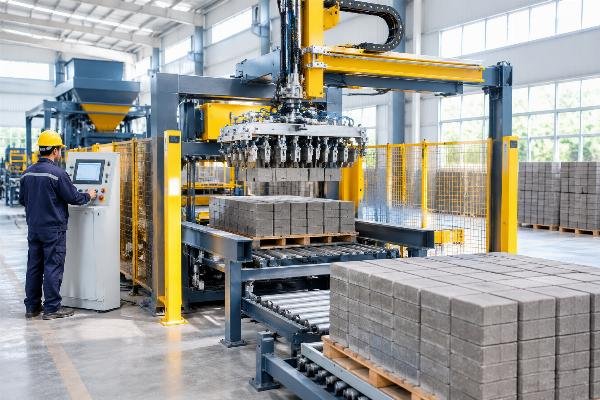
For government contractors or larger developers executing public housing or infrastructure projects, the requirement shifts to throughput, consistency, and documentation. A fully automatic PLC line like the QT10-15 delivers high daily output with minimal manual labor, and the control system logs production data that auditors may request. The certification package must be complete before the machine ships, because tender compliance reviews happen at the document stage, not the installation stage.
I supplied a QT10-15 line to a contractor executing a housing project near Bucaramanga. Their tender required CE certification, a documented training program for local operators, and a commissioning engineer present for the full startup phase. We delivered the line with the certification dossier, ran operator training on mixing ratios and mold changeover, and the commissioning engineer stayed until the first full production shift ran without intervention. The contractor later used the same documentation package to bid on a second municipal project [NEED_CITE: Colombian public housing construction equipment compliance standards].
For established distributors looking to stock inventory or take on territory representation, the calculation changes again. Container loading efficiency matters because freight cost per unit directly affects landed pricing. Spare parts availability and response speed matter because your local reputation depends on keeping client machines running. I work with distributors across Latin America on container loading plans that maximize unit count per shipment while leaving room for mold sets and wearing parts.
What Are the Three Most Common Pitfalls When Setting Up a Block Plant in Colombia?
Voltage instability, raw material mismatch, and slow spare parts response are the three failure sources I see repeatedly, and all three can be addressed before the machine ships.
Voltage instability is the number one cause of unexpected downtime in the block machine market Colombia. Industrial grids in many cities experience surges and drops that generic inverters cannot handle. The symptom is usually an inverter fault code appearing within the first few production shifts. The fix is a site-specific voltage survey followed by specifying a stabilized power configuration with a dedicated transformer and inverter rated for the local fluctuation range. I have seen buyers skip this step to save a small amount on the initial order, only to spend several times that amount on inverter replacements within the first year.
Raw material mismatch is the second trap. Colombian clay and aggregate sources vary noticeably by region. Some areas supply clean crushed stone, while others deliver material with high silt content. A high-pressure molding setup designed for clean aggregate will choke and clog when fed material with excess fines. The solution is a raw material sample sent to the manufacturer before configuration is finalized, so the mixing ratio, mold design, and pressing force can be adjusted to match. I had a buyer in the coffee region whose local sand carried noticeably higher clay content than expected. We adjusted the mixing recipe and mold geometry after receiving their sample, and the production line ran cleanly from the first day.
Spare parts response is the third issue, and it is largely a planning problem. Wearing parts like mold liners, mixer blades, and conveyor belts need replacement on a predictable schedule. If the buyer has not stocked these locally, a single broken mold liner can halt production until an international shipment arrives. The practical approach is to order a spare parts package sized for the first year of operation at the same time the main line is shipped. Container space allocated to spare parts costs very little in freight but saves significant downtime later.
A contractor near Cartagena learned this the hard way. Their line ran well for several months, then a conveyor belt failed. Without a local spare, they waited for a replacement shipment and lost nearly a full production week. The cost of that idle time far exceeded what a spare belt would have cost in the original container.
Conclusion
The block machine market Colombia rewards buyers who prepare before they order, not those who chase the lowest invoice price. Voltage customization, certification compliance, and raw material adaptation are the three variables that separate a smooth startup from a costly delay. Match your configuration to your buyer profile, confirm site conditions in writing, and stock wearing parts from day one. The machines themselves are proven; the variable is always the preparation around them.
Leave a Reply