

Block Machine Price in UK: 2026 Complete Buyer Guide
The sticker price on a block machine is only a fraction of what you actually pay.
For UK buyers in 2026, a realistic Block Machine Price in UK ranges from entry-level manual units to fully-automatic turnkey lines, but the machine cost itself typically represents only a portion of total project spend. Shipping, import duties, port handling, site preparation, mould adaptation, and commissioning form the real financial picture. Understanding this breakdown before you order is what separates profitable investors from those who bleed cash on "hidden" expenses.
I still remember standing at Tincan Island port in Lagos, watching a container holding a QT6-15 block machine sit idle under the West African sun. The wooden pallets used for internal bracing lacked fumigation certificates, and Nigerian customs refused to release the cargo. Three weeks of demurrage later, we hired local carpenters to dismantle and rebuild the packaging on-site before the authorities would budge. That single packaging oversight cost the client more in port fees than the freight itself. Since that day, I inspect packaging specs with the same intensity I give to hydraulic pressure tests. When you evaluate Block Machine Price in UK, you must look far beyond the invoice from the manufacturer.
Let us walk through the actual cost architecture so you can budget with confidence.
What Does a Block Machine Actually Cost in the UK in 2026?
Block Machine Price in UK varies dramatically based on automation level, daily output target, and whether you are buying a standalone unit or a complete production line.
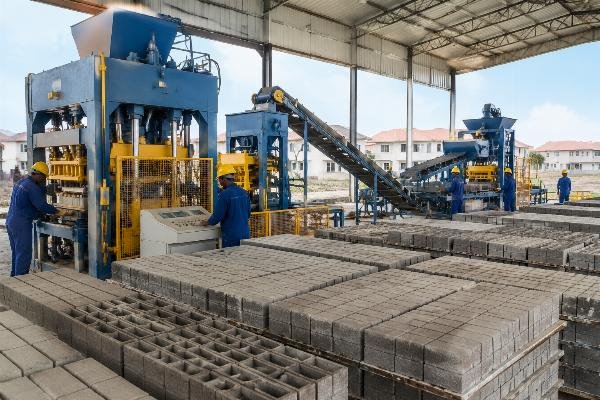
The market segments roughly into three tiers. Manual and semi-automatic machines suit small-scale operators producing hollow blocks for local construction projects. These units require significant human labor but keep capital expenditure low. Semi-automatic lines with basic PLC control offer a middle ground, balancing output consistency with manageable investment. Fully-automatic lines with integrated batching, mixing, conveying, pallet circulation, and stacking represent the top tier, designed for commercial block yards and government housing contracts.
| Automation Level | Typical Daily Output | Labor Requirement | Site Space | Power Demand |
|---|---|---|---|---|
| Manual / Egg-Layer | Low volume | High | Minimal | Basic |
| Semi-Auto Line | Moderate volume | Moderate | Standard workshop | Standard three-phase |
| Fully-Auto Line | High volume | Low | Large industrial plot | Heavy industrial with stabilization |
A Middle East contractor once asked me why his European-sourced line produced barely half its rated capacity. The answer was not the machine—it was the local aggregate particle size exceeding the mould cavity tolerance. The blocks came out with visible cracks and unacceptable break rates. We spent weeks adjusting the mould specifications and recalibrating the mix design before output stabilized. This is a reality that no price list will ever show you.
When comparing Block Machine Price in UK across suppliers, always request a detailed specification sheet that includes mould cavity dimensions, vibration frequency range, and hydraulic pressure ratings. These parameters determine whether the machine can handle your specific raw material profile. [NEED_CITE: correlation between aggregate gradation and block compressive strength per BS EN 771-3]
FOB vs Landed Cost: Where Do Hidden Fees Hide?
The FOB price you see on a quotation is never the final amount that lands at your site.
International trade terms define where responsibility transfers, but they do not eliminate costs—they merely shift them between buyer and seller. For UK importers, the journey from a Chinese factory floor to your block yard involves multiple cost layers that accumulate silently.
Ocean freight rates fluctuate based on container availability, fuel surcharges, and seasonal demand peaks. A standard fully-automatic line requires multiple containers for the main machine, batching plant, silos, and auxiliary equipment. Roll-on/roll-off shipping for oversized components adds another variable.
UK import duties on concrete block machinery fall under specific HS codes, and the applicable tariff rate depends on precise equipment classification. [NEED_CITE: UK Global Tariff schedule for concrete block making machinery HS 8474] You must also account for VAT on the total landed value, port handling charges, customs broker fees, and inland transportation from Felixstowe or Southampton to your facility.
A European distributor once shared that his total landed cost exceeded the FOB price by a substantial margin after all port charges, inland haulage, and commissioning support were included. Buyers who only compare FOB quotations are comparing incomplete numbers.
| Cost Component | Visibility at Quotation Stage | Typical Control Level |
|---|---|---|
| Machine FOB Price | Fully visible | High |
| Ocean Freight | Estimated, volatile | Moderate |
| Import Duty | Determinable with correct HS code | High |
| Port Handling & Demurrage Risk | Unpredictable | Low |
| Inland Transport | Quotable but variable | Moderate |
| Installation & Commissioning | Often excluded | Low |
When you request a Block Machine Price in UK quotation, insist that the supplier provides a landed cost estimate or at minimum a clear breakdown of what is and is not included. Suppliers who refuse to clarify this boundary are hiding risk in your lap.
Manual vs Semi-Auto vs Fully-Auto: Which Fits Your Site?
The right machine is the one that matches your daily target, your available labor force, and your site infrastructure—not the one with the highest automation.
Many first-time buyers assume that fully-automatic is always better. This is a costly misconception. A fully-automatic line demands stable three-phase power, consistent raw material supply, trained PLC operators, and disciplined maintenance routines. If your site experiences frequent power fluctuations, the PLC will trigger protective shutdowns repeatedly, and your actual output will plummet far below rated capacity.
I have walked sites in West Africa where premium fully-automatic lines sat half-idle because the local grid could not sustain the voltage stability required. The machines were technically perfect; the operating environment was not. In those cases, a robust semi-automatic line with manual overrides delivered better real-world productivity and faster return on investment.
| Decision Factor | Manual / Egg-Layer | Semi-Auto Line | Fully-Auto Line |
|---|---|---|---|
| Daily Output Target | Low | Moderate to High | High to Very High |
| Available Labor | Abundant, low cost | Moderate | Limited, skilled |
| Power Stability | Tolerant | Moderate tolerance | Demanding |
| Maintenance Capability | Basic | Intermediate | Advanced |
| Initial Capital | Low | Moderate | High |
| Payback Period | Extended | Balanced | Accelerated if conditions met |
Before committing to any Block Machine Price in UK offer, conduct an honest audit of your site conditions. Measure your actual voltage stability over a full week. Survey your available labor pool. Calculate your realistic daily sales capacity rather than relying on machine-rated output. A South American investor learned this the hard way when he purchased a top-tier line but could only sell half the daily output locally. The machine sat underutilized for an extended period before he diversified his product range.
How to Avoid Costly Mistakes Before You Order?
Three pre-order verification steps will save you from the majority of post-delivery disasters: mould compatibility testing, power infrastructure validation, and packaging compliance confirmation.
First, send your local raw material samples to the supplier for trial production before finalizing your order. Aggregate type, sand fineness modulus, cement grade, and water-cement ratio all interact with mould design and vibration parameters. A supplier who refuses to run trial batches with your material is selling you a machine, not a solution.
Second, provide your site’s actual electrical measurements—not the nominal grid voltage printed on utility documents. In many regions, nominal voltage and real-world voltage differ substantially. If your site experiences frequent dips or surges, you must specify voltage stabilization equipment in your order. The cost is minor compared to the damage caused by repeated PLC faults and component burnout.
Third, confirm packaging specifications in writing. For sea freight, all wooden materials must comply with ISPM 15 international standards for phytosanitary treatment and bear the official certification mark. Non-compliant packaging triggers customs holds in numerous countries, generating demurrage charges that dwarf the original packaging cost.
| Verification Step | Common Failure Mode | Consequence |
|---|---|---|
| Raw Material Trial | Mould mismatch, poor block quality | High rejection rate, customer complaints |
| Power Audit | PLC shutdowns, component damage | Extended downtime, repair costs |
| Packaging Compliance | Customs detention, demurrage | Delayed project launch, penalty fees |
A UK-based contractor evaluating Block Machine Price in UK options should treat these verification steps as non-negotiable gate checks. The supplier who supports you through this process—providing trial reports, electrical load calculations, and certified packaging documentation—is demonstrating the competence that justifies their price.
Why Emerging Market Buyers Choose Chinese Manufacturers?
The decision is rarely about the lowest price tag—it is about verified field performance, responsive customization, and total cost of ownership under real operating conditions.
Chinese block machine manufacturers have spent decades refining equipment for the most demanding environments on earth: unstable power grids, extreme dust, high ambient temperatures, and operators with varying skill levels. This field-hardened design philosophy produces machines that deliver consistent output where over-engineered alternatives fail.
The customization capability is equally critical. A manufacturer willing to modify mould dimensions, adjust vibration parameters, adapt hydraulic systems for local voltage conditions, and provide on-site commissioning with operator training delivers value that no catalogue specification can capture.
Delivery timelines for complete production lines from established Chinese manufacturers typically fall within a compressed window, significantly faster than many European competitors who batch production orders quarterly. For investors racing to meet construction deadlines or government contract milestones, this responsiveness translates directly into revenue.
A North African government housing contractor needed a complete block production line commissioned within a tight timeframe before the rainy season. The European supplier quoted a delivery timeline that would miss the window entirely. The Chinese manufacturer delivered, installed, and trained the local crew to full operational capacity before the first rains arrived. The project stayed on schedule, and the contractor secured the housing contract.
When you evaluate Block Machine Price in UK proposals, weigh the total package: machine quality, customization depth, commissioning support, spare parts availability, and the supplier’s track record in environments similar to yours. The cheapest invoice often becomes the most expensive investment.
Conclusion
Block Machine Price in UK is a multi-layered equation, not a single number.
The machine invoice is merely the starting point. Freight, duties, port charges, site preparation, mould adaptation, power infrastructure, and operator training collectively determine whether your investment generates profit or pain. Verify your raw materials, validate your power supply, confirm packaging compliance, and choose a supplier who treats your project as a partnership rather than a transaction. The right preparation turns a capital expenditure into a revenue-generating asset.
Leave a Reply