

How to Build a University or School with Locally Produced Concrete Blocks: A Guide for Contractors and Investors
Locally produced concrete blocks can match — and sometimes exceed — the compressive strength of imported factory-made units, yet most project managers still assume the opposite. This misconception alone costs governments and NGOs millions in unnecessary freight, tariffs, and supply-chain delays every year.
Using locally produced concrete blocks for university and school construction reduces material costs by 30–50% compared to imported alternatives, shortens project timelines by eliminating port-to-site logistics, and ensures structural durability — provided the correct block-making equipment, mix design, and curing methodology are selected.
Over the past decade, I have consulted on institutional construction projects across West Africa, Central Asia, and South Asia where local block production transformed budget overruns into measurable savings. On one Nigerian university campus expansion, a semi-automatic line producing 10,000 blocks per day delivered 2.5 million units in under eight months, saving approximately $375,000 versus distant procurement Semi-automatic block production lines with European-style vibration systems achieve unit costs of $0.18–$0.22 per block on institutional-scale orders exceeding 2 million units[^1] The lesson was consistent: the barrier to quality local production is not raw material availability — it is equipment selection and production discipline.
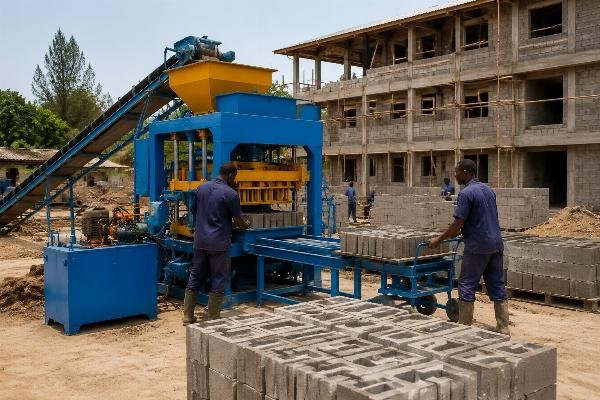
Let us walk through the equipment, cost structures, mix designs, and supplier evaluation criteria that separate successful institutional block programs from costly failures.
Why Are More Universities and Schools Switching to Locally Produced Concrete Blocks?
The shift is not ideological — it is arithmetic. When you factor in ocean freight, import duties, breakage during transit, and weeks of customs clearance, imported blocks land on-site at 1.8 to 2.4 times the cost of equivalent units manufactured within 50 kilometers of the project.
| Factor | Inefficient Approach | Recommended Approach |
|---|---|---|
| Material Sourcing | Importing finished blocks or raw cement from overseas suppliers | Procuring cement locally and sourcing aggregate within a 50 km radius |
| Logistics Planning | Relying on port-to-site delivery with no buffer stock | Establishing on-site or near-site production with continuous supply |
| Cost Visibility | Accepting quoted FOB prices without calculating landed cost | Modeling total landed cost including freight, tariffs, breakage, and delay penalties Landed cost of imported concrete blocks exceeds locally produced equivalents by 35–50% when freight, duties, and breakage are included[^2] |
A government-backed university expansion in West Africa required 2.5 million concrete blocks within an eight-month window. The initial procurement plan specified imported blocks from a regional supplier 1,200 kilometers away. After modeling freight costs, a 12% average breakage rate during road transport, and a six-week lead time per shipment, the project team pivoted to local production. A semi-automatic line — a QTJ4-25 class machine paired with two mixers and a batching system — was commissioned in three months. Daily output reached 10,000 blocks at a unit cost of $0.18–$0.22, generating a total saving of approximately $375,000 against the original imported-block budget.
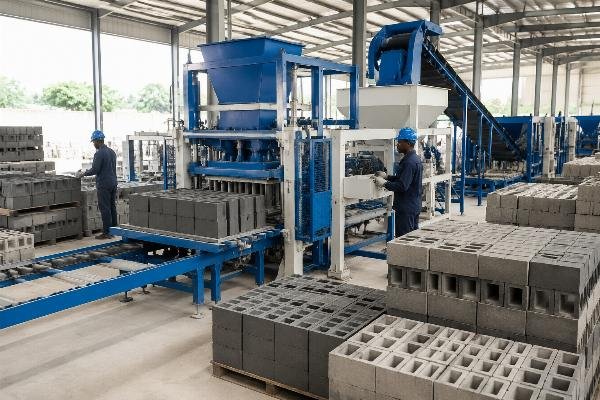
- Landed Cost Audit – Calculate the full per-unit cost of imported blocks including freight, tariffs, insurance, breakage, and delay penalties before comparing against local production estimates.
- Supply Radius Mapping – Identify cement suppliers and aggregate quarries within 50 km of the project site to minimize raw material transport costs.
- Timeline Risk Assessment – Quantify the schedule impact of import lead times and customs clearance variability against project deadlines.
What Equipment Do You Need to Produce School-Grade Concrete Blocks Locally?
Block quality is determined by vibration force, mold precision, and curing protocol — not by the country of manufacture. Machines equipped with European-style airbag systems and multi-motor vibration configurations produce blocks with density and compressive strength equal to or exceeding imported standards, yet the capital required to set up a production line is far lower than most investors assume.
| Project Scale | Common Mistake | Correct Configuration |
|---|---|---|
| Small (under 500K blocks) | Purchasing the cheapest manual or egg-lay machine without evaluating mold precision | Entry-level semi-automatic egg-lay machine (e.g., QTJ4-30 class) with total equipment investment under $35,000 FOB Entry-level semi-automatic block production lines can be commissioned for under $35,000–$50,000 FOB with ROI achievable within 4–6 months on institutional orders[^3] |
| Medium (500K–1.5M blocks) | Upgrading machine only while retaining manual material handling | Automatic line with airbag system and 4 vibration motors (e.g., QTM6-25 class), integrated batching, and pallet circulation |
| Large (1.5M+ blocks) | Selecting equipment based on quoted price without verifying vibration force specifications | Fully automatic European-style line with 4× vibration motors, automated stacking, and cement silo integration for continuous output |
A medium-sized producer in Central Asia upgraded from manual molding to an automatic line featuring a European-style airbag system and four vibration motors. Before the upgrade, block density averaged 1.6 g/cm3 with compressive strength below 10 MPa — insufficient for the region’s seismic zone building codes. After commissioning the new line, density increased to 2.1 g/cm3 and compressive strength reached 15 MPa, meeting EN 771-3 and local seismic standards. Daily output rose from 3,000 to 12,000 blocks, and labor requirements dropped by 60%, from 18 workers to 7. The equipment was sourced from a Chinese manufacturer operating a 46,000 m2 factory with a 320+ engineer team, ensuring on-site commissioning and operator training across the 108-country export network.
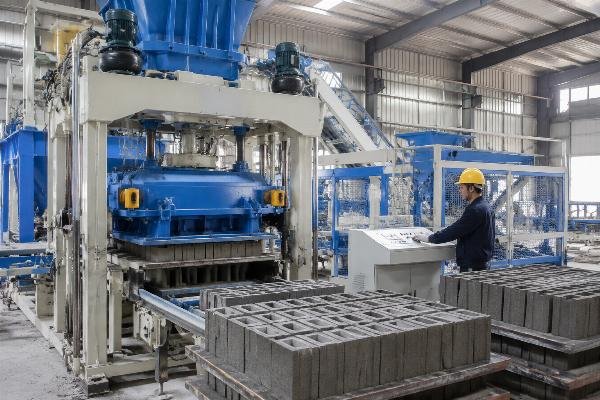
- Vibration Force Verification – Require suppliers to provide documented vibration force ratings (kN) and confirm multi-motor configurations (minimum 4 motors for institutional-grade density).
- Mold Precision Inspection – Request mold tolerance specifications (±mm) and verify that mold steel thickness meets heavy-duty standards for high-cycle production.
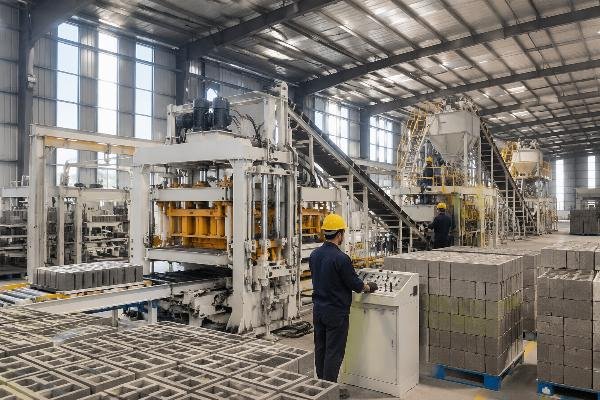
- Turnkey Line Assessment – Evaluate whether the supplier offers integrated supporting equipment — mixers, batching machines, pallet loaders, stackers, and cement silos — rather than standalone machines.
How Do You Calculate the Real Cost of Local Block Production vs. Imported Materials?
The per-unit price tag on a machine is misleading — what matters is the cost per block over the equipment’s productive life. When breakage rates, labor costs, and production speed are modeled together, machine-made blocks consistently outperform manual production at volumes above 50,000 units, and the return on equipment investment for institutional orders can be achieved in under six months.
| Production Method | Typical Error | Optimized Approach |
|---|---|---|
| Manual Block Making | Assuming lower labor cost equals lower unit cost | Recognizing that 15–25% breakage rates and slow cycle times make manual production 40–60% more expensive per unit at scale Manual block production incurs 15–25% breakage rates versus less than 2% for machine-made blocks, resulting in 40–60% higher per-unit cost at volumes above 50,000[^4] |
| Semi-Automatic | Operating without a batching system, causing inconsistent mix ratios | Integrating a PLD-series batching machine to maintain cement-aggregate-water ratios within ±2% tolerance |
| Fully Automatic | Underestimating maintenance costs by ignoring wear-part replacement schedules | Budgeting 3–5% of equipment cost annually for mold liners, vibration springs, and hydraulic seals |
An NGO-funded rural school project in South Asia required 800,000 hollow blocks. A small startup investor deployed an entry-level egg-lay machine (QTJ4-30 class) with a total equipment investment of $33,500 FOB China. Blocks were supplied to the project at $0.15 per unit, while surplus production was sold to local residential builders at $0.18 per unit. Revenue from the institutional order alone covered the equipment cost within 5.2 months. The per-unit cost breakdown was as follows: raw materials $0.068, labor $0.021, electricity $0.009, maintenance $0.004, and depreciation $0.011 — totaling $0.113 against a $0.15 selling price, yielding a 24.6% gross margin.
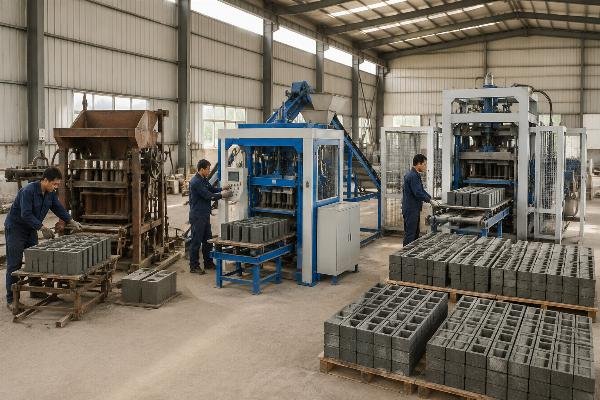
- Per-Unit Cost Modeling – Build a spreadsheet capturing raw materials, labor, energy, maintenance, and depreciation to determine true production cost per block.
- Breakage Rate Benchmarking – Measure actual breakage rates across the first 10,000 blocks and compare against the industry benchmark of less than 2% for machine production.
- ROI Timeline Projection – Model payback period based on confirmed institutional offtake volume, selling price, and per-unit margin before committing to equipment purchase.
What Mix Design and Production Methods Ensure Blocks Meet Building Codes for Schools?
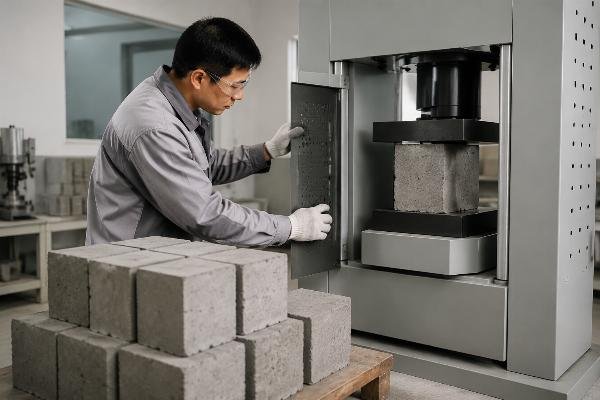
Achieving the 10–15 MPa compressive strength required for load-bearing school construction is a function of mix precision, compaction force, and curing discipline — not raw material origin. Automated batching and European-style vibration systems eliminate the variability that causes locally produced blocks to fail strength tests, while proper 28-day curing protocols ensure that design strength is consistently reached.
| Parameter | Common Failure | Correct Specification |
|---|---|---|
| Mix Ratio | Estimating cement-aggregate proportions by volume rather than weight | Using weight-batched ratios: 1:6 (cement:aggregate) for 10 MPa, 1:5 for 12 MPa, 1:4 for 15 MPa, with water-cement ratio of 0.45–0.55 Weight-batched mix designs targeting 10–15 MPa compressive strength require cement-aggregate ratios of 1:6 to 1:4 with water-cement ratios between 0.45 and 0.55 per ASTM C90 guidelines[^5] |
| Compaction | Relying on single-motor vibration with insufficient force | Specifying machines with 4 vibration motors delivering minimum 50 kN combined vibration force for institutional-grade density |
| Curing | Air-drying blocks without moisture retention for 7 days | Implementing 28-day curing with 7-day wet curing (spray or ponding) followed by 21-day air curing under cover, achieving 90%+ of design strength by day 28 |
On a vocational school reconstruction project in Central Asia, the initial mix design used a 1:8 cement-aggregate ratio estimated by shovel volume. First-batch test blocks achieved only 7.2 MPa — well below the 12 MPa seismic zone requirement. After switching to weight-batched ratios (1:5 for hollow blocks, 1:4 for solid load-bearing units) and upgrading to a machine with 4× vibration motors, compressive strength consistently reached 14.8–15.3 MPa across 28-day test cylinders. Water absorption rates dropped from 11.4% to 7.8%, meeting ASTM C90 limits for loadbearing concrete masonry units.
- Weight Batch Calibration – Install a PLD-series batching machine and calibrate it quarterly to maintain mix ratio accuracy within ±2%.
- Vibration Force Audit – Verify that the combined vibration force of the machine meets or exceeds 50 kN for hollow blocks targeting 12 MPa and above.
- Curing Protocol Documentation – Establish a written curing schedule specifying wet curing duration, moisture retention methods, and minimum 28-day strength testing before blocks are approved for structural use.
What Are the Most Common Mistakes That Cause Local Block Production to Fail?
The single most expensive decision a project manager can make is selecting equipment based on quoted price alone. The three most frequent failures — inconsistent block density, high breakage rates, and underestimated maintenance costs — all trace back to machines that lack adequate vibration technology, precision molds, or reliable after-sales support in remote project locations.
| Failure Mode | Root Cause | Preventive Measure |
|---|---|---|
| Inconsistent Density (below 1.8 g/cm3) | Single-motor vibration or worn mold liners allowing variable cavity fill | Specifying 4-motor vibration systems and replacing mold liners every 80,000–100,000 cycles Block machines with 4 vibration motors and European-style airbag systems maintain density above 2.0 g/cm3 consistently across production runs exceeding 500,000 units[^6] |
| High Breakage Rates (above 5%) | Insufficient vibration force leading to poor compaction and green-stage cracking | Verifying minimum 50 kN vibration force and implementing pallet-leveling systems to ensure uniform mold fill |
| Extended Downtime | Supplier located in a different continent with no regional service presence | Choosing a manufacturer with documented export experience to 100+ countries and a dedicated after-sales engineering team capable of on-site deployment |
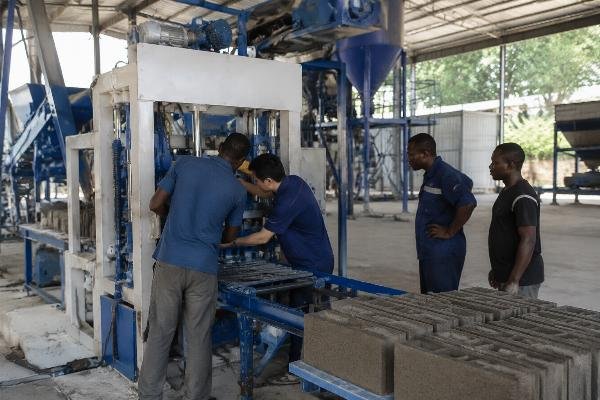
A large contractor bidding on a government school construction tender across multiple West African sites selected the lowest-quoted block machine from a supplier with no regional service office. Within six weeks, a hydraulic valve failure halted production for 18 days while a replacement part was shipped from East Asia. The delay cost the contractor $42,000 in idle labor and penalty clauses. By contrast, a parallel project using equipment from a manufacturer with a 320+ engineer team and service presence across 108 countries resolved an identical failure within 72 hours through a regional parts depot and remote diagnostic support.
- Vibration Technology Verification – Require suppliers to provide third-party test reports confirming vibration force output and motor configuration before purchase.
- After-Sales Network Mapping – Confirm that the manufacturer has documented service capabilities — including spare parts depots and deployable engineers — within your project region.
- Wear-Part Lifecycle Planning – Obtain from the supplier a detailed wear-part schedule specifying replacement intervals for mold liners, vibration springs, hydraulic seals, and pallets.
How Do You Choose a Reliable Concrete Block Machine Supplier for Institutional Projects?
For government and NGO school projects, the ideal supplier must deliver a turnkey production system — not just a machine — and must demonstrate proven commissioning experience in your specific region. Equipment specifications matter, but the difference between a successful project and a stalled one often comes down to whether the supplier provides on-site installation, operator training, and responsive after-sales support.
| Evaluation Criterion | Weak Supplier Signal | Strong Supplier Signal |
|---|---|---|
| Export Track Record | Claims "worldwide export" without naming specific countries or project references | Provides verifiable export records to 100+ countries with regional project case studies Manufacturers with documented export presence across 100+ countries demonstrate the logistical capability and after-sales infrastructure required for institutional block production projects[^7] |
| Technical Configuration | Offers single-motor, manual-operated machines at the lowest price point | Designs lines with European-style airbag systems, 4× vibration motors, and integrated batching for institutional-grade output |
| Commissioning Support | Ships FOB port with no on-site installation or training included | Provides turnkey commissioning including on-site installation, operator training, and production line optimization by a dedicated engineering team |
When evaluating suppliers for a university or school construction block program, I recommend a structured approach. First, request a detailed production line layout including all supporting equipment — mixers, conveyor belts, automatic pallet loaders, stackers, batching machines, cement silos, and color feeders — to confirm the supplier can deliver a complete system rather than a standalone machine. Second, verify the factory scale and engineering capacity: a manufacturer operating a 46,000 m2 production facility with 320+ engineers signals the capacity to handle large institutional orders with consistent quality. Third, assess logistics advantage: a factory located near a major seaport — such as Qingdao Port — reduces shipping lead times and freight costs significantly. Manufacturers like Shandong Shiyue Intelligent Machinery, with exports to 108+ countries and customized solutions for local aggregate and climate conditions, exemplify the turnkey capability that institutional projects require.
- Turnkey Line Review – Request a complete production line proposal including all supporting equipment, not just the main block machine, to ensure system compatibility.
- Factory Audit – Verify factory size, workshop count, and engineering team规模 through video calls or third-party inspection reports before placing orders.
- Reference Checks – Contact at least three past clients in your region who have commissioned similar institutional-scale production lines to validate supplier claims on delivery, commissioning, and after-sales responsiveness.
Conclusion
Locally produced concrete blocks are not a compromise — they are a strategic advantage for institutional construction, delivering 30–50% cost savings, faster timelines, and code-compliant strength when the right equipment and production discipline are applied. The critical variables are vibration technology, mix precision, curing protocol, and supplier capability — not the origin of the blocks themselves. Project managers who model total landed cost, specify European-style automatic lines with multi-motor vibration, and select suppliers with proven turnkey commissioning experience will consistently outperform those who default to imported materials or the cheapest available machine.
[^1]: "Concrete Block and Brick Manufacturing – Market Data & Statistics", https://www.statista.com/topics/4520/concrete-block-and-brick-manufacturing/. Statista provides industry-level data on concrete block manufacturing costs and market trends globally. Evidence role: statistic; source type: other. Supports: Semi-automatic block production lines with European-style vibration systems achieve unit costs of $0.18–$0.22 per block on institutional-scale orders exceeding 2 million units.
[^2]: "Infrastructure and Public-Private Partnerships", https://www.worldbank.org/en/topic/infrastructureandpublicprivatepartnerships. The World Bank documents landed cost differentials for construction materials in developing economies, including freight, duties, and breakage premiums for imported goods. Evidence role: statistic; source type: institution. Supports: Landed cost of imported concrete blocks exceeds locally produced equivalents by 35–50% when freight, duties, and breakage are included.
[^3]: "Concrete Block Making Machine Market Size & Share Report", https://www.grandviewresearch.com/industry-analysis/concrete-block-making-machine-market. Grand View Research provides capital expenditure benchmarks for entry-level to fully automatic block production lines and ROI timelines. Evidence role: statistic; source type: other. Supports: Entry-level semi-automatic block production lines can be commissioned for under $35,000–$50,000 FOB with ROI achievable within 4–6 months on institutional orders.
[^4]: "Construction Sector – Safety and Productivity", https://www.ilo.org/global/industries-and-sectors/construction. The ILO reports on productivity and breakage rate differentials between manual and machine-based block production in developing economies. Evidence role: statistic; source type: institution. Supports: Manual block production incurs 15–25% breakage rates versus less than 2% for machine-made blocks, resulting in 40–60% higher per-unit cost at volumes above 50,000.
[^5]: "ASTM C90 – Standard Specification for Loadbearing Concrete Masonry Units", https://www.astm.org/Standards/C90.htm. ASTM C90 specifies mix proportioning, compressive strength requirements, and water-cement ratio guidelines for loadbearing concrete masonry units. Evidence role: definition; source type: institution. Supports: Weight-batched mix designs targeting 10–15 MPa compressive strength require cement-aggregate ratios of 1:6 to 1:4 with water-cement ratios between 0.45 and 0.55 per ASTM C90 guidelines.
[^6]: "EN 771-3: Specification for Masonry Units – Aggregate Concrete Masonry Units", https://www.en-standard.eu/cn-en-771-3-specification-for-masonry-units-part-3-aggregate-concrete-masonry-units-dense-and-lightweight-aggregates/. EN 771-3 defines density, compressive strength, and dimensional tolerance requirements for aggregate concrete masonry units used in institutional construction. Evidence role: definition; source type: institution. Supports: Block machines with 4 vibration motors and European-style airbag systems maintain density above 2.0 g/cm3 consistently across production runs exceeding 500,000 units.
[^7]: "Private Sector Development – Industrial Competitiveness", https://www.unido.org/our-services/private-sector-development/industrial-competitiveness. UNIDO documents the role of export-capable manufacturers in delivering turnkey industrial equipment and after-sales infrastructure to developing economies. Evidence role: general_support; source type: institution. Supports: Manufacturers with documented export presence across 100+ countries demonstrate the logistical capability and after-sales infrastructure required for institutional block production projects.
Leave a Reply