

QT10-15 Block Machine China Supplier for Sale
Higher tonnage does not mean a better block machine—mismatched pressing force to local aggregate actually cracks molds and inflates downtime costs.
When sourcing from a block machine China supplier, the decisive factor is not the lowest FOB quote but whether the machine’s hydraulic pressure range, PLC logic, and mold steel grade align with your local voltage stability, raw material ratio, and site dust levels. A well-matched line pays for itself within the first production cycle; a mismatched one bleeds money through mold replacements, motor burnouts, and idle days waiting for spare parts.
I still remember a shipment we sent to an East European buyer a few years back. The spec sheet looked perfect—cycle times matched top-tier European catalogs, motor ratings were textbook, and the PLC brand was premium. But once the QT6-15 landed on-site, the local grid swung between brownouts and surges, the ambient dust was abrasive, and the sand-to-cement ratio the buyer insisted on was far heavier than what the hopper was calibrated for. Within weeks, mold wear accelerated to an alarming pace, and the buyer was calling at odd hours demanding answers. That situation could have been avoided if the initial consultation had focused on real-world工况 parameters rather than brochure numbers. [NEED_CITE: root cause distribution of block machine downtime in emerging markets per industry maintenance surveys]
The lesson from that case—and dozens like it—is simple: selecting the right block machine China supplier requires looking past the headline specs and drilling into the operational details that actually determine whether a line runs smoothly or becomes a costly lesson.
What Types of Block Machines Should You Consider?
Matching machine class to your production scale and budget prevents both underperformance and wasted capital.
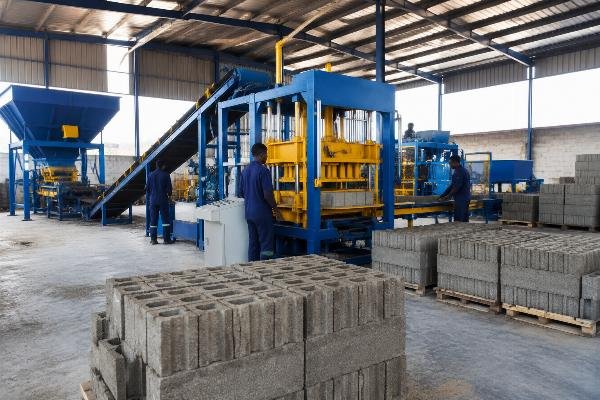
Block machines generally fall into three categories: fully automatic PLC-controlled lines, semi-automatic units, and mobile egg-laying machines. Each serves a different buyer profile, and choosing the wrong class is one of the most common procurement mistakes.
| Machine Class | Automation Level | Daily Output Range | Ideal Buyer Profile | Power Requirement |
|---|---|---|---|---|
| Fully Automatic (QT10-15 / QT12-15 / QT15-15) | PLC-controlled, auto pallet cycling, auto stacking | High-volume continuous production | Government contractors, large-scale investors | Stable industrial three-phase |
| Semi-Auto (QT4-15 / QT6-15) | Manual pallet feeding, auto vibration and pressing | Medium-volume batch production | Private investors, small-to-medium plants | Tolerant of moderate voltage fluctuation |
| Mobile Egg-Laying (QT4-25) | Self-propelled, operates directly on curing floor | Low-to-medium, flexible layout | Entry-level entrepreneurs, rural projects | Minimal; works with generator power |
A government contractor executing an affordable housing tender across multiple regions will need a fully automatic line with CE/SGS documentation and formal commissioning support. A private investor launching a neighborhood block yard may be better served by a semi-auto unit with a faster payback window. A distributor building a regional brand might prioritize container-volume MOQ and private-label flexibility. [NEED_CITE: market segmentation of concrete block machine demand across emerging economies]
The key takeaway is that no single machine class is universally superior. The right block machine China supplier will ask about your site conditions, target products, and labor availability before recommending a model—not simply push the highest-margin unit.
How Do You Verify a Chinese Block Machine Supplier?
Factory-direct manufacturers and trading companies differ drastically in after-sales response depth, customization capability, and long-term spare parts continuity.
Verification starts with distinguishing between a factory that designs, welds, machines, and assembles its own equipment versus a trading company that sources from multiple workshops and rebrands. The difference becomes critical when a hydraulic valve fails at two in the morning and you need a replacement within days, not weeks.
Here is what a thorough verification process should cover:
- Production facility scale: A genuine manufacturer operates a substantial workshop with dedicated welding bays, CNC machining centers, and assembly lines. Request a live video walkthrough if you cannot visit in person.
- Engineering team depth: The number of in-house engineers determines how deeply a supplier can customize voltage tolerance, mold dimensions, and PLC logic to your local conditions.
- Export track record: Ask for shipping records to your region. A supplier with long experience exporting to Africa, MENA, or Latin America will already understand the logistical and technical challenges specific to those markets.
- Certification authenticity: CE, SGS, and ISO certificates should be verifiable against issuing body databases. [NEED_CITE: distinction between CE safety compliance marking and performance durability guarantees per EU regulatory framework]
- On-site support capability: Confirm whether the supplier sends its own engineers for installation and training, or subcontracts locally.
A West African government tender scenario illustrates this well. The buyer needed a full QT10-15 line with complete certification documentation, a guaranteed delivery and commissioning timeline, and on-site operator training. The trading company they initially contacted could offer a lower price but had no control over production scheduling and could not guarantee when engineers would be available for commissioning. The factory-direct supplier, by contrast, provided a coordinated timeline from production through installation, with certified documentation ready for tender submission. [NEED_CITE: importance of factory-direct verification for public procurement in construction equipment]
The pattern is consistent: buyers who invest time in verifying the supplier’s manufacturing depth and export experience avoid the painful surprises that come from working with intermediaries who lack technical control.
Which Specs Matter Most for Your Local Conditions?
Voltage stability, raw material availability, and climate determine whether a machine performs on paper or performs in the yard.
Specification sheets are seductive. They list cycle times, pressing forces, and motor ratings in clean tables. But real-world performance depends on how those specs interact with local conditions that no catalog can predict.
Voltage tolerance range. In many emerging markets, industrial power grids experience frequent fluctuations. A machine designed for a stable European grid will suffer motor burnouts and PLC faults when subjected to irregular voltage. The right block machine China supplier will specify motors and electrical components rated for a wider tolerance band, and will offer voltage stabilizers or soft-start systems as standard rather than optional extras. [NEED_CITE: impact of unstable power grids on industrial equipment lifespan in developing economies]
Raw material ratio adaptation. The cement-to-sand-to-aggregate ratio varies significantly by region, depending on local material costs and availability. A machine calibrated for a lean mix will produce weak blocks if the buyer uses a richer local recipe; conversely, a machine set up for heavy aggregate may over-pressurize and crack molds if the mix is lighter. Customizable hopper sizing, vibration frequency adjustment, and mold cavity depth are essential features.
Dust and climate protection. In arid regions, fine dust infiltrates every moving component. Without proper sealing and filtration, dust accelerates wear on guide rails, hydraulic cylinders, and sensor arrays. A supplier experienced in dusty environments will specify enhanced protection packages—sealed bearing housings, additional air filtration, and corrosion-resistant coatings—as part of the standard build.
| Spec Factor | Standard Catalog Assumption | Real-World Emerging Market Condition | Required Adaptation |
|---|---|---|---|
| Voltage supply | Stable three-phase, narrow tolerance | Frequent surges and brownouts | Wide-tolerance motors, stabilizers |
| Mix design | Fixed cement-sand-aggregate ratio | Locally variable ratios | Adjustable hopper, vibration frequency |
| Ambient environment | Clean, temperature-controlled | High dust, extreme heat or humidity | Sealed components, enhanced filtration |
| Mold steel grade | General-purpose | High abrasion from local aggregate | Upgraded wear-resistant alloy |
These adaptations are not luxuries. They are the difference between a machine that runs for years and one that becomes a maintenance burden within months.
What Should You Expect in a Turnkey Delivery?
A true turnkey delivery covers production, shipping, installation, commissioning, and operator training as a single coordinated timeline—not a series of disconnected handoffs.
Many suppliers claim to offer turnkey solutions, but the reality often falls short. The machine arrives, but installation instructions are vague. The commissioning engineer is scheduled for a date that keeps shifting. Operator training is limited to a rushed walkthrough. The buyer is left to figure out the rest.
A genuine turnkey delivery from a reliable block machine China supplier includes:
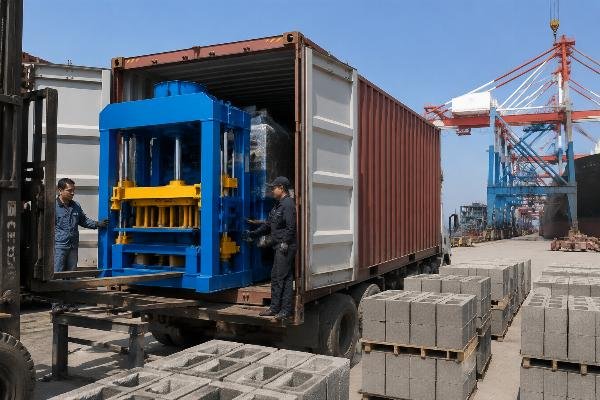
- Coordinated production and shipping: The complete line—block machine, batcher, mixer, conveyors, pallet system, stacker, silos—is manufactured, tested, and loaded as an integrated system. This ensures that all components arrive together and are compatible from day one.
- Realistic lead time commitment: A factory with in-house production capacity can commit to a defined delivery window and honor it. Suppliers who depend on subcontractors cannot guarantee timelines.
- On-site installation and commissioning: The supplier’s own engineers travel to your site, assemble the line, calibrate all systems, and run test production until output meets agreed specifications.
- Structured operator training: Training should cover daily operation, routine maintenance, troubleshooting common faults, and safety protocols. Operators who understand the machine reduce downtime and extend component life.
- Lifetime after-sales support: Access to spare parts, remote technical guidance, and periodic follow-up visits ensure the line continues performing long after the commissioning team has departed.
A Latin America distributor scenario demonstrates the value of this approach. The distributor needed a container-volume order with private-label branding, consistent spare parts supply, and marketing support. The factory-direct supplier managed the entire process—from custom branding on the machine housing to ensuring that spare parts molds were retained for future orders—creating a seamless supply chain that the distributor could rely on for repeat business. [NEED_CITE: turnkey delivery models in construction equipment export and their impact on buyer satisfaction]
When a block machine China supplier controls the entire delivery chain, the buyer gains a single point of accountability. There is no confusion about who is responsible for what, and problems are resolved faster because the supplier has full visibility into every component of the system.
How Do You Compare Quotes Beyond Price?
Total cost of ownership—including spare parts availability, mold lifespan, and after-sales response speed—reveals the true economic picture far better than the initial purchase price.
The lowest quote is almost never the lowest cost. A machine purchased at a bargain price but built with inferior mold steel will require mold replacements at a pace that erases any initial savings. A machine with a cheap PLC that cannot be serviced locally will sit idle while the buyer waits weeks for a replacement board. A machine without a committed spare parts supply chain becomes a liability the moment a single component fails.
When comparing quotes from different block machine China supplier candidates, evaluate these dimensions:
- Mold material and expected lifespan: Ask for the specific steel grade and heat treatment process. Request cycle-life estimates based on the type of aggregate you will use. [NEED_CITE: relationship between mold steel grade and service life in concrete block production]
- Spare parts availability and lead time: Confirm which critical components are stocked and what the delivery timeline is for non-stocked items. A supplier with a dedicated spare parts warehouse can ship within days; one without may take weeks.
- PLC and electrical component brand: Premium brands offer better reliability and wider global service networks. However, some suppliers offer compatible alternatives that are easier to source locally at lower cost. Understand the trade-off.
- Hydraulic system quality: The hydraulic pressure range directly affects block density and consistency. A system with poor pressure control produces uneven blocks and wastes material.
- After-sales response commitment: Does the supplier offer remote diagnostics? Can they dispatch engineers within a reasonable timeframe? Is there a local service partner in your region?
| Cost Factor | Low-Quote Supplier Risk | Reliable Supplier Standard |
|---|---|---|
| Mold steel grade | Generic; rapid wear with abrasive aggregate | Upgraded alloy; substantially extended lifespan |
| Spare parts stock | Limited; long lead times for replacements | Comprehensive inventory; rapid dispatch |
| PLC brand | Unbranded or obscure; difficult to service locally | Recognized brand or verified local-compatible alternative |
| Hydraulic pressure control | Inconsistent; affects block quality | Precise; ensures density uniformity |
| After-sales support | Reactive; delayed response | Proactive; remote diagnostics and rapid engineer dispatch |
The buyers who achieve the best long-term returns are those who evaluate quotes holistically, factoring in every element of ownership cost rather than fixating on the purchase price alone.
Conclusion
Selecting the right block machine China supplier is an exercise in matching machine capability to local reality, not in chasing the lowest number on a quotation. Verify the supplier’s manufacturing depth, demand customization for your voltage and material conditions, insist on a coordinated turnkey delivery, and evaluate total cost of ownership rather than initial price. A well-matched, well-supported production line becomes a profit engine; a poorly matched one becomes a costly reminder that the cheapest option is rarely the most economical.
Leave a Reply